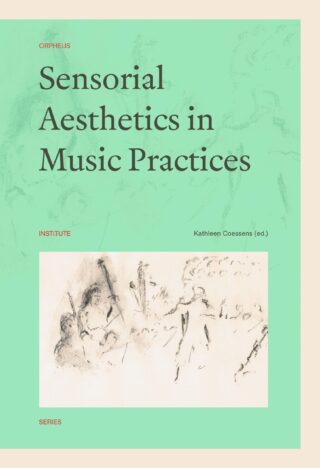
Sensorial Aesthetics in Music Practices
Kathleen Coessens (Editor),
Series: Orpheus Institute Series
Category: Artistic Practice, Music
Language: English
ISBN: 9789462701847
Publication date: July 15, 2019
€20.00 (including 6% VAT)
Buy NowNumber of pages: 192
Size: 285 x 195 x 15 mm
Number of illustrations: 30
Illustrations and other content description:
Illustrated b/w

Stock item: 129620
Standard delivery time for print books:
For Belgium: 5 to 8 working days
For EU: 2 to 3 weeks
For other countries: 4 to 5 weeks
Series: Orpheus Institute Series
Category: Artistic Practice, Music
Language: English
ISBN: 9789461662910
Publication date: July 15, 2019
€29.50 (including 6% VAT)
Buy NowNumber of pages: 192
Number of illustrations: 30
Illustrations and other content description:
Illustrated b/w
Embodied experience and sensorial understandings in Western music
The Western history of aesthetics is characterised by tension between theory and practice. Musicians listen, play, and then listen more profoundly in order to play differently, adapt the body, and sense the environment. They become deeply involved in the sensorial qualities of music practice. Artistic practice refers to the original meaning of aesthetics—the senses. Whereas Baumgarten and Goethe explored the relationship between sensibility and reason, sensation and thinking, later philosophers of aesthetics deemed the sensorial to be confused and unreliable and instead prioritised a cognitive or objective approach.
Written by authors from the fields of philosophy, composition, performance, and artistic practice, Sensorial Aesthetics in Music Practices repositions aesthetics as a domain of the sensible and explores the interaction between artists, life, and environment. Aesthetics becomes a field of sensorial and embodied experience involving temporal and spatial influences, implicit knowledge, and human characteristics.
Contributors: Kathleen Coessens (Koninklijk Conservatorium Brussel, Orpheus Institute), Tim Ingold (University of Aberdeen), Michaël Levinas (Conservatoire National Supérieur de Musique de Paris), Fabien Lévy (Hochschule für Musik Detmold), Lasse Thoresen (Norwegian Academy of Music), Vanessa Tomlinson (Queensland Conservatorium of Music), Salomé Voegelin (University of the Arts London)
This publication is GPRC-labeled (Guaranteed Peer-Reviewed Content).
INTRODUCTION
Kathleen Coessens
SOUND AND SENSE IN MUSICAL PHRASES: FROM THE ART OF THE KEYBOARD TO THE QUESTION OF PHRASE AND MELODY Michaël Levinas
Intermezzo 1
ON THE SENSORIAL OF AESTHETICS Kathleen Coessens
NOISE, SOUND, SILENCE Tim Ingold
Intermezzo 2
ON THE SENSORIAL OF MUSIC AND BREATHING Kathleen Coessens
SENSE VERSUS SENSITIVITY IN COMPOSITION: A PHONEY DEBATE? Fabien Lévy
Intermezzo 3
ON THE SENSORIAL OF HUMAN BEINGS Kathleen Coessens
EXTREME INTERPRETATION? SOME OBSERVATIONS ON RACHMANINOFF’S VERSION OF CHOPIN’S THIRD BALLADE IN A-FLAT MAJOR, OP. 47 Lasse Thoresen
Intermezzo 4
ON THE SENSORIAL OF THE HUMAN BODY IN PERFORMANCE Kathleen Coessens
REFLECTIONS ON THE POLITICS OF SENTIMENT SCORE FOR PERFORMING THE CRITICALITY OF A SONIC SENSIBILITY Salomé Voegelin
Intermezzo 5
ON THE SENSORIAL OF IMAGINATION Kathleen Coessens and Vanessa Tomlinson
NOTES ON CONTRIBUTORS INDEX
Frequently Asked Questions
What is "Sensorial Aesthetics in Music Practices" about?
Embodied experience and sensorial understandings in Western music
The Western history of aesthetics is characterised by tension between theory and practice. Musicians listen, play, and then listen more profoundly in order to play differently, adapt the body, and sense the environment. They become deeply involved in the sensorial qualities of music practice. Artistic practice refers to the original meaning of aesthetics—the senses. Whereas Baumgarten and Goethe explored the relationship between sensibility and reason, sensation and thinking, later philosophers of aesthetics deemed the sensorial to be confused and unreliable and instead prioritised a cognitive or objective approach.
Written by authors from the fields of philosophy, composition, performance, and artistic practice, Sensorial Aesthetics in Music Practices repositions aesthetics as a domain of the sensible and explores the interaction between artists, life, and environment. Aesthetics becomes a field of sensorial and embodied experience involving temporal and spatial influences, implicit knowledge, and human characteristics.
Contributors: Kathleen Coessens (Koninklijk Conservatorium Brussel, Orpheus Institute), Tim Ingold (University of Aberdeen), Michaël Levinas (Conservatoire National Supérieur de Musique de Paris), Fabien Lévy (Hochschule für Musik Detmold), Lasse Thoresen (Norwegian Academy of Music), Vanessa Tomlinson (Queensland Conservatorium of Music), Salomé Voegelin (University of the Arts London)
This publication is GPRC-labeled (Guaranteed Peer-Reviewed Content).
Who edited "Sensorial Aesthetics in Music Practices"?
"Sensorial Aesthetics in Music Practices" was edited by Kathleen Coessens.
Kathleen Coessens is director of the Koninklijk Conservatorium Brussel, professor at the Vrije Universiteit Brussel, and associate researcher at the Orpheus Institute, Ghent.
Is "Sensorial Aesthetics in Music Practices" part of a series?
Yes, "Sensorial Aesthetics in Music Practices" is part of the "Orpheus Institute Series" series.

Throughout the Orpheus Institute’s various activities there is a clear focus on the development of a new research discipline in the arts, one that addresses questions and topics that are at the heart of musical practice, building on the unique expertise and perspectives of musicians and in constant dialogue with more established research disciplines.
Within this context, the Orpheus Institute launched an international Research Centre in 2007 that acts as a stable constituent within an ever-growing field of enquiry. The Orpheus Research Centre is a place where musical artists can fruitfully conduct individual and collaborative research on issues that are of concern to all involved in artistic practice. It is important that at the centre of the international Orpheus Institute network is a place, a building, a community. As the concepts and methodologies of artistic research in music have evolved, work at Orpheus Institute has found new structures. Since 2012, research has been consolidated into a number of groups focused on specific areas, each led by a principal investigator of substantial international reputation as a practicing musician. The work of Orpheus Institute is disseminated through events, publications and musical performances, and through its active animation of discussion within the sector.
This series of peer-reviewed publications —launched in 2013— encompasses monographs by Research Fellows and associates of the Orpheus Institute, compilations of lectures, texts, and performances from seminars and study days, and edited volumes on topics arising from work at the institute. Research can be presented in digital media as well as printed texts. As a whole, the series is meant to enhance and advance discourse in the field of artistic research in music and to generate future work in this emerging and vital area of study.

Editorial board
William Brooks (Chair, Series Editor), Peter Dejans, Jonathan Impett, Kathleen Coessens, Paulo de Assis, Heike Vermeire, Ed Crooks, Laura Cull, Aurelie Daems
Proposals
Proposals and enquiries can be sent to the series editor William Brooks.
Please make use of the submission form to present your manuscript or proposal to our board.
Authors interested in Open Access can consult the available funding options.
Links & Resources
What is the Table of Contents for "Sensorial Aesthetics in Music Practices"?
INTRODUCTION
Kathleen Coessens
SOUND AND SENSE IN MUSICAL PHRASES: FROM THE ART OF THE KEYBOARD TO THE QUESTION OF PHRASE AND MELODY Michaël Levinas
Intermezzo 1
ON THE SENSORIAL OF AESTHETICS Kathleen Coessens
NOISE, SOUND, SILENCE Tim Ingold
Intermezzo 2
ON THE SENSORIAL OF MUSIC AND BREATHING Kathleen Coessens
SENSE VERSUS SENSITIVITY IN COMPOSITION: A PHONEY DEBATE? Fabien Lévy
Intermezzo 3
ON THE SENSORIAL OF HUMAN BEINGS Kathleen Coessens
EXTREME INTERPRETATION? SOME OBSERVATIONS ON RACHMANINOFF’S VERSION OF CHOPIN’S THIRD BALLADE IN A-FLAT MAJOR, OP. 47 Lasse Thoresen
Intermezzo 4
ON THE SENSORIAL OF THE HUMAN BODY IN PERFORMANCE Kathleen Coessens
REFLECTIONS ON THE POLITICS OF SENTIMENT SCORE FOR PERFORMING THE CRITICALITY OF A SONIC SENSIBILITY Salomé Voegelin
Intermezzo 5
ON THE SENSORIAL OF IMAGINATION Kathleen Coessens and Vanessa Tomlinson
NOTES ON CONTRIBUTORS INDEX
What is the DOI for "Sensorial Aesthetics in Music Practices"?
The Digital Object Identifier (DOI) for "Sensorial Aesthetics in Music Practices" is 10.11116/9789461662910.
Related titles
 The Book of Requiems, 1815–1900
John Koslovsky (Editor), Steven Vande Moortele (Editor),
December 2026
 Collective Trauma and Future Fantasies
Raika Khorshidian (Editor), Birgit Mersmann (Editor), Cathrine Bublatzky (Editor), Julia Stenzel (Editor),
November 2026




 Violence and Trauma in Contemporary Performance
Sofie de Smet (Editor), Marieke Breyne (Editor), Pedzisai Maedza (Editor), Christel Stalpaert (Editor),
May 2025
 Music Theory and Analysis Volume 12 Issue 1, 2025 (Journal Subscription)
John Koslovsky (Editor), Markus Neuwirth (Editor), Derek Remeš (Editor),
May 2025