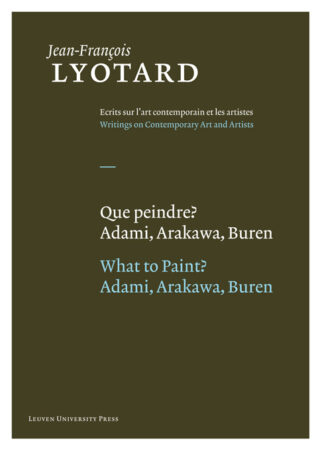
Que peindre? / What to Paint?
Adami, Arakawa, Buren
Jean-François Lyotard (Author), Herman Parret (Editor), Antony Hudek (Translator), Vlad Ionescu (Translator), Peter W. Milne (Translator), Gérald Sfez (),
Series: J.F. Lyotard Writings on Contemporary Art and Artists 5
Category: Art, Philosophy
ISBN: 9789058677921
Publication date: September 24, 2012
€69.50 (including 6% VAT)
Buy NowNumber of pages: 512
Size: 230 x 160 x 35 mm

Stock item: 67339
Standard delivery time for print books:
For Belgium: 5 to 8 working days
For EU: 2 to 3 weeks
For other countries: 4 to 5 weeks
The most important writings of Lyotard on contemporary art in English for the first time
Seven writings assembled in the context of the philosophy of art that Jean-François Lyotard developed in the nineteen-eighties, at the time of the Differend(1983) and of the ‘Kantian turn’ leading to the Lessons on the Analytic of the Sublime (1992), are here published for the first time in English translation. The texts focus on three artists with widely divergent aesthetic orientations: the colourist-draughtsman Valerio Adami, the conceptual metaphysician Shusaku Arakawa, and Daniel Buren, the ‘pragmatist of the invisible’. These three protagonists share the notion that the interest in art does not lie in the simple denotation of a frame of reference, but in the connotations of material nuances, in flavours, in tones-in one word, the visual that is barely revealed in the anamnesis that guides the visible and provokes the essential inquietude of the aesthetic experience. What to Paint? Not reality or a ‘world’, nor a rich subjectivity, nor even the phantasms of dreams or ideals of being-together, but the act of painting itself, and, beyond the performance of the painter, the presence of matters, a presence that in Arakawa’s word is quite obviously blank, elusive.
This publication is GPRC-labeled (Guaranteed Peer-Reviewed Content)
Table des matières
Table of contents
Herman Parret:
Préface /
Illustrations 1-6
Preface
Illustrations 7-27
Jean-François Lyotard:
Que peindre ? Adami, Arakawa, Buren
What to Paint? Adami, Arakawa, Buren
La présence
Presence
La ligne
The Line
La franchise
Frankness
L’anamnèse
Anamnesis
Le point
The Point
Le site
The Site
L’exposition
The Exposure
Lectures / Readings
Supplément I/Supplement I
Arakawa – Réserve d’événements spatiaux
Arakawa – Reserves of Spatial Events
Supplément II / Supplement II
Daniel Buren – Fà»ts
Daniel Buren – Shafts
Gérald Sfez:
Postface /
Epilogue
Illustrations 28-69
L'art selon Lyotard.
Les textes présentés sont extraits des volumes de 'Que Peindre?' et de L'Assassinat de l'expérience par la peinture : Jacques Monory'
Philosophie Magazine n°62, septembre 2012
La réédition des écrits de Jean-François Lyotard, dont cet ouvrage-ci constitue le cinquième volet, est une bonne entrée en matière pour comprendre la critique philosophique de l'art de cet auteur. La série de textes bilingues consacrés à Valerio Adami, Shusaku Arakawa et Daniel Buren, introduite par une longue préface d'Herman Parret, permet d'envisager cette méthode inspirée de l'expérience phénoménologique contraire à l'approche formaliste de l'art. Jean-François Lyotard impose donc un vocabulaire prédéterminé qu'il développe au contact des échanges avec les artistes.
Damien Delille, « Jean-François Lyotard, Que peindre ? / What to paint?: Adami, Arakawa, Buren », Critique d'art [En ligne], URL : http://critiquedart.revues.org/8102
Frequently Asked Questions
What is "Que peindre? / What to Paint?" about?
The most important writings of Lyotard on contemporary art in English for the first time
Seven writings assembled in the context of the philosophy of art that Jean-François Lyotard developed in the nineteen-eighties, at the time of the Differend(1983) and of the ‘Kantian turn' leading to the Lessons on the Analytic of the Sublime (1992), are here published for the first time in English translation. The texts focus on three artists with widely divergent aesthetic orientations: the colourist-draughtsman Valerio Adami, the conceptual metaphysician Shusaku Arakawa, and Daniel Buren, the ‘pragmatist of the invisible'. These three protagonists share the notion that the interest in art does not lie in the simple denotation of a frame of reference, but in the connotations of material nuances, in flavours, in tones-in one word, the visual that is barely revealed in the anamnesis that guides the visible and provokes the essential inquietude of the aesthetic experience. What to Paint? Not reality or a ‘world', nor a rich subjectivity, nor even the phantasms of dreams or ideals of being-together, but the act of painting itself, and, beyond the performance of the painter, the presence of matters, a presence that in Arakawa's word is quite obviously blank, elusive.
This publication is GPRC-labeled (Guaranteed Peer-Reviewed Content)
Who wrote "Que peindre? / What to Paint?"?
"Que peindre? / What to Paint?" was written by Jean-François Lyotard and Gérald Sfez.
Who edited "Que peindre? / What to Paint?"?
"Que peindre? / What to Paint?" was edited by Herman Parret.
Herman Parret is Emeritus Professor of Aesthetics and Philosophy of Language at the Institute of Philosophy, Katholieke Universiteit Leuven. Hoger Instituut van Wijsbegeerte, KU Leuven
Who translated "Que peindre? / What to Paint?"?
"Que peindre? / What to Paint?" was translated by Antony Hudek, Vlad Ionescu and Peter W. Milne.
Is "Que peindre? / What to Paint?" part of a series?
Yes, "Que peindre? / What to Paint?" is part of the "J.F. Lyotard Writings on Contemporary Art and Artists" series. It's book 5 in the series.
The series Jean-François Lyotard: Ecrits sur l'art contemporain et les artistes / Writings on Contemporary Art and Artists consists of six volumes that offer a complete collection of all the writings by Lyotard concerning contemporary art and artists, some of which have been published only in German, French or English. Others, from Lyotard's personal archive, are being published here for the first time. Leuven's six volumes include the complete original French texts along with English translations on facing pages. The parallel presentation of both the French text and the English translation will introduce a wide English-speaking public to the intriguing manner in which Lyotard approached the artists and their work. Illustrations of the works discussed accompany the texts. All volumes include an introduction by Herman Parret and an epilogue by another Lyotard expert.
General Editor
Herman Parret (KU Leuven)
Associate Editors
Vlad Ionescu (KU Leuven), Peter W. Milne (Seoul National University)
In collaboration with
Christine Buci-Glucksmann (Université de Paris VIII), Geoffrey Bennington and Dalia Judovitz (Emory University, Atlanta), Jean-Michel Durafour (Université Paris-Est, Marne-la-Vallée), Dolorès Lyotard (Université du Littoral-Côte d’Opale), Gérald Sfez (Khâgne Lycée La Bruyère, Versailles), Sarah Wilson (Courtauld Institute, London)
_____
La série Jean-François Lyotard : Ecrits sur l'art contemporain et les artistes / Writings on Contemporary Art and Artists est constituée de six volumes offrant une collection complète des écrits de Lyotard concernant l'art contemporain et les artistes, dont certains n'ont fait l'objet d'une publication qu'en allemand, en français ou en anglais.
Jean-François Lyotard est très connu et plus particulièrement pour ses opinions sur la réflexion postmoderniste et son impact sur la société. Le langage philosophique spécifique de Lyotard reflète l'utilisation du langage d'une part et l'utilisation volontaire d'un style subtile en vue d'aborder des thèmes contemporains éthiques et spécifiques d'autre part. Ses essais, ses réflexions et ses impressions sur les artistes contemporains représentent une partie particulièrement intéressante de son œuvre.
La série Jean-François Lyotard : Ecrits sur l'art contemporain et les artistes / Writings on Contemporary Art and Artists est constituée de six volumes offrant une collection complète des écrits de Lyotard concernant l'art contemporain et les artistes, dont certains n'ont fait l'objet d'une publication qu'en allemand, en français ou en anglais. D'autres écrits, issus des archives personnelles de Lyotard, sont ici publiés pour la première fois. Les six volumes de Leuven comprennent les textes français originaux accompagnés d'une traduction anglaise en vis-à-vis. Cette présentation côte à côte des textes français et de leur traduction anglaise permettra d'initier un vaste public anglophone à la manière intrigante que Lyotard utilise pour approcher les artistes et leur travail. Les textes sont accompagnés d'illustrations des œuvres abordées. Les préfaces de tous les volumes sont écrites par H. Parrett et leurs épilogues par un autre expert de Lyotard.
Sous la direction de
Herman Parret (KU Leuven)
Rédacteurs adjoints
Vlad Ionescu (KU Leuven), Peter W. Milne (Seoul National University)
Avec la collaboration de
Christine Buci-Glucksmann (Université de Paris VIII), Geoffrey Bennington et Dalia Judovitz (Emory University, Atlanta), Jean-Michel Durafour (Université Paris-Est, Marne-la-Vallée), Dolorès Lyotard (Université du Littoral-Côte d’Opale), Gérald Sfez (Khâgne Lycée La Bruyère, Versailles), Sarah Wilson (Courtauld Institute, Londres)
What is the Table of Contents for "Que peindre? / What to Paint?"?
Table des matières
Table of contents
Herman Parret:
Préface /
Illustrations 1-6
Preface
Illustrations 7-27
Jean-François Lyotard:
Que peindre ? Adami, Arakawa, Buren
What to Paint? Adami, Arakawa, Buren
La présence
Presence
La ligne
The Line
La franchise
Frankness
L'anamnèse
Anamnesis
Le point
The Point
Le site
The Site
L'exposition
The Exposure
Lectures / Readings
Supplément I/Supplement I
Arakawa - Réserve d'événements spatiaux
Arakawa - Reserves of Spatial Events
Supplément II / Supplement II
Daniel Buren - Fà»ts
Daniel Buren - Shafts
Gérald Sfez:
Postface /
Epilogue
Illustrations 28-69
Related titles
 Collective Trauma and Future Fantasies
Raika Khorshidian (Editor), Birgit Mersmann (Editor), Cathrine Bublatzky (Editor), Julia Stenzel (Editor),
November 2026

 Orality and Scribal Culture in the High Middle Ages
Timothy B. Noone (Author), Mark J. Clark (Author),
November 2026
 Feminists Resisting Gendered Violence
Hemangini Gupta (Editor), Fiona Mackay (Editor), Jan Breckenridge (Editor), Louise Chappell (Editor), Rachna Mehra (Editor), Rukmini Sen (Editor), Mailin Suchting (Editor),
October 2026
 A City in Practice
Aude Tournaye (Editor), Filip De Boeck (Editor), Picha Collective (Editor),
September 2026
 Ecologies of Photography in the American West
Monica Bravo (Editor), Carolin Görgen (Editor),
September 2026
 Summa (Quaestiones ordinariae) art. LXXIII – LXXV
Henry of Ghent (Author), Gordon Wilson (Editor), Juan Carlos Flores (Editor),
September 2026
 The Medieval Aristotle
Nena Bobovnik (Editor), Clelia V. Crialesi (Editor), Lisa Devriese (Editor),
August 2026
 Jean Katambayi Mukendi
Johannes Muselaers (Editor), Stéphane Symons (Editor), Anne-Claire Schmitz (Editor), Emma Enderby (Editor),
April 2026
 Nomadic Camera
Burcu Dogramaci (Editor), Winfried Gerling (Editor), Jens Jäger (Editor), Birgit Mersmann (Editor),
March 2026
 Thomas Aquinas and Hervaeus Natalis on Concepts and Intentional Objects
Fabrizio Amerini (Author),
February 2026
 Entangled Art Histories
Valérie Mavridorakis (Editor), Alexander Streitberger (Editor), Hilde Van Gelder (Editor), Erik Verhagen (Editor),
October 2025