

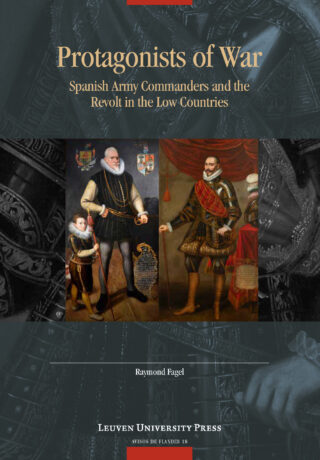

Protagonists of War
Spanish Army Commanders and the Revolt in the Low Countries
Raymond Fagel (Author),

Series: Avisos de Flandes 18
Category: History, History 1500-1800
Language: English
ISBN: 9789462702875
Publication date: September 17, 2021
€32.00 (including 6% VAT)
Buy NowNumber of pages: 388
Size: 244 x 170 x 23 mm
Number of illustrations: 20

Funded by: NWO Free competition
Stock item: 143292
Standard delivery time for print books:
For Belgium: 5 to 8 working days
For EU: 2 to 3 weeks
For other countries: 4 to 5 weeks
Series: Avisos de Flandes 18
Category: History, History 1500-1800
Language: English
ISBN: 9789461664044
Publication date: October 1, 2021
Download Free EpubNumber of pages: 388
Number of illustrations: 20
Funded by: NWO Free competition
Series: Avisos de Flandes 18
Category: History, History 1500-1800
Language: English
ISBN: 9789461664037
Publication date: October 1, 2021
Download Free PDFNumber of pages: 388
Number of illustrations: 20
Funded by: NWO Free competition
A new vision on the Revolt of the Low Countries through the eyes of Spanish commanders
Julián Romero, Sancho Dávila, Cristóbal de Mondragón, and Francisco de Valdés were prominent Spanish military commanders during the first decade of the Revolt in the Low Countries (1567–1577). Occupying key positions in this conflict, they featured as central characters in various war narratives and episodical descriptions of the events they were involved in, ranging from chronicles, poems, theatre plays, engravings, and songs to news pamphlets. To this day, they still figure as protagonists of historical novels: brave heroes in some, cruel oppressors in others. Yet personal, first-hand accounts also exist. Archival research into the letters written by these commanders now makes it possible to include their perspectives and the way they describe their own experiences. Looking through the eyes of four Spanish commanders, Protagonists of War provides the reader with an alternative reading of the Revolt, contrasting the subjective experiences of these protagonists with fictionalised perceptions.
Ebook available in Open Access.
This publication is GPRC-labeled (Guaranteed Peer-Reviewed Content).
Abbreviations
Introduction
Words of gratitude
Chapter I: Captain Julián: the hero of the battlefield
Chapter II: Sancho Dávila: the champion of Catholic Spain
Chapter III: Cristóbal de Mondragón: the good Spaniard
Chapter IV: Francisco de Valdés: the exemplary soldier
General conclusion: episodic war narratives in comparison
Bibliography Index
To a large extent, the malleability, contradictions, and diverse interpretations of
these figures are rightly presented by Fagel as inherent to the process of narrative appropriation and re-creation. Indeed, showing the numerous ways that the presentation of the
actions, motives, and reputation of these figures have been shaped through the hands of
chroniclers, historians, and playwrights is key to these accounts. Yet stressing this aspect of
the study would understate the extent that Fagel has also deployed a wealth of administrative and personal correspondence to set the anecdotes, interpretations, and assumptions
against a more substantive, verifiable account of the lives and actions of these men.
In consequence, while the book tells us much about their shifting historical reputations
from the sixteenth century to the present day, it also offers detailed evidence about the
dynamics of military service for these officers in the Army of Flanders. Parrott, D., Early Modern Low Countries, 6(2), 299–301. https://doi.org/10.51750/emlc13432
Obwohl eine vorgeschaltete Darstellung der Revolte sich gelohnt hätte, sodass Wiederholungen in der Darstellung vermieden worden wären, bietet Fagels Darstellung einen Zugang zum Aufstand in den Spanischen Niederlanden, der es auch dem interessierten Laien ermöglicht, spannende Informationen zu gewinnen, ohne dessen eigentliche wissenschaftliche Fragestellung genauer verfolgen zu müssen. - Martin Meier, Militaergeschichtliche Zeitschrift, vol. 83, no. 2, 2024, pp. 562-565. https://doi.org/10.1515/mgzs-2024-0080
Frequently Asked Questions
What is "Protagonists of War" about?
A new vision on the Revolt of the Low Countries through the eyes of Spanish commanders
Julián Romero, Sancho Dávila, Cristóbal de Mondragón, and Francisco de Valdés were prominent Spanish military commanders during the first decade of the Revolt in the Low Countries (1567–1577). Occupying key positions in this conflict, they featured as central characters in various war narratives and episodical descriptions of the events they were involved in, ranging from chronicles, poems, theatre plays, engravings, and songs to news pamphlets. To this day, they still figure as protagonists of historical novels: brave heroes in some, cruel oppressors in others. Yet personal, first-hand accounts also exist. Archival research into the letters written by these commanders now makes it possible to include their perspectives and the way they describe their own experiences. Looking through the eyes of four Spanish commanders, Protagonists of War provides the reader with an alternative reading of the Revolt, contrasting the subjective experiences of these protagonists with fictionalised perceptions.
Ebook available in Open Access.
This publication is GPRC-labeled (Guaranteed Peer-Reviewed Content).
Who wrote "Protagonists of War"?
"Protagonists of War" was written by Raymond Fagel.
Raymond Fagel is lecturer in early modern history at the Institute of History, Leiden University.
Is "Protagonists of War" part of a series?
Yes, "Protagonists of War" is part of the "Avisos de Flandes" series. It's book 18 in the series.

Series editor
Werner Thomas, KU Leuven
Proposals
To submit a proposal please send a preliminary abstract (1-2 pp.) and a short bio to series editor Werner Thomas. The evaluation process takes an average of four weeks. Upon approval of the abstract, the full manuscript will be submitted to international peer review. Two peer reviewers will be asked for expert advice, three in case of conflicting reports.
Please make use of the submission form to present the full manuscript to our board.
Authors interested in Open Access can consult the available funding options.
Links & Resources
Is "Protagonists of War" available Open Access?
Yes, "Protagonists of War" is published Open Access. It is available under a BY-NC-ND license.
Who funded the publication of "Protagonists of War"?
Publication of "Protagonists of War" was funded by NWO Free competition
.
What is the Table of Contents for "Protagonists of War"?
Abbreviations
Introduction
Words of gratitude
Chapter I: Captain Julián: the hero of the battlefield
Chapter II: Sancho Dávila: the champion of Catholic Spain
Chapter III: Cristóbal de Mondragón: the good Spaniard
Chapter IV: Francisco de Valdés: the exemplary soldier
General conclusion: episodic war narratives in comparison
Bibliography Index
What is the DOI for "Protagonists of War"?
The Digital Object Identifier (DOI) for "Protagonists of War" is 10.11116/9789461664037.
Related titles
 Toekomstdromen
Maarten Van Dijck (Editor), Gerrit Verhoeven (Editor), Hans Cools (Editor),
November 2026
 Trend en toeval – vierde editie
Bruno Blondé (Author), Isabelle Devos (Author), Jord Hanus (Author), Wouter Ryckbosch (Author),
August 2026
 Political Exile in the Global Twentieth Century
Wolfram Kaiser (Editor), Piotr H. Kosicki (Editor),
April 2026
 Christian Democracy and the Fall of Communism
Michael Gehler (Editor), Piotr H. Kosicki (Editor), Helmut Wohnout (Editor),
April 2026
 Brusselse plaatsnamen
Iadine Degryse (Editor), Benjamin Wayens (Editor), Chantal Kesteloot (Editor), Dennis De Vriese (Editor), Matthijs Degraeve (Editor),
April 2026

 Cartographies of Catastrophes
Laura Demeter (Editor), Carmen M. Enss (Editor), Piotr Kisiel (Editor), Carol Ludwig (Editor),
February 2026
 Denken en dialogeren over identiteit
Karel Van Nieuwenhuyse (Author), Bauke Verbergt (Author), Greet Vermeiren (Author), Ellen Claes (Author),
October 2025
 Vroegmoderne dieren in de Nederlanden
Judith Brouwer (Editor), djoeke van Netten (Editor),
November 2025