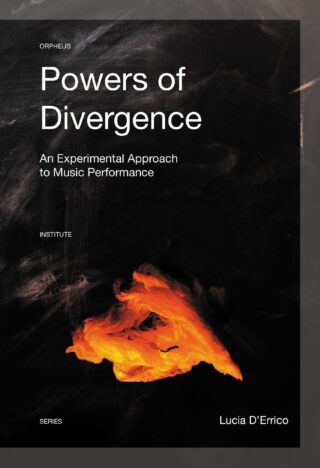

Powers of Divergence
An Experimental Approach to Music Performance
Lucia D'Errico (Author),

Series: Orpheus Institute Series
Category: Artistic Practice, Music
Language: English
ISBN: 9789462701397
Publication date: July 27, 2018
€45.00 (including 6% VAT)
Buy NowNumber of pages: 198
Size: 285 x 190 x 10 mm
Number of illustrations: 14
Illustrations and other content description:
14 black & white images

Stock item: 123189
Standard delivery time for print books:
For Belgium: 5 to 8 working days
For EU: 2 to 3 weeks
For other countries: 4 to 5 weeks
Series: Orpheus Institute Series
Category: Artistic Practice, Music
Language: English
ISBN: 9789461662514
Publication date: July 10, 2018
Download Free PDFNumber of pages: 198
Number of illustrations: 14
Illustrations and other content description:
14 black & white images
Beyond resemblance: creative divergence in music performance
What does it mean to produce resemblance in the performance of written music? Starting from how this question is commonly answered by the practice of interpretation in Western notated art music, this book proposes a move beyond commonly accepted codes, conventions and territories of music performance. Appropriating reflections from post-structural philosophy, visual arts and semiotics, and crucially based upon an artistic research project with a strong creative and practical component, it proposes a new approach to music performance. The approach is based on divergence, on the difference produced by intensifying the chasm between the symbolic aspect of music notation and the irreducible materiality of performance. Instead of regarding performance as reiteration, reconstruction and reproduction of past musical works, Powers of Divergence emphasises its potential for the emergence of the new and for the problematisation of the limits of musical semiotics.
Ebook available in Open Access.
This publication is GPRC-labeled (Guaranteed Peer-Reviewed Content).
Erratum: Table of contents
In the table of contents of the printed books the description of Book I, Book II and Book III is incorrect. This information is correct in the table of contents below and in the PDF version of the book.
Preface
Acknowledgments Specific Terminology Introduction
BOOK I Description of the Practice The Problem of Resemblance Beyond Improvisation A Series of Anamorphic Glances On Methodology Phonographic Writing The Phantasmic Image of the Musical Work The Vectors of the Body The Musical Work as a “Manifold” A Peripheral Instrument Modes of Exposition BOOK II Derivatives Derivative I: On Three Different (Musical) Eyes Derivative II: The Phonocentric Vision of Music Derivative III: An Eye That Sees Itself Derivative IV: The Joyous Power of Simulacra Derivative V: How to Defy Perspective through Perspective Derivative VI: Automaton Derivative VII: How to Produce a Phantasm? Part I: Gian Lorenzo Bernini Derivative VIII: How to Produce a Phantasm? Part II: Francis Bacon Derivative IX: How to Produce a Phantasm? Part III: Salvatore Sciarrino Derivative X: How to Produce a Phantasm? Part IV: Carmelo Bene BOOK III Five Glances upon the Unspeakable Body Appendix 1: Techniques of Minoration Appendix 2: List of Musical Examples Closing Remarks References Biographical Note
“‘Woe to those who do not have a problem,’ Gilles Deleuze exhorts his audience during one of his seminars. And a ‘problem’ in this philosophical sense is not something to dispense with, a difficulty to resolve, an obstacle to eliminate; nor is it something one inherits ready-made. Just as a ‘concept’ in the paradigmatic repertoire of Deleuze’s philosophy is a creation, a ‘problem’ must be invented; it needs to be developed, its strength measured by the force of the path it breaches across an already established field - reconstructing it, reorganising it. The principal virtue of Lucia D’Errico's book is that it constructs precisely such a problem.” - Zsuzsa Baross
“An original and valuable contribution to the field of artistic research, integrating theory and practice and charting a clear pathway through the work of a great number of artists, philosophers, and composers by way of philosophy, art and media theory, semiotics, and musical composition.” - Edward Campbell
Frequently Asked Questions
What is "Powers of Divergence" about?
Beyond resemblance: creative divergence in music performance
What does it mean to produce resemblance in the performance of written music? Starting from how this question is commonly answered by the practice of interpretation in Western notated art music, this book proposes a move beyond commonly accepted codes, conventions and territories of music performance. Appropriating reflections from post-structural philosophy, visual arts and semiotics, and crucially based upon an artistic research project with a strong creative and practical component, it proposes a new approach to music performance. The approach is based on divergence, on the difference produced by intensifying the chasm between the symbolic aspect of music notation and the irreducible materiality of performance. Instead of regarding performance as reiteration, reconstruction and reproduction of past musical works, Powers of Divergence emphasises its potential for the emergence of the new and for the problematisation of the limits of musical semiotics.
Ebook available in Open Access.
This publication is GPRC-labeled (Guaranteed Peer-Reviewed Content).
Who wrote "Powers of Divergence"?
"Powers of Divergence" was written by Lucia D'Errico.
Lucia D’Errico is a musician and artistic researcher. She is research fellow at the Orpheus Institute Ghent.
Is "Powers of Divergence" part of a series?
Yes, "Powers of Divergence" is part of the "Orpheus Institute Series" series.

Throughout the Orpheus Institute’s various activities there is a clear focus on the development of a new research discipline in the arts, one that addresses questions and topics that are at the heart of musical practice, building on the unique expertise and perspectives of musicians and in constant dialogue with more established research disciplines.
Within this context, the Orpheus Institute launched an international Research Centre in 2007 that acts as a stable constituent within an ever-growing field of enquiry. The Orpheus Research Centre is a place where musical artists can fruitfully conduct individual and collaborative research on issues that are of concern to all involved in artistic practice. It is important that at the centre of the international Orpheus Institute network is a place, a building, a community. As the concepts and methodologies of artistic research in music have evolved, work at Orpheus Institute has found new structures. Since 2012, research has been consolidated into a number of groups focused on specific areas, each led by a principal investigator of substantial international reputation as a practicing musician. The work of Orpheus Institute is disseminated through events, publications and musical performances, and through its active animation of discussion within the sector.
This series of peer-reviewed publications —launched in 2013— encompasses monographs by Research Fellows and associates of the Orpheus Institute, compilations of lectures, texts, and performances from seminars and study days, and edited volumes on topics arising from work at the institute. Research can be presented in digital media as well as printed texts. As a whole, the series is meant to enhance and advance discourse in the field of artistic research in music and to generate future work in this emerging and vital area of study.

Editorial board
William Brooks (Chair, Series Editor), Peter Dejans, Jonathan Impett, Kathleen Coessens, Paulo de Assis, Heike Vermeire, Ed Crooks, Laura Cull, Aurelie Daems
Proposals
Proposals and enquiries can be sent to the series editor William Brooks.
Please make use of the submission form to present your manuscript or proposal to our board.
Authors interested in Open Access can consult the available funding options.
Links & Resources
Is "Powers of Divergence" available Open Access?
Yes, "Powers of Divergence" is published Open Access. It is available under a BY-NC-ND license.
What is the Table of Contents for "Powers of Divergence"?
Erratum: Table of contents
In the table of contents of the printed books the description of Book I, Book II and Book III is incorrect. This information is correct in the table of contents below and in the PDF version of the book.
Preface
Acknowledgments Specific Terminology Introduction
BOOK I Description of the Practice The Problem of Resemblance Beyond Improvisation A Series of Anamorphic Glances On Methodology Phonographic Writing The Phantasmic Image of the Musical Work The Vectors of the Body The Musical Work as a “Manifold” A Peripheral Instrument Modes of Exposition BOOK II Derivatives Derivative I: On Three Different (Musical) Eyes Derivative II: The Phonocentric Vision of Music Derivative III: An Eye That Sees Itself Derivative IV: The Joyous Power of Simulacra Derivative V: How to Defy Perspective through Perspective Derivative VI: Automaton Derivative VII: How to Produce a Phantasm? Part I: Gian Lorenzo Bernini Derivative VIII: How to Produce a Phantasm? Part II: Francis Bacon Derivative IX: How to Produce a Phantasm? Part III: Salvatore Sciarrino Derivative X: How to Produce a Phantasm? Part IV: Carmelo Bene BOOK III Five Glances upon the Unspeakable Body Appendix 1: Techniques of Minoration Appendix 2: List of Musical Examples Closing Remarks References Biographical Note
What is the DOI for "Powers of Divergence"?
The Digital Object Identifier (DOI) for "Powers of Divergence" is 10.11116/9789461662514.
Related titles
 The Book of Requiems, 1815–1900
John Koslovsky (Editor), Steven Vande Moortele (Editor),
December 2026
 Collective Trauma and Future Fantasies
Raika Khorshidian (Editor), Birgit Mersmann (Editor), Cathrine Bublatzky (Editor), Julia Stenzel (Editor),
November 2026


 Violence and Trauma in Contemporary Performance
Sofie de Smet (Editor), Marieke Breyne (Editor), Pedzisai Maedza (Editor), Christel Stalpaert (Editor),
May 2025
 Music Theory and Analysis Volume 12 Issue 1, 2025 (Journal Subscription)
John Koslovsky (Editor), Markus Neuwirth (Editor), Derek Remeš (Editor),
May 2025