Platons Timaios als Grundtext der Kosmologie in Spätantike, Mittelalter und Renaissance
Plato's Timaeus and the foundations of cosmology in Late Antiquity, the Middle Ages and Renaissance
Thomas Leinkauf (Editor), Carlos Steel (Editor),
The particular focus of this volume is a study of the influence of Timaeus on the development of Western cosmology in three axial periods of European culture: Late Antiquity, Middle Ages and Renaissance. In each period, the Timaeus was read in a different context and from different perspectives. During the Middle Ages, scholars were mostly interested in reconciling the rational cosmology of the Timaeus with the Christian understanding of creation. In Late Antiquity, the concordance of Plato with Aristotle was considered the most important issue, whereas in early modern times, the confrontation with the new mathematical physics offered possibilities for a fresh assessment of Plato’s explanation of the cosmos. The present volume has three sections corresponding to these three periods of interpreting the Timaeus, each sectionis introduced by a synthesis of the main issues at discussion. This ‘epochal’ approach gives this volume its particular character.
Thomas Leinkauf – Carlos Steel
Preface
Thomas Leinkauf
Vorwort
I. Spätantike
Franco Ferrari (Salerno)
Interpretare il Timeo
Christoph Helmig (Leuven)
Die Weltentstehung des Timaios – zum kosmologischen Hintergrund von Plutarchs De sera numinis vindicta 550 D-E
Walter Mesch (Heidelberg)
Plotins Deutung der platonischen Weltseele. Zur antiken Rezeptionsgeschichte von Timaios 35 A
Jan Opsomer (Köln)
A craftsman and his handmaiden. Demiurgy according to PLotinus
Alain Lernould (Lille)
En quoi la physique du Timée est-elle encore selon Proclus un ‘eikos logos’?
Carlos Steel (Leuven)
Proclus’ defence of the Timaeus against Aristotle’s abjections. A reconstruction of a lost polemical treatise
Guy Guldentops (Leuven)
Plato’s Timaeus in Simplicius’ In de caelo. A confrontation with Alexander
II. Mittelalter
Andreas Speer (Köln)
Lectio physica. Anmerkungen zur Timaios-Rezeption im Mittelalter
Theo Kobusch (Bonn)
Der Timaios in Chartres
Edouard Jeauneau (Paris)
Du désordre à l’ordre (Timée 30 A)
Alexander Fidora (Frankfurt/M)
Die Ursachenlehre des Isaak von Stella im Anschluss and Platons Timaios
Ada Neschke-Hentschke (Lausanne)
Die iustitia naturalis gemäss Platos Timaios in den Deutungen der Dekretisten des XII. Jahrhunderts. Ein Beitrag zur Archäologie der Menschenrechte
Paul Edward Dutton (Burnady)
Holding women in common. A particular Platonic problem for the twelfth century
Henryk Anzulewicz (Bonn)
Die Timaios-Rezeption bei Albertus Magnus
III. Renaissance/Frühe Neuzeit
Thomas Leinkauf (Münster)
Aspekte und Perspektiven der Präsenz des Timaios in Renaissance und Früher Neuzeit
James Hankins (Harvard)
Plato’s psychogony in the later Renaissance: changing attitudes to the christianization of pagan philosophy
Mischa Von Perger (Neusäss)
Paolo Benis Timaios-Kommentar – eine christliche Kritik an aristotelischen und neuplatonischen Interpretationen
Karin Hartbecke (Halle)
Der Timaios in der französischen Aufklärung
Indices
Frequently Asked Questions
What is "Platons Timaios als Grundtext der Kosmologie in Spätantike, Mittelalter und Renaissance" about?
The particular focus of this volume is a study of the influence of Timaeus on the development of Western cosmology in three axial periods of European culture: Late Antiquity, Middle Ages and Renaissance. In each period, the Timaeus was read in a different context and from different perspectives. During the Middle Ages, scholars were mostly interested in reconciling the rational cosmology of the Timaeus with the Christian understanding of creation. In Late Antiquity, the concordance of Plato with Aristotle was considered the most important issue, whereas in early modern times, the confrontation with the new mathematical physics offered possibilities for a fresh assessment of Plato's explanation of the cosmos. The present volume has three sections corresponding to these three periods of interpreting the Timaeus, each sectionis introduced by a synthesis of the main issues at discussion. This 'epochal' approach gives this volume its particular character.
Who edited "Platons Timaios als Grundtext der Kosmologie in Spätantike, Mittelalter und Renaissance"?
"Platons Timaios als Grundtext der Kosmologie in Spätantike, Mittelalter und Renaissance" was edited by Thomas Leinkauf and Carlos Steel.
Carlos Steel is emeritus professor of ancient and medieval philosophy at KU Leuven and director of the “Aristoteles Latinus” project.
Is "Platons Timaios als Grundtext der Kosmologie in Spätantike, Mittelalter und Renaissance" part of a series?
Yes, "Platons Timaios als Grundtext der Kosmologie in Spätantike, Mittelalter und Renaissance" is part of the "Ancient and Medieval Philosophy - Series 1" series. It's book 34 in the series.
Ancient and Medieval Philosophy - Series 1 presents state-of-the-art research on the history of Western thought from its origins to the beginnings of modernity.
In association with The De Wulf-Mansion Centre.


About the Series
The series' focus lies primarily on the continuity and thematic transitions between ancient, medieval and renaissance thought, but also includes volumes on specific topics related to any of those periods. ‘Philosophy' is understood broadly to include metaphysics, ethics, natural philosophy, epistemology and philosophy of mind, and philosophical theology. Since the series is particularly devoted to making available Latin and Greek source texts, we welcome critical text editions as well as contributions that are based on philological scrutiny of those texts, without losing sight of their philosophical importance.
Ancient and Medieval Philosophy - Series 1 aims to publish at least two volumes a year and accepts monographs as well as thematically coherent edited volumes in English (without excluding the possibility of French, German, or Italian contributions to edited volumes). Manuscripts should be 80.000 to 120.000 words in length.
Readership
Researchers and graduate students in ancient, medieval and renaissance philosophy, in classics and in history.
Editorial Coordinator
Russell Friedman, KU Leuven, Belgium
Editorial Board
Pieter Beullens, KU Leuven, Belgium
Lisa Devriese, KU Leuven, Belgium
Pieter d'Hoine, KU Leuven, Belgium
Jan Opsomer, KU Leuven, Belgium
Jenny Pelletier, KU Leuven, Belgium
Andrea Robiglio, KU Leuven, Belgium
Carlos Steel, KU Leuven, Belgium
Gerd Van Riel, KU Leuven, Belgium
Advisory Board
Brad Inwood, Yale Universityo, USA
Jill Kraye, The Warburg Institute, London, United Kingdom
John Marenbon, University of Cambridge, United Kingdom
Lodi Nauta, University of Groningen, The Netherlands
Timothy Noone (†) , The Catholic University of America, USA
Robert Pasnau, University of Colorado at Boulder, USA
Martin Pickavé, University of Toronto, Canada,
Pasquale Porro, Università degli Studi di Milano, Italy
Geert Roskam, KU Leuven, Belgium
Proposals
Proposals and enquiries can be sent to editorial coordinator Russell L. Friedman. Please send a preliminary abstract (3-4 pp.) and a short bio. Upon approval of this abstract, the full manuscript will be submitted to international peer review.
Please make use of the submission form to present the full manuscript to our board.
Authors interested in Open Access can consult the available funding options.
Links & Resources
What is the Table of Contents for "Platons Timaios als Grundtext der Kosmologie in Spätantike, Mittelalter und Renaissance"?
Thomas Leinkauf - Carlos Steel
Preface
Thomas Leinkauf
Vorwort
I. Spätantike
Franco Ferrari (Salerno)
Interpretare il Timeo
Christoph Helmig (Leuven)
Die Weltentstehung des Timaios - zum kosmologischen Hintergrund von Plutarchs De sera numinis vindicta 550 D-E
Walter Mesch (Heidelberg)
Plotins Deutung der platonischen Weltseele. Zur antiken Rezeptionsgeschichte von Timaios 35 A
Jan Opsomer (Köln)
A craftsman and his handmaiden. Demiurgy according to PLotinus
Alain Lernould (Lille)
En quoi la physique du Timée est-elle encore selon Proclus un 'eikos logos'?
Carlos Steel (Leuven)
Proclus' defence of the Timaeus against Aristotle's abjections. A reconstruction of a lost polemical treatise
Guy Guldentops (Leuven)
Plato's Timaeus in Simplicius' In de caelo. A confrontation with Alexander
II. Mittelalter
Andreas Speer (Köln)
Lectio physica. Anmerkungen zur Timaios-Rezeption im Mittelalter
Theo Kobusch (Bonn)
Der Timaios in Chartres
Edouard Jeauneau (Paris)
Du désordre à l'ordre (Timée 30 A)
Alexander Fidora (Frankfurt/M)
Die Ursachenlehre des Isaak von Stella im Anschluss and Platons Timaios
Ada Neschke-Hentschke (Lausanne)
Die iustitia naturalis gemäss Platos Timaios in den Deutungen der Dekretisten des XII. Jahrhunderts. Ein Beitrag zur Archäologie der Menschenrechte
Paul Edward Dutton (Burnady)
Holding women in common. A particular Platonic problem for the twelfth century
Henryk Anzulewicz (Bonn)
Die Timaios-Rezeption bei Albertus Magnus
III. Renaissance/Frühe Neuzeit
Thomas Leinkauf (Münster)
Aspekte und Perspektiven der Präsenz des Timaios in Renaissance und Früher Neuzeit
James Hankins (Harvard)
Plato's psychogony in the later Renaissance: changing attitudes to the christianization of pagan philosophy
Mischa Von Perger (Neusäss)
Paolo Benis Timaios-Kommentar - eine christliche Kritik an aristotelischen und neuplatonischen Interpretationen
Karin Hartbecke (Halle)
Der Timaios in der französischen Aufklärung
Indices
Related titles
 Orality and Scribal Culture in the High Middle Ages
Timothy B. Noone (Author), Mark J. Clark (Author),
November 2026
 Summa (Quaestiones ordinariae) art. LXXIII – LXXV
Henry of Ghent (Author), Gordon Wilson (Editor), Juan Carlos Flores (Editor),
September 2026
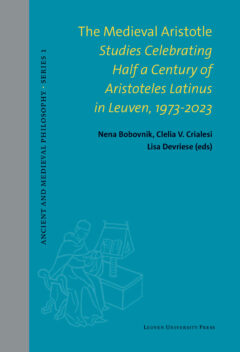 The Medieval Aristotle
Nena Bobovnik (Editor), Clelia V. Crialesi (Editor), Lisa Devriese (Editor),
August 2026

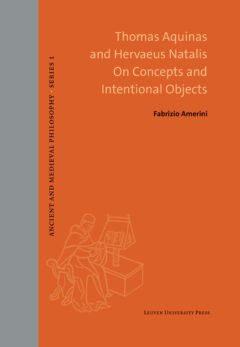 Thomas Aquinas and Hervaeus Natalis on Concepts and Intentional Objects
Fabrizio Amerini (Author),
February 2026
 Epicureanism and Scientific Debates. Epicurean Tradition and its Ancient Reception
Francesca Masi (Editor), Pierre-Marie Morel (Editor), Francesco Verde (Editor),
January 2025
 Quaestiones de divinis praedicamentis XXVIII-XXXII
James of Viterbo (Author), Mark D. Gossiaux (Editor), Christopher D. Schabel (Editor),
June 2024
 Summa (Quaestiones ordinariae) art. LXIII-LXVII
Henry of Ghent (Author), Gordon Wilson (Editor), Girard Etzkorn (Editor), Bernd Goehring (Editor), Linda N. Etzkorn (Assisted by),
February 2024
 Epicureanism and Scientific Debates. Antiquity and Late Reception
Francesca Masi (Editor), Pierre-Marie Morel (Editor), Francesco Verde (Editor),
August 2023
 Questiones super I-VII libros Politicorum
Peter of Auvergne (Author), Marco Toste (Editor),
December 2022