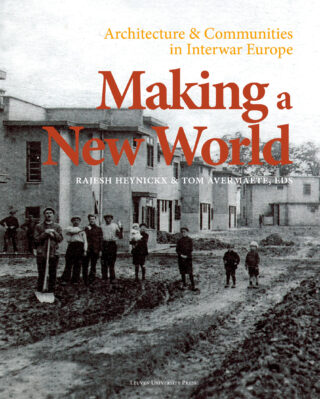
Making a New World
Architecture & Communities in Interwar Europe
Rajesh Heynickx (Editor), Tom Avermaete (Editor),
Series: KADOC-Artes 13
Category: Architecture and Urban Planning, History, History 1800-present
Language: English
ISBN: 9789058679093
Publication date: June 1, 2012
€49.50 (including 6% VAT)
Buy NowNumber of pages: 252
Size: 280 x 225 x 20 mm

Stock item: 66420
Standard delivery time for print books:
For Belgium: 5 to 8 working days
For EU: 2 to 3 weeks
For other countries: 4 to 5 weeks
Study of the foundations and working mechanisms of modern communities
In the changing world of interwar Europe a longing for stability rose to the surface of social life. Newly developed neighbourhoods and buildings were designed to create the healing community that many people were dreaming of. Various social groups with nationalist, ideological, or religious agendas made this concept of community a cornerstone in their framework and appropriated it to prescribe the relations between architecture and modernity. Making a New World analyses the various ways in which these relations were determined.
Most activists/entities encountered the potentialities of modernity, such as technology or mass media, in an accommodating way. In a broad spectrum of actions and proposals – from art exhibitions to séances, photo reports to roof tiles, landscapes to sanitation – these reformists were hoping to create a universe in which their communal dream could become a reality. The 17 contributions to this richly illustrated volume draw the contours of this new world by analysing its foundations and working mechanisms at its heart.
This publication is GPRC-labeled (Guaranteed Peer-Reviewed Content).
PROLOGUE
Rajesh Heynickx and Tom Avermaete
Community as a Prism. Re-aligning the Architectural Theory and Practice of the Interwar Period
EXEGESIS
Rajesh Heynickx
Introduction
Thomas Rohkrämer
German Cultural Criticism. The Desire for a Sense of Place and Community
David Matless
Communities of Landscape. Nation, Locality and Modernity in Interwar England
Michiel Dehaene
The (Il)legible City. Civic Survey and the Imagined Community
Hilde Heynen
Modernity and Community. A Difficult Combination
EXPERIENCE
Marieke Kuipers
Introduction
Stuart Evans
Model Homes for Working Class Urban Living
Martin Kohlrausch
‘Houses of Glass’. Modern Architecture and the Idea of Community in Poland, 1925-1944
Barry Curtis
Negotiated Modernism. British Suburbia between the Wars
Kenny Cupers
Making Camp. Landscape and Community in the Interwar German Youth Movements
EXPECTATION
Elizabeth Darling
Introduction
Elizabeth Darling
Nuclei of a Genuine Urban Life. Bringing the Country to the City in 1930s London
Tom Avermaete
Building Internal Colonies. Play, Form and Youth Environments in Interwar France
Hansjakob Ziemer
Modernizing Musical Spaces. Music Halls and Utopian Communities in Frankfurt am Main, 1900-1930
Marieke Kuipers
Colonizing Fresh Air. Community and Reform in Dutch Vacation Colonies and De Vonk
IMAGINATION
Tom Avermaete & Rajesh Heynickx
Introduction
Bruno Notteboom
Images of the Countryside. Landscape, Village and Community in the Discourse of Belgian Farmers
Rajesh Heynickx
A Law of Inertia. The Tower as Site and Symbol in Interwar Flanders
Nader Vossoughian
The Sociology of the City. Otto Neurath and the Concept of Gemeinwirtschaft
Charles van den Heuvel
Envisioning Knowledge Architectures for a World Society. Paul Otlet’s Architectural and Epistemic Design Strategies
Bibliography
Index of persons
Authors
Colophon
Frequently Asked Questions
What is "Making a New World" about?
Study of the foundations and working mechanisms of modern communities
In the changing world of interwar Europe a longing for stability rose to the surface of social life. Newly developed neighbourhoods and buildings were designed to create the healing community that many people were dreaming of. Various social groups with nationalist, ideological, or religious agendas made this concept of community a cornerstone in their framework and appropriated it to prescribe the relations between architecture and modernity. Making a New World analyses the various ways in which these relations were determined.
Most activists/entities encountered the potentialities of modernity, such as technology or mass media, in an accommodating way. In a broad spectrum of actions and proposals - from art exhibitions to séances, photo reports to roof tiles, landscapes to sanitation - these reformists were hoping to create a universe in which their communal dream could become a reality. The 17 contributions to this richly illustrated volume draw the contours of this new world by analysing its foundations and working mechanisms at its heart.
This publication is GPRC-labeled (Guaranteed Peer-Reviewed Content).
Who edited "Making a New World"?
"Making a New World" was edited by Rajesh Heynickx and Tom Avermaete.
Rajesh Heynickx is gewoon hoogleraar aan de Faculteit Architectuur en voorzitter van het Departement Architectuur van de KU Leuven.
Rajesh Heynickx is intellectual historian at KU Leuven, Faculty of Architecture.
Tom Avermaete is associate professor of architecture at Delft University with a special research interest in the post-war public realm and the architecture of the city in Western and non-Western contexts.
Is "Making a New World" part of a series?
Yes, "Making a New World" is part of the "KADOC-Artes" series. It's book 13 in the series.
The richly illustrated peer-reviewed book series KADOC Artes offers new insights into the material cultures and legacies of religions in Europe and the world since 1750 from interreligious and transnational perspectives. By means of monographs and edited volumes, the series explores thematic frontiers and embraces innovative methodological approaches in heritage studies. Taken together, KADOC Artes and its companion series KADOC Studies in Religion, Culture and Society represent a diptych featuring the material and immaterial cultures and legacies of religions in Europe and the world from the 18th century onwards.
KADOC ARTES reflects the particular expertise of KADOC – the Interfaculty Documentation and Research Centre on Religion, Culture and Society at KU Leuven – as a heritage institution with particularly rich and diverse documentary holdings, and as an interdisciplinary research center.
KADOC Artes managed by an independent Editorial Board. Books are published in English. The series welcomes monographs and edited volumes.
To submit a book proposal please go to the website of KADOC or consult LUP’s guidelines about submission. The series welcomes monographs and edited volumes. Book proposals may relate to, for example, the representation of religious diversity and the politicization of religious heritage.
All book proposals and manuscripts are subject to double blind peer review involving at least one external reviewer (proposals) or at least two (manuscripts). The editors strive towards completing the review of proposals within two months and of complete manuscripts within five months after submission.


Editorial board
Elena Arigita Maza (Universidad de Granada)
Florian Bock (Ruhr Universität Bochum)
Timothy Brittain‐Catlin (University of Cambridge)
James Chappel (Duke University)
Kim Christiaens (KADOC-KU Leuven)
Kathleen James-Chakraborty (University College Dublin)
James Kennedy (Utrecht University)
Franziska Metzger (PH Luzern)
Patrick Pasture (MoSa‐KU Leuven) - chairman
Isabelle Saint‐Martin (EPHE Paris)
Thijl Sunier (VU Amsterdam)
Árpád von Klimó (Catholic University of America)
Veerle De Laet (Leuven University Press)
Peter Heyrman (KADOC-KU Leuven) - secretary
Proposals
Proposals and enquiries can be sent to Peter Heyrman.
Please make use of the submission form to present your manuscript or proposal to our board.
Authors interested in Open Access can consult the available funding options.
Links & Resources
What is the Table of Contents for "Making a New World"?
PROLOGUE
Rajesh Heynickx and Tom Avermaete
Community as a Prism. Re-aligning the Architectural Theory and Practice of the Interwar Period
EXEGESIS
Rajesh Heynickx
Introduction
Thomas Rohkrämer
German Cultural Criticism. The Desire for a Sense of Place and Community
David Matless
Communities of Landscape. Nation, Locality and Modernity in Interwar England
Michiel Dehaene
The (Il)legible City. Civic Survey and the Imagined Community
Hilde Heynen
Modernity and Community. A Difficult Combination
EXPERIENCE
Marieke Kuipers
Introduction
Stuart Evans
Model Homes for Working Class Urban Living
Martin Kohlrausch
'Houses of Glass'. Modern Architecture and the Idea of Community in Poland, 1925-1944
Barry Curtis
Negotiated Modernism. British Suburbia between the Wars
Kenny Cupers
Making Camp. Landscape and Community in the Interwar German Youth Movements
EXPECTATION
Elizabeth Darling
Introduction
Elizabeth Darling
Nuclei of a Genuine Urban Life. Bringing the Country to the City in 1930s London
Tom Avermaete
Building Internal Colonies. Play, Form and Youth Environments in Interwar France
Hansjakob Ziemer
Modernizing Musical Spaces. Music Halls and Utopian Communities in Frankfurt am Main, 1900-1930
Marieke Kuipers
Colonizing Fresh Air. Community and Reform in Dutch Vacation Colonies and De Vonk
IMAGINATION
Tom Avermaete & Rajesh Heynickx
Introduction
Bruno Notteboom
Images of the Countryside. Landscape, Village and Community in the Discourse of Belgian Farmers
Rajesh Heynickx
A Law of Inertia. The Tower as Site and Symbol in Interwar Flanders
Nader Vossoughian
The Sociology of the City. Otto Neurath and the Concept of Gemeinwirtschaft
Charles van den Heuvel
Envisioning Knowledge Architectures for a World Society. Paul Otlet's Architectural and Epistemic Design Strategies
Bibliography
Index of persons
Authors
Colophon
Related titles
 Margarete Schütte-Lihotzky and the Architecture of Collective Dissidence, 1918–1989
S.E. Eisterer (Author),
April 2027
 Infrastructuring Arrival
Karel Arnaut (Editor), Luce Beeckmans (Editor), Bruno Meeus (Editor),
November 2026

 Toekomstdromen
Maarten Van Dijck (Editor), Gerrit Verhoeven (Editor), Hans Cools (Editor),
November 2026
 German–Rapanui Entanglements
Cristián Moreno Pakarati (Editor), Diego Muñoz (Editor), Philipp Schorch (Editor),
August 2026
 Trend en toeval – vierde editie
Bruno Blondé (Author), Isabelle Devos (Author), Jord Hanus (Author), Wouter Ryckbosch (Author),
August 2026
 Cinema in Post-War Belgium
Gertjan Willems (Editor), Bjorn Gabriels (Editor), Bénédicte Rochet (Editor),
May 2026
 Performing Magnetism
Eleonora Paklons (Editor), Kristof Smeyers (Editor), Kurt Vanhoutte (Editor), Hannah Welslau (Editor),
May 2026
 Christian Democracy and the Fall of Communism
Michael Gehler (Editor), Piotr H. Kosicki (Editor), Helmut Wohnout (Editor),
April 2026
 Political Exile in the Global Twentieth Century
Wolfram Kaiser (Editor), Piotr H. Kosicki (Editor),
April 2026
 Brusselse plaatsnamen
Iadine Degryse (Editor), Benjamin Wayens (Editor), Chantal Kesteloot (Editor), Dennis De Vriese (Editor), Matthijs Degraeve (Editor),
April 2026
 Cartographies of Catastrophes
Laura Demeter (Editor), Carmen M. Enss (Editor), Piotr Kisiel (Editor), Carol Ludwig (Editor),
February 2026