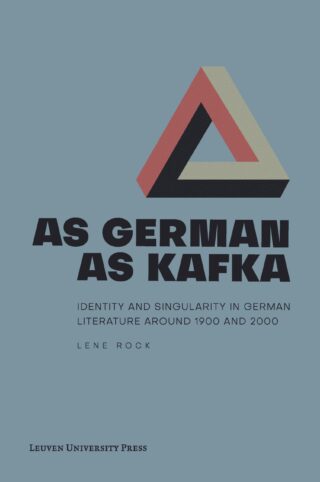

As German as Kafka
Identity and Singularity in German Literature around 1900 and 2000
Lene Rock (Author),

Category: Diversity and Equity Studies, Literature, Migration Studies, Urban Studies
Language: English
ISBN: 9789462701786
Publication date: December 12, 2019
€29.50 (including 6% VAT)
Buy NowNumber of pages: 370
Size: 234 x 156 x 20 mm

Funded by: KU Leuven Fund for Fair Open Access
Stock item: 132491
Standard delivery time for print books:
For Belgium: 5 to 8 working days
For EU: 2 to 3 weeks
For other countries: 4 to 5 weeks
Category: Diversity and Equity Studies, Literature, Migration Studies, Urban Studies
Language: English
ISBN: 9789461662859
Publication date: December 12, 2019
Download Free EpubNumber of pages: 370
Funded by: KU Leuven Fund for Fair Open Access
Category: Diversity and Equity Studies, Literature, Migration Studies, Urban Studies
Language: English
ISBN: 9789461662842
Publication date: December 12, 2019
Download Free PDFNumber of pages: 370
Funded by: KU Leuven Fund for Fair Open Access
The first extensive comparison of the German-Jewish literary corpus and contemporary minority writing in German
Since the turn of the 21st century, countless literary endeavors by ‘new Germans’ have entered the spotlight of academic research. Yet ‘minority writing’, with its distinctive renegotiation of traditional concepts of cultural identity, is far from a recent phenomenon in German literature. A hundred years previously, the intense involvement of German-Jewish intellectuals in cultural and political discourses on Jewish identity put a clear stamp on German modernism. This book is the first to unfold literary parallels between these two riveting periods in German cultural history. Drawing on the philosophical oeuvre of Jean-Luc Nancy, a comparative reading of texts by, amongst others, Beer-Hofmann, Kermani, Özdamar, Roth, Schnitzler, and Zaimoglu examines a variety of literary approaches to the thorny issue of cultural identity, while developing an overarching perspective on the ‘politics of literature’.
Ebook available in Open Access.
This publication is GPRC-labeled (Guaranteed Peer-Reviewed Content).
Acknowledgements
Introduction
Chapter 1
Constitutive outsiders
1.1 Ambivalences of Kultur and Aufklärung
Constructions of German identity
Kultur versus Zivilisation
1.2 “Trapped by the image of a rejected self ”—Jews in Germany, German Jews
Emancipation and acculturation (1770–1880)
Modern anti-Semitism and Jewish dissimilation (1880–1933)
The ambivalence of assimilation 50
1.3 A reluctant country of immigration
From emigration to immigration
Kultur in the aftermath of non-policy: MultiKulti—Leitkultur—‘Deutschland schafft sich ab’
1.4 Literature, identity, and singularity
Chapter 2
Aesthetes between identity and opposition 67
2.1 The authenticity paradox—Writing between identity and opposition
2.2 The aesthete’s retreat: Arthur Schnitzler’s Fräulein Else (1924) versus Navid Kermani’s Kurzmitteilung (2007)
The ‘value’ of cultural difference: Arthur Schnitzler and Navid Kermani
A conflict of codes: ‘aesthetics of opposition’ versus ‘aesthetics of identity’
2.3 The aesthete’s awakening: Beer-Hofmann’s Der Tod Georgs (1900) versus Zaimoglu’s Liebesbrand (2008) 102
Jewish aesthete and romantic rebel: Richard Beer-Hofmann and Feridun Zaimoglu
Realitätsablehnung & experiences of finitude
Aesthetics of becoming—The ambivalent rhetoric of blood
Conclusion
Chapter 3
City dwellers between difference and indifference
3.1 Images of the city: emancipatory visions and spatialized difference
Berlin: image of an unsettled national identity
Indifference to difference
The city as a site of Jewish self-definition
Urban stereotype and spatialized difference
3.2 The failure of exemplarity—‘Figures of immanence’:Ludwig Jacobowski’s Werther, der Jude (1892) versus Terezia Mora’s Alle Tage (2004)
Exemplarity, identification, alienation
‘Figures of immanence’: the atomic individual versus the Leerstelle
Metropolitan milieus: ‘the law of the proper’ versus Verletzbarkeit
3.3 Disoriented city dwellers—Figures of ‘distanced proximity’:
Franz Hessel’s Spazieren in Berlin (1929) versus Emine Sevgi Ozdamar’s “Der Hof im Spiegel” (2001)
Reading the city
Disoriented/dis-Oriented city dwellers
Conclusion
Chapter 4
Family heroes between myth and storytelling
4.1 Writing in the shadow of an empire
4.2 Family heroes redefined: Joseph Roth’s Radetzkymarsch (1932) versus Dimitre Dinev’s Engelszungen (2003)
Storytellers between empires and nations:Joseph Roth and Dimitre Dinev
“Listening to the same story”—Heroic grandfathers and the power of fiction
“Against the confines of the image”—Un-/antiheroic grandsons and the power of storytelling
4.3 “Diaspora’s children”—Heroics of endurance and hope:
Joseph Roth’s Hiob (1930) versus Zsusza Bank’s Der Schwimmer (2002)
Between East and West—Between pathos and hope: Joseph Roth and Zsuzsa Bank
Communities of violence—Communities of silence
Allowing something to be said—Hope emerging from silence
Conclusion
Conclusion
The fallibility of Bildung
Notes
Introduction
Chapter 1: Constitutive outsiders
Chapter 2: Aesthetes between identity and opposition
Chapter 3. City dwellers between difference and indifference
Chapter 4. Family heroes between myth and storytelling
Conclusion: The fallibility of Bildung
Bibliography
Frequently Asked Questions
What is "As German as Kafka" about?
The first extensive comparison of the German-Jewish literary corpus and contemporary minority writing in German
Since the turn of the 21st century, countless literary endeavors by 'new Germans' have entered the spotlight of academic research. Yet 'minority writing', with its distinctive renegotiation of traditional concepts of cultural identity, is far from a recent phenomenon in German literature. A hundred years previously, the intense involvement of German-Jewish intellectuals in cultural and political discourses on Jewish identity put a clear stamp on German modernism. This book is the first to unfold literary parallels between these two riveting periods in German cultural history. Drawing on the philosophical oeuvre of Jean-Luc Nancy, a comparative reading of texts by, amongst others, Beer-Hofmann, Kermani, Özdamar, Roth, Schnitzler, and Zaimoglu examines a variety of literary approaches to the thorny issue of cultural identity, while developing an overarching perspective on the ‘politics of literature’.
Ebook available in Open Access.
This publication is GPRC-labeled (Guaranteed Peer-Reviewed Content).
Who wrote "As German as Kafka"?
"As German as Kafka" was written by Lene Rock.
Lene Rock obtained a PhD in Literature from KU Leuven in 2017.
Is "As German as Kafka" available Open Access?
Yes, "As German as Kafka" is published Open Access. It is available under a BY-NC-ND license.
Who funded the publication of "As German as Kafka"?
Publication of "As German as Kafka" was funded by KU Leuven Fund for Fair Open Access
.
What is the Table of Contents for "As German as Kafka"?
Acknowledgements
Introduction
Chapter 1
Constitutive outsiders
1.1 Ambivalences of Kultur and Aufklärung
Constructions of German identity
Kultur versus Zivilisation
1.2 “Trapped by the image of a rejected self ”—Jews in Germany, German Jews
Emancipation and acculturation (1770–1880)
Modern anti-Semitism and Jewish dissimilation (1880–1933)
The ambivalence of assimilation 50
1.3 A reluctant country of immigration
From emigration to immigration
Kultur in the aftermath of non-policy: MultiKulti—Leitkultur—‘Deutschland schafft sich ab’
1.4 Literature, identity, and singularity
Chapter 2
Aesthetes between identity and opposition 67
2.1 The authenticity paradox—Writing between identity and opposition
2.2 The aesthete’s retreat: Arthur Schnitzler’s Fräulein Else (1924) versus Navid Kermani’s Kurzmitteilung (2007)
The ‘value’ of cultural difference: Arthur Schnitzler and Navid Kermani
A conflict of codes: ‘aesthetics of opposition’ versus ‘aesthetics of identity’
2.3 The aesthete’s awakening: Beer-Hofmann’s Der Tod Georgs (1900) versus Zaimoglu’s Liebesbrand (2008) 102
Jewish aesthete and romantic rebel: Richard Beer-Hofmann and Feridun Zaimoglu
Realitätsablehnung & experiences of finitude
Aesthetics of becoming—The ambivalent rhetoric of blood
Conclusion
Chapter 3
City dwellers between difference and indifference
3.1 Images of the city: emancipatory visions and spatialized difference
Berlin: image of an unsettled national identity
Indifference to difference
The city as a site of Jewish self-definition
Urban stereotype and spatialized difference
3.2 The failure of exemplarity—‘Figures of immanence’:Ludwig Jacobowski’s Werther, der Jude (1892) versus Terezia Mora’s Alle Tage (2004)
Exemplarity, identification, alienation
‘Figures of immanence’: the atomic individual versus the Leerstelle
Metropolitan milieus: ‘the law of the proper’ versus Verletzbarkeit
3.3 Disoriented city dwellers—Figures of ‘distanced proximity’:
Franz Hessel’s Spazieren in Berlin (1929) versus Emine Sevgi Ozdamar’s “Der Hof im Spiegel” (2001)
Reading the city
Disoriented/dis-Oriented city dwellers
Conclusion
Chapter 4
Family heroes between myth and storytelling
4.1 Writing in the shadow of an empire
4.2 Family heroes redefined: Joseph Roth’s Radetzkymarsch (1932) versus Dimitre Dinev’s Engelszungen (2003)
Storytellers between empires and nations:Joseph Roth and Dimitre Dinev
“Listening to the same story”—Heroic grandfathers and the power of fiction
“Against the confines of the image”—Un-/antiheroic grandsons and the power of storytelling
4.3 “Diaspora’s children”—Heroics of endurance and hope:
Joseph Roth’s Hiob (1930) versus Zsusza Bank’s Der Schwimmer (2002)
Between East and West—Between pathos and hope: Joseph Roth and Zsuzsa Bank
Communities of violence—Communities of silence
Allowing something to be said—Hope emerging from silence
Conclusion
Conclusion
The fallibility of Bildung
Notes
Introduction
Chapter 1: Constitutive outsiders
Chapter 2: Aesthetes between identity and opposition
Chapter 3. City dwellers between difference and indifference
Chapter 4. Family heroes between myth and storytelling
Conclusion: The fallibility of Bildung
Bibliography
What is the DOI for "As German as Kafka"?
The Digital Object Identifier (DOI) for "As German as Kafka" is 10.11116/9789461662842.
Related titles

 Margarete Schütte-Lihotzky and the Architecture of Collective Dissidence, 1918–1989
S.E. Eisterer (Author),
April 2027

 Infrastructuring Arrival
Karel Arnaut (Editor), Luce Beeckmans (Editor), Bruno Meeus (Editor),
November 2026
 Feminists Resisting Gendered Violence
Hemangini Gupta (Editor), Fiona Mackay (Editor), Jan Breckenridge (Editor), Louise Chappell (Editor), Rachna Mehra (Editor), Rukmini Sen (Editor), Mailin Suchting (Editor),
October 2026
 A City in Practice
Aude Tournaye (Editor), Filip De Boeck (Editor), Picha Collective (Editor),
September 2026
 Affect in Translation and Interpreting
Sofía Monzón (Editor), Lucie Spezzatti (Editor), Elisabeth Goemans (Editor),
May 2026
 Research Methods in Literary Reception Studies
Jeroen Dera (Editor), Anne Oerlemans (Editor), Frederik Van Dam (Editor),
May 2026
 Brusselse plaatsnamen
Iadine Degryse (Editor), Benjamin Wayens (Editor), Chantal Kesteloot (Editor), Dennis De Vriese (Editor), Matthijs Degraeve (Editor),
April 2026

 Nomadic Camera
Burcu Dogramaci (Editor), Winfried Gerling (Editor), Jens Jäger (Editor), Birgit Mersmann (Editor),
March 2026
 Cartographies of Catastrophes
Laura Demeter (Editor), Carmen M. Enss (Editor), Piotr Kisiel (Editor), Carol Ludwig (Editor),
February 2026
 Comics and the Global South
Andrea Aramburú (Editor), Dibyadyuti Roy (Editor), Joe Sutliff Sanders (Editor),
February 2026

 Situatedness and Performativity
Raquel Pacheco Aguilar (Editor), Marie-France Guénette (Editor),
November 2025