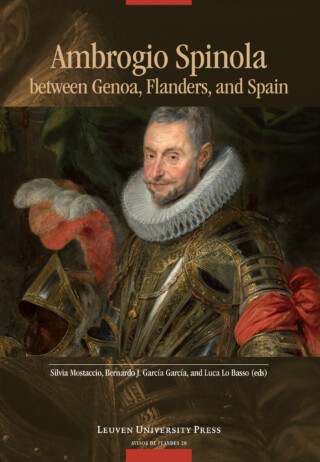
Ambrogio Spinola between Genoa, Flanders, and Spain
Silvia Mostaccio (Editor), Bernardo J. García García (Editor), Luca Lo Basso (Editor),
Series: Avisos de Flandes 20
Category: History, History 1500-1800
Language: English
ISBN: 9789462703421
Publication date: September 21, 2022
€65.00 (including 6% VAT)
Buy NowNumber of pages: 384
Size: 244 x 170 x mm
Number of illustrations: 75
Illustrations and other content description:
Illustrated b/w & f/c

Stock item: 150306
Standard delivery time for print books:
For Belgium: 5 to 8 working days
For EU: 2 to 3 weeks
For other countries: 4 to 5 weeks
Series: Avisos de Flandes 20
Category: History, History 1500-1800
Language: English
ISBN: 9789461664723
Publication date: September 21, 2022
€55.00 (including 6% VAT)
Buy NowNumber of pages: 384
Number of illustrations: 75
Illustrations and other content description:
Illustrated b/w & f/c
Interdisciplinary study of Spinola’s turbulent life
Many of the most significant studies devoted to Ambrogio Spinola have focused on one particular aspect of his life: his successful military career. This volume, through its interdisciplinary and cultural approach, breaks open this all too narrow perspective and expands our understanding of Spinola and his world. As a great military strategist and Catholic knight, entrepreneur in the international finance market, courtier, and diplomat, Spinola was certainly a Genoese, but he was also a member of the transnational Iberian elite, to which he linked his fate and that of his children. His life’s journey between Italy, Flanders, and Spain, and the reinterpretations of his life by his contemporaries in art, literature, and the press, give us the opportunity to reflect on the multiple identities and the physical and mental wanderings of many Europeans of the Early Modern Age. Ambrogio Spinola offers an example of humanity that is impossible to capture in a single reading and is much more contemporary than we can imagine.
Ambrogio Spinola between Genoa, Flanders, and Spain allows the reader to better understand not only his military activities, but also (and above all) the family, social and political foundations of his successful career, as well as the various forms of art and communication (literature, architecture, paintings, sculptures, engravings, newspapers, etc.), which were used to celebrate him both during his life and beyond.
Contributors: Blythe Alice Raviola (University of Milan), Emiliano Beri (University of Genoa), Alicia Esteban Estríngana (University of Alcala), Dries Raeymaekers (Radboud University), Davide Maffi (University of Pavia), Nina Lamal (Royal Netherlands Academy of Arts and Sciences), Paul Arblaster (Saint-Louis University Brussels), Enrico Zucchi (University of Padua), Laura Stagno (University of Genoa)
This publication is GPRC-labeled (Guaranteed Peer-Reviewed Content).
List of Illustrations
Ambrogio Spinola: The Threads of a Multiple Past Silvia Mostaccio, Bernardo J. García García, Luca Lo Basso
Part IAmbrogio and the Spinola of San Luca: Gender and Family Strategies
Around Ambrogio: The Family Network in Genoa, Milan, and Spain, and Giovanni Botero’s Eulogy Blythe Alice Raviola
Federico and Ambrogio Spinola between Mediterranean Corsairs, War in Flanders, and the Invasion of England Emiliano Beri
“Ingrandire la famiglia”: Ambrogio Spinola on Honour, War, and Money in his Flanders Correspondence with the Women of his Family Silvia Mostaccio
Part IINetworks: War, Finance, Politics, and Diplomacy
A Joab for King David: Ambrogio Spinola, General of Archduke Albert, and the Davidic Imaginary in the Time of Philip III (1598–1605) 97 Alicia Esteban Estríngana
“The Great Alcandre”: Ambrogio Spinola at Court Dries Raeymaekers
The Last Venture: Ambrogio Spinola as Governor of Milan (1629–30) Davide Maffi
To Lose One’s Honour: Ambrogio Spinola’s Return to Italy, the Casale Affair, and the End of “Pax Hispanica” (1627–30) Luca Lo Basso
Part IIIMemory Construction and Appropriation of Ambrogio Spinola’s Images
Spinola’s Fame in the News Press Nina Lamal, Paul Arblaster
Contesting the Spanish Myth: Republican Shaping of Ambrogio Spinola’s Image in Genoese Literature (1608–52) Enrico Zucchi
Ambrogio Spinola in Genoese Art Laura Stagno
“Tempore et Loco”: Heroic Rhetoric of Spinola’s Fortune, from Military Entrepreneur to Spanish Grandee Bernardo J. García García
Index
This volume will
undoubtedly be an obligatory reference for anyone who wants to study Spinola in
depth or wants to understand the mechanisms that operated in the service to the
Hispanic monarchy and in the cursus honorum of some of the most prestigious
Genoese houses of the Republic. The enormous collection of sources on which the
various chapters are based, including manuscripts, printed texts, architectural
testimonies and artistic objects, among others, from Spanish, Flemish, Dutch
and Italian libraries, collections and archives, allow us to delineate points
of view on the life of Spinola which, until now, had remained obscured.Yasmina
Ben Yessef Garfia, University Federico II (Naples)
Frequently Asked Questions
What is "Ambrogio Spinola between Genoa, Flanders, and Spain" about?
Interdisciplinary study of Spinola’s turbulent life
Many of the most significant studies devoted to Ambrogio Spinola have focused on one particular aspect of his life: his successful military career. This volume, through its interdisciplinary and cultural approach, breaks open this all too narrow perspective and expands our understanding of Spinola and his world. As a great military strategist and Catholic knight, entrepreneur in the international finance market, courtier, and diplomat, Spinola was certainly a Genoese, but he was also a member of the transnational Iberian elite, to which he linked his fate and that of his children. His life's journey between Italy, Flanders, and Spain, and the reinterpretations of his life by his contemporaries in art, literature, and the press, give us the opportunity to reflect on the multiple identities and the physical and mental wanderings of many Europeans of the Early Modern Age. Ambrogio Spinola offers an example of humanity that is impossible to capture in a single reading and is much more contemporary than we can imagine.
Ambrogio Spinola between Genoa, Flanders, and Spain allows the reader to better understand not only his military activities, but also (and above all) the family, social and political foundations of his successful career, as well as the various forms of art and communication (literature, architecture, paintings, sculptures, engravings, newspapers, etc.), which were used to celebrate him both during his life and beyond.
Contributors: Blythe Alice Raviola (University of Milan), Emiliano Beri (University of Genoa), Alicia Esteban Estríngana (University of Alcala), Dries Raeymaekers (Radboud University), Davide Maffi (University of Pavia), Nina Lamal (Royal Netherlands Academy of Arts and Sciences), Paul Arblaster (Saint-Louis University Brussels), Enrico Zucchi (University of Padua), Laura Stagno (University of Genoa)
This publication is GPRC-labeled (Guaranteed Peer-Reviewed Content).
Who edited "Ambrogio Spinola between Genoa, Flanders, and Spain"?
"Ambrogio Spinola between Genoa, Flanders, and Spain" was edited by Silvia Mostaccio, Bernardo J. García García and Luca Lo Basso.
Silvia Mostaccio is professor of early modern history at UCLouvain.
Bernardo J. García García is professor of early modern history at the Complutense University of Madrid, and coordinates the research activities of the Charles of Antwerp Foundation in Madrid.
Luca Lo Basso is professor of early modern history and maritime history at the University of Genoa, and Director of the Laboratory of Maritime and Naval History in Genoa.
Is "Ambrogio Spinola between Genoa, Flanders, and Spain" part of a series?
Yes, "Ambrogio Spinola between Genoa, Flanders, and Spain" is part of the "Avisos de Flandes" series. It's book 20 in the series.

Series editor
Werner Thomas, KU Leuven
Proposals
To submit a proposal please send a preliminary abstract (1-2 pp.) and a short bio to series editor Werner Thomas. The evaluation process takes an average of four weeks. Upon approval of the abstract, the full manuscript will be submitted to international peer review. Two peer reviewers will be asked for expert advice, three in case of conflicting reports.
Please make use of the submission form to present the full manuscript to our board.
Authors interested in Open Access can consult the available funding options.
Links & Resources
What is the Table of Contents for "Ambrogio Spinola between Genoa, Flanders, and Spain"?
List of Illustrations
Ambrogio Spinola: The Threads of a Multiple Past Silvia Mostaccio, Bernardo J. García García, Luca Lo Basso
Part IAmbrogio and the Spinola of San Luca: Gender and Family Strategies
Around Ambrogio: The Family Network in Genoa, Milan, and Spain, and Giovanni Botero’s Eulogy Blythe Alice Raviola
Federico and Ambrogio Spinola between Mediterranean Corsairs, War in Flanders, and the Invasion of England Emiliano Beri
“Ingrandire la famiglia”: Ambrogio Spinola on Honour, War, and Money in his Flanders Correspondence with the Women of his Family Silvia Mostaccio
Part IINetworks: War, Finance, Politics, and Diplomacy
A Joab for King David: Ambrogio Spinola, General of Archduke Albert, and the Davidic Imaginary in the Time of Philip III (1598–1605) 97 Alicia Esteban Estríngana
“The Great Alcandre”: Ambrogio Spinola at Court Dries Raeymaekers
The Last Venture: Ambrogio Spinola as Governor of Milan (1629–30) Davide Maffi
To Lose One’s Honour: Ambrogio Spinola’s Return to Italy, the Casale Affair, and the End of “Pax Hispanica” (1627–30) Luca Lo Basso
Part IIIMemory Construction and Appropriation of Ambrogio Spinola’s Images
Spinola’s Fame in the News Press Nina Lamal, Paul Arblaster
Contesting the Spanish Myth: Republican Shaping of Ambrogio Spinola’s Image in Genoese Literature (1608–52) Enrico Zucchi
Ambrogio Spinola in Genoese Art Laura Stagno
“Tempore et Loco”: Heroic Rhetoric of Spinola’s Fortune, from Military Entrepreneur to Spanish Grandee Bernardo J. García García
Index
What is the DOI for "Ambrogio Spinola between Genoa, Flanders, and Spain"?
The Digital Object Identifier (DOI) for "Ambrogio Spinola between Genoa, Flanders, and Spain" is 10.11116/9789461664723.
Related titles

 Toekomstdromen
Maarten Van Dijck (Editor), Gerrit Verhoeven (Editor), Hans Cools (Editor),
October 2026
 Trend en toeval – vierde editie
Bruno Blondé (Author), Isabelle Devos (Author), Jord Hanus (Author), Wouter Ryckbosch (Author),
August 2026

 Christian Democracy and the Fall of Communism
Michael Gehler (Editor), Piotr H. Kosicki (Editor), Helmut Wohnout (Editor),
April 2026

 Political Exile in the Global Twentieth Century
Wolfram Kaiser (Editor), Piotr H. Kosicki (Editor),
April 2026
 Brusselse plaatsnamen
Iadine Degryse (Editor), Benjamin Wayens (Editor), Chantal Kesteloot (Editor), Dennis De Vriese (Editor), Matthijs Degraeve (Editor),
April 2026

 Cartographies of Catastrophes
Laura Demeter (Editor), Carmen M. Enss (Editor), Piotr Kisiel (Editor), Carol Ludwig (Editor),
February 2026




 Vroegmoderne dieren in de Nederlanden
Judith Brouwer (Editor), djoeke van Netten (Editor),
November 2025