
Profound theoretical and philosophical approach to contemporary music
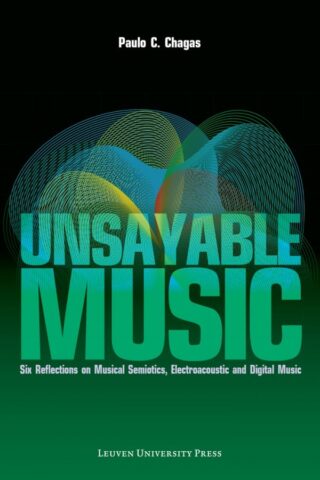
Unsayable Music presents theoretical, critical and analytical reflections on key topics of contemporary music including acoustic, electroacoustic and digital music, and audiovisual and multimedia composition. Six essays by Paulo C. Chagas approaching music from different perspectives such as philosophy, sociology, cybernetics, musical semiotics, media, and critical studies. Chagas’s practical experience, both as a composer of contemporary music and sound director of the Electronic Music Studio of Cologne, nourishes his observations on the specific creativity that emerges with the use of the technical apparatus, the development of the electronic music studio, the different aesthetics of electroacoustic music, and the forms of audiovisual and multimedia composition.
The title Unsayable Music is a reference to Wittgenstein, who suggested that sound is only the surface of music and that the musical work conceals something more profound that can hardly be described by philosophical models or scientific theories.
This publication is GPRC-labeled (Guaranteed Peer-Reviewed Content).
Introduction
1. Musical Understanding: Wittgenstein, Ethics, and Aesthetics 2. Spectral Semiotics: Sound, Temporality, and Aff ect in Chopin 3. Communication and Meaning: Music as Social System 4. The Creativity of Electroacoustic and Digital Music 5. The Temple of Electronic Music: The Electronic Music Studio of Cologne in the 1990s 6. Audiovisual and Multimedia Composition: The Relationship between Medium and Form
APPENDIX I WDR Studio of Electronic Music: Works produced from 1987 to 2000
APPENDIX II WDR Studio of Electronic Music: Studio equipment used from 1990 to 2000
Bibliography
'Paulo C. Chagas is one of those remarkable composers well versed not only in the methods and means of musical creation but also in theoretical issues of aesthetics, semiotics, mathematics, and philology. This book displays an exceptional grasp of a wide range of complex theoretical and philosophical issues, all of them nonetheless directly connected to the act of composing music. Indeed, it is precisely because of his passionate intellectual engagement that Chagas's music always exhibits emotional immediacy as well as technical sophistication. Both his works and his ideas draw their inspiration from the wellspring of daily life and its frequently harsh realities.' - Walter Clark, University of California, Riverside
The unsayable that says! A review of the book Unsayable Music by Paulo Chagas
A review of the book Unsayable Music: Six Reflections on Musical Semiotics, Electroacoustic and Digital Music written by the Brazilian composer Paulo Chagas (1953). The review presents a summary of each chapter not only to promote the work, but also to reflect on the aesthetic prerogatives of music and the role of the composer in contemporary society.
Antenor Ferreira Corrêa (UnB), Opus, Porto Alegre, v. 21, n. 1, p. 185-192, jun. 2015
Frequently Asked Questions
What is "Unsayable Music" about?
Profound theoretical and philosophical approach to contemporary music
Unsayable Music presents theoretical, critical and analytical reflections on key topics of contemporary music including acoustic, electroacoustic and digital music, and audiovisual and multimedia composition. Six essays by Paulo C. Chagas approaching music from different perspectives such as philosophy, sociology, cybernetics, musical semiotics, media, and critical studies. Chagas’s practical experience, both as a composer of contemporary music and sound director of the Electronic Music Studio of Cologne, nourishes his observations on the specific creativity that emerges with the use of the technical apparatus, the development of the electronic music studio, the different aesthetics of electroacoustic music, and the forms of audiovisual and multimedia composition.
The title Unsayable Music is a reference to Wittgenstein, who suggested that sound is only the surface of music and that the musical work conceals something more profound that can hardly be described by philosophical models or scientific theories.
This publication is GPRC-labeled (Guaranteed Peer-Reviewed Content).
Who wrote "Unsayable Music"?
"Unsayable Music" was written by Paulo C. Chagas.
Paulo C. Chagas is Professor of Composition at the University of California, Riverside, member of the International Project on Music Signification, and composer of acoustic, electroacoustic, and audiovisual music He is active in Europe, Brazil, and the United States.
What is the Table of Contents for "Unsayable Music"?
Introduction
1. Musical Understanding: Wittgenstein, Ethics, and Aesthetics 2. Spectral Semiotics: Sound, Temporality, and Aff ect in Chopin 3. Communication and Meaning: Music as Social System 4. The Creativity of Electroacoustic and Digital Music 5. The Temple of Electronic Music: The Electronic Music Studio of Cologne in the 1990s 6. Audiovisual and Multimedia Composition: The Relationship between Medium and Form
APPENDIX I WDR Studio of Electronic Music: Works produced from 1987 to 2000
APPENDIX II WDR Studio of Electronic Music: Studio equipment used from 1990 to 2000
Bibliography
Related titles
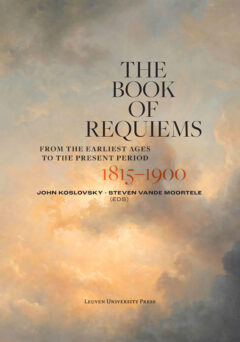 The Book of Requiems, 1815–1900
John Koslovsky (Editor), Steven Vande Moortele (Editor),
December 2026
 Music Theory and Analysis Volume 12 Issue 1, 2025 (Journal Subscription)
John Koslovsky (Editor), Markus Neuwirth (Editor), Derek Remeš (Editor),
May 2025




 Musiceren is topsport
Bert De Cuyper (Author), Griet Baert (Author), Linde Verjans (Author),
December 2021
 Theory into practice
Nicholas Cook (Author), Peter Johnson (Author), Hans Zender (Author),
October 2021