Quaestiones de esse intelligibili
Petrus Thomae (Author), Garrett R. Smith (Editor),
Series: Ancient and Medieval Philosophy - Series 1 52
Category: Philosophy
ISBN: 9789462700352
Publication date: July 7, 2015
€75.00 (including 6% VAT)
Buy NowSize: 240 x 160 x mm

Stock item: 99671
Standard delivery time for print books:
For Belgium: 5 to 8 working days
For EU: 2 to 3 weeks
For other countries: 4 to 5 weeks
Series: Ancient and Medieval Philosophy - Series 1 52
Category: Philosophy
ISBN: 9789461661760
Publication date: July 7, 2015
€56.00 (including 6% VAT)
Buy Now
First critical edition of Petrus Thomae’s theory of non-causal dependence.
This work of Scotist metaphysics is an investigation into the ultimate constitution of things. In the course of this treatise, Petrus Thomae examines whether the essences of things ultimately depend on being thought of by God for their very intelligibility or whether they have it of themselves. Defending in detail the second option, Peter argues that creatures exist independently of the divine intellect in the divine essence. They enjoy real, eternal being in the divine essence and objective being in the divine mind. Aware that these views conflicted with his belief in the Christian doctrine of creation, Peter laboured to alleviate the conflict with a theory of non-causal dependence, according to which even if God did not cause creatures to be in the divine essence, nevertheless they are necessary correlatives of the divine essence.
This publication is GPRC-labeled (Guaranteed Peer-Reviewed Content).
Preface
Introduction
I. Life
II. Works
III. Themes of the Quaestiones de esse intelligibili
IV. The Edition A. Description of Manuscripts B. Prior Editions C. Isolated Accidents D. Common Accidents E. The alia littera of MS S F. Stemma codicum G. Editorial Principles H. Authenticity and Title I. Dating J. Sources K. Influence
Abbreviations
QUAESTIONES DE ESSE INTELLIGIBILI Q. 1 Utrum intellectus creatus producat rem intellectam in esse intelligibili Q. 2 Utrum intellectus divinus producat quidditates creabilium in esse intelligibili Q. 3 Utrum illud esse intelligibile quod habuit quidditas creabilis ab aeterno sit esse causatum Q. 4 Utrum esse intelligibile creabilium sit prius aliquo modo esse subsistentiae productae in divinis Q. 5 Utrum quidditas creaturae in esse intelligibili posita sit formaliter idea Q. 6 Utrum esse quidditatis in esse intelligibili positae sit totaliter respectivum Q. 7 Utrum teneat ista consequentia: ‘aliquid non habet esse subiective, ergo non habet esse’ Q. 8 Utrum creatura ab aeterno habuit aliquod verum esse reale distinctum aliquo modo ab esse divino Q. 9 Utrum ponens creaturam habuisse aliquod verum esse reale ab aeterno possit salvare creationem
Appendix
IOANNI S CANONICI Quaestiones super libros Physicorum II q. 3 a. 2
MATTHIAS DOERING Lectura I d. 35 Lectura I d. 46
Bibliography Primary Sources Secundary Sources
Indices
What kind of being do creatures possess before creation? That is the overall problem dealt with in Peter Phomae's Quaestiones de esse intelligibili that have now appeared as the first volume in a new series devoted to the works of Peter Thomae (Petri Thomae Opera), a subseries within the well-known series Ancient and Medieval Philosophy of the De Wulf-mansion centre, Leuven. That the Franciscan friar Peter Thomae († 1340), henceforth Pt, is given his own series is remarkable, considering that he has not as yet attracted too much attention from medievalist scholarship. Certainly, some of his works have long been available in critical editions, but the new series that will contain his major works will provide a much more adequate impression of his way of thinking and is bound to shed new light on the intellectual history of the early 14th century, especially on the earliest stage of the Scotist school. [...] The solid scholarship presented in this first volume allows us to have high expectations in regard to the next volumes in the series.
Claus A. Andersen, Archivum Franciscanum Historicum - Annus 109 - Ianuarius - Iunius 2016 - Fasc. 1-2
Make no mistake, this is a good edition. Once Garrett Smith had collated in full all eight witnesses with tremendous effort and considerable success, when analyzing the readings and forming the text, he unfortunately found that the manuscript tradition exhibited evidence of both contamination and slight revision, even contamination across the two redactions. The surviving manuscripts of both redactions, moreover, did not provide clean texts—indeed, one could not even cobble together a perfect text from all witnesses taken together. Smith did a good job investigating and explaining what had happened, although the more complicated the situation, the greater the number of possible explanations. In the end, instead of printing the flawed text of gamma or N (and relegating the other to the apparatus criticus), either of which would have required editorial emendation, Smith chose to edit a combined text. The result is a perhaps necessary compromise, generally as close to Petrus Thomae's original(s) as we can get. For this heroic solo effort, Garrett Smith deserves our praise and gratitude.
Chris Schabel, Vivarium 54 (2016) 357-362, DOI 10.1163/15685349-12341324
'On ne peut que recommander cet ouvrage, qui complète notre connaissance du scotisme, enrichit notre compréhension de la pensée théologique et philosophique franciscaine, et présente une conceptualisation
originale de la notion de dépendance ontologique, susceptible d’intéresser les métaphysiciens néo-aristotéliciens.'
Magali Roques, Revue philosophique de la France et de l'étranger 2017/3 (Tome 142), p. 377-434
DOI 10.3917/rphi.173.0377
Revue philosophique de la France et de l'étranger
Frequently Asked Questions
What is "Quaestiones de esse intelligibili" about?
First critical edition of Petrus Thomae’s theory of non-causal dependence.
This work of Scotist metaphysics is an investigation into the ultimate constitution of things. In the course of this treatise, Petrus Thomae examines whether the essences of things ultimately depend on being thought of by God for their very intelligibility or whether they have it of themselves. Defending in detail the second option, Peter argues that creatures exist independently of the divine intellect in the divine essence. They enjoy real, eternal being in the divine essence and objective being in the divine mind. Aware that these views conflicted with his belief in the Christian doctrine of creation, Peter laboured to alleviate the conflict with a theory of non-causal dependence, according to which even if God did not cause creatures to be in the divine essence, nevertheless they are necessary correlatives of the divine essence.
This publication is GPRC-labeled (Guaranteed Peer-Reviewed Content).
Who wrote "Quaestiones de esse intelligibili"?
"Quaestiones de esse intelligibili" was written by Petrus Thomae.
Who edited "Quaestiones de esse intelligibili"?
"Quaestiones de esse intelligibili" was edited by Garrett R. Smith.
Garrett R. Smith is Associate Professor at The Catholic University of America.
Is "Quaestiones de esse intelligibili" part of a series?
Yes, "Quaestiones de esse intelligibili" is part of the "Ancient and Medieval Philosophy - Series 1" series. It's book 52 in the series.
Ancient and Medieval Philosophy - Series 1 presents state-of-the-art research on the history of Western thought from its origins to the beginnings of modernity.
In association with The De Wulf-Mansion Centre.


About the Series
The series' focus lies primarily on the continuity and thematic transitions between ancient, medieval and renaissance thought, but also includes volumes on specific topics related to any of those periods. ‘Philosophy' is understood broadly to include metaphysics, ethics, natural philosophy, epistemology and philosophy of mind, and philosophical theology. Since the series is particularly devoted to making available Latin and Greek source texts, we welcome critical text editions as well as contributions that are based on philological scrutiny of those texts, without losing sight of their philosophical importance.
Ancient and Medieval Philosophy - Series 1 aims to publish at least two volumes a year and accepts monographs as well as thematically coherent edited volumes in English (without excluding the possibility of French, German, or Italian contributions to edited volumes). Manuscripts should be 80.000 to 120.000 words in length.
Readership
Researchers and graduate students in ancient, medieval and renaissance philosophy, in classics and in history.
Editorial Coordinator
Russell Friedman, KU Leuven, Belgium
Editorial Board
Pieter Beullens, KU Leuven, Belgium
Lisa Devriese, KU Leuven, Belgium
Pieter d'Hoine, KU Leuven, Belgium
Jan Opsomer, KU Leuven, Belgium
Jenny Pelletier, KU Leuven, Belgium
Andrea Robiglio, KU Leuven, Belgium
Carlos Steel, KU Leuven, Belgium
Gerd Van Riel, KU Leuven, Belgium
Advisory Board
Brad Inwood, Yale Universityo, USA
Jill Kraye, The Warburg Institute, London, United Kingdom
John Marenbon, University of Cambridge, United Kingdom
Lodi Nauta, University of Groningen, The Netherlands
Timothy Noone (†) , The Catholic University of America, USA
Robert Pasnau, University of Colorado at Boulder, USA
Martin Pickavé, University of Toronto, Canada,
Pasquale Porro, Università degli Studi di Milano, Italy
Geert Roskam, KU Leuven, Belgium
Proposals
Proposals and enquiries can be sent to editorial coordinator Russell L. Friedman. Please send a preliminary abstract (3-4 pp.) and a short bio. Upon approval of this abstract, the full manuscript will be submitted to international peer review.
Please make use of the submission form to present the full manuscript to our board.
Authors interested in Open Access can consult the available funding options.
Links & Resources
What is the Table of Contents for "Quaestiones de esse intelligibili"?
Preface
Introduction
I. Life
II. Works
III. Themes of the Quaestiones de esse intelligibili
IV. The Edition A. Description of Manuscripts B. Prior Editions C. Isolated Accidents D. Common Accidents E. The alia littera of MS S F. Stemma codicum G. Editorial Principles H. Authenticity and Title I. Dating J. Sources K. Influence
Abbreviations
QUAESTIONES DE ESSE INTELLIGIBILI Q. 1 Utrum intellectus creatus producat rem intellectam in esse intelligibili Q. 2 Utrum intellectus divinus producat quidditates creabilium in esse intelligibili Q. 3 Utrum illud esse intelligibile quod habuit quidditas creabilis ab aeterno sit esse causatum Q. 4 Utrum esse intelligibile creabilium sit prius aliquo modo esse subsistentiae productae in divinis Q. 5 Utrum quidditas creaturae in esse intelligibili posita sit formaliter idea Q. 6 Utrum esse quidditatis in esse intelligibili positae sit totaliter respectivum Q. 7 Utrum teneat ista consequentia: 'aliquid non habet esse subiective, ergo non habet esse' Q. 8 Utrum creatura ab aeterno habuit aliquod verum esse reale distinctum aliquo modo ab esse divino Q. 9 Utrum ponens creaturam habuisse aliquod verum esse reale ab aeterno possit salvare creationem
Appendix
IOANNI S CANONICI Quaestiones super libros Physicorum II q. 3 a. 2
MATTHIAS DOERING Lectura I d. 35 Lectura I d. 46
Bibliography Primary Sources Secundary Sources
Indices
Related titles
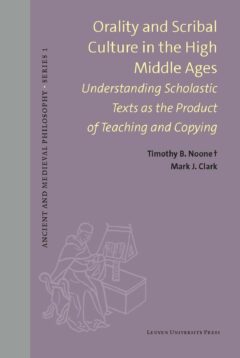 Orality and Scribal Culture in the High Middle Ages
Timothy B. Noone (Author), Mark J. Clark (Author),
November 2026
 Summa (Quaestiones ordinariae) art. LXXIII – LXXV
Henry of Ghent (Author), Gordon Wilson (Editor), Juan Carlos Flores (Editor),
September 2026
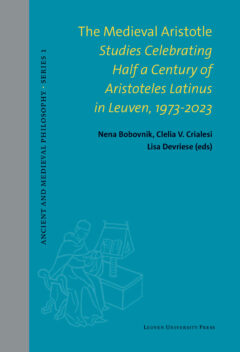 The Medieval Aristotle
Nena Bobovnik (Editor), Clelia V. Crialesi (Editor), Lisa Devriese (Editor),
August 2026

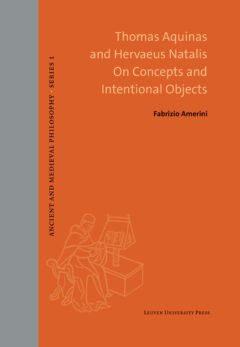 Thomas Aquinas and Hervaeus Natalis on Concepts and Intentional Objects
Fabrizio Amerini (Author),
February 2026
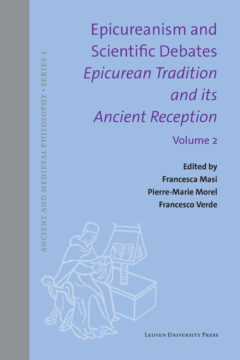 Epicureanism and Scientific Debates. Epicurean Tradition and its Ancient Reception
Francesca Masi (Editor), Pierre-Marie Morel (Editor), Francesco Verde (Editor),
January 2025

 Quaestiones de divinis praedicamentis XXVIII-XXXII
James of Viterbo (Author), Mark D. Gossiaux (Editor), Christopher D. Schabel (Editor),
June 2024
 Summa (Quaestiones ordinariae) art. LXIII-LXVII
Henry of Ghent (Author), Gordon Wilson (Editor), Girard Etzkorn (Editor), Bernd Goehring (Editor), Linda N. Etzkorn (Assisted by),
February 2024
 Epicureanism and Scientific Debates. Antiquity and Late Reception
Francesca Masi (Editor), Pierre-Marie Morel (Editor), Francesco Verde (Editor),
August 2023
 Questiones super I-VII libros Politicorum
Peter of Auvergne (Author), Marco Toste (Editor),
December 2022