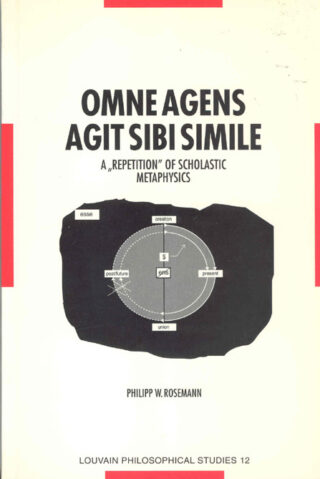
Omne agens agit sibi simile
A 'Repetition' of Scholastic Metaphysics
Philipp W. Rosemann (Author),
The principle, omne agens agit sibi simile, “every agent causes something similar to itself”, is fundamental to Scholastic metaphysics, and especially natural theology. In fact, it is only upon its vasis that inferences can be made from creaturely characteristics to the nature of the Creator. However, omne agens agit sibi simile, is taken for granted even by an author such as Saint Thomas Aquinas, who never feels any need to justify its validity, in spite of the fact that “there is hardly a phrase which occurs more often in Saint Thomas”, as Etienne Gilson remarked.
Tracing the historical roots of omne agens agit sibi simile is an indispensable first step in trying to explain the import of this principle in Scholastic Thought. The first part of the book is devoted to this task. it argues that the mediaeval metaphysics of causal similarity is rooted in a conception of the cosmos which goes back to the Presocratics, and according to which being is essentially circular, or self-reflexive. This conception was further elaborated by Plato, Aristotle, the Neoplatonists, and their mediaeval successors. The second part examines omne agens agit sibi simile in Thomistic metaphysics. Without neglecting Aquinas’s sources, it attempts to elucidate the structure of his thought in the light of contemporary philosophical questions. It is stressed, for instance, that in Aquinas’s thought, causality involves a process of ‘concealing revelation” of the cause in and through its effect -an idea which was later to become a central element in Heidegger’s philosophy.
Plato and Aristotle, or the Circularity of Being
- Plotinus and Proclus, or Vertical and Horizontal Causality
- Pseudo-Dionysus and Saint-Augsutine, or Causation and the Trinity
- Eriugena – Causality as Concealing Revelation
- Peter Lombard on Image and Likeness
- Avicenna’s Inventory of Causal Similarities. Followed by Some Remarks upon Averoës’s Use of “A Man Begets a Man”
- Saint Albert the Great, or Aristotelian Causality and Neoplatonic Flux
- “Synthesis” and “System”: Saint Thomas Aquinas’s Use of the Scholastic Method
- Aquinas’s “Repetition” of the History of Philosophy (1): The Circularity of Being
- Aquinas’s “Repetition” of the History of Philosophy (2): Horizontal and vertical Causality
- Aquinas’s “Repetition” of the History of Philosophy (3): Causality as Consealing Revelation
- Aquinas’s “Repetition” of the History of Philosophy (4): The Trinity
Bibliography
Frequently Asked Questions
What is "Omne agens agit sibi simile" about?
The principle, omne agens agit sibi simile, "every agent causes something similar to itself", is fundamental to Scholastic metaphysics, and especially natural theology. In fact, it is only upon its vasis that inferences can be made from creaturely characteristics to the nature of the Creator. However, omne agens agit sibi simile, is taken for granted even by an author such as Saint Thomas Aquinas, who never feels any need to justify its validity, in spite of the fact that "there is hardly a phrase which occurs more often in Saint Thomas", as Etienne Gilson remarked.
Tracing the historical roots of omne agens agit sibi simile is an indispensable first step in trying to explain the import of this principle in Scholastic Thought. The first part of the book is devoted to this task. it argues that the mediaeval metaphysics of causal similarity is rooted in a conception of the cosmos which goes back to the Presocratics, and according to which being is essentially circular, or self-reflexive. This conception was further elaborated by Plato, Aristotle, the Neoplatonists, and their mediaeval successors. The second part examines omne agens agit sibi simile in Thomistic metaphysics. Without neglecting Aquinas's sources, it attempts to elucidate the structure of his thought in the light of contemporary philosophical questions. It is stressed, for instance, that in Aquinas's thought, causality involves a process of 'concealing revelation" of the cause in and through its effect -an idea which was later to become a central element in Heidegger's philosophy.
Who wrote "Omne agens agit sibi simile"?
"Omne agens agit sibi simile" was written by Philipp W. Rosemann.
Is "Omne agens agit sibi simile" part of a series?
Yes, "Omne agens agit sibi simile" is part of the "Louvain Philosophical Studies" series. It's book 12 in the series.
What is the Table of Contents for "Omne agens agit sibi simile"?
Plato and Aristotle, or the Circularity of Being
- Plotinus and Proclus, or Vertical and Horizontal Causality
- Pseudo-Dionysus and Saint-Augsutine, or Causation and the Trinity
- Eriugena - Causality as Concealing Revelation
- Peter Lombard on Image and Likeness
- Avicenna's Inventory of Causal Similarities. Followed by Some Remarks upon Averoës's Use of "A Man Begets a Man"
- Saint Albert the Great, or Aristotelian Causality and Neoplatonic Flux
- "Synthesis" and "System": Saint Thomas Aquinas's Use of the Scholastic Method
- Aquinas's "Repetition" of the History of Philosophy (1): The Circularity of Being
- Aquinas's "Repetition" of the History of Philosophy (2): Horizontal and vertical Causality
- Aquinas's "Repetition" of the History of Philosophy (3): Causality as Consealing Revelation
- Aquinas's "Repetition" of the History of Philosophy (4): The Trinity
Bibliography
Related titles

 Orality and Scribal Culture in the High Middle Ages
Timothy B. Noone (Author), Mark J. Clark (Author),
November 2026
 Summa (Quaestiones ordinariae) art. LXXIII – LXXV
Henry of Ghent (Author), Gordon Wilson (Editor), Juan Carlos Flores (Editor),
September 2026
 The Medieval Aristotle
Nena Bobovnik (Editor), Clelia V. Crialesi (Editor), Lisa Devriese (Editor),
August 2026

 Thomas Aquinas and Hervaeus Natalis on Concepts and Intentional Objects
Fabrizio Amerini (Author),
February 2026
 Epicureanism and Scientific Debates. Epicurean Tradition and its Ancient Reception
Francesca Masi (Editor), Pierre-Marie Morel (Editor), Francesco Verde (Editor),
January 2025

 Quaestiones de divinis praedicamentis XXVIII-XXXII
James of Viterbo (Author), Mark D. Gossiaux (Editor), Christopher D. Schabel (Editor),
June 2024
 Summa (Quaestiones ordinariae) art. LXIII-LXVII
Henry of Ghent (Author), Gordon Wilson (Editor), Girard Etzkorn (Editor), Bernd Goehring (Editor), Linda N. Etzkorn (Assisted by),
February 2024

 Epicureanism and Scientific Debates. Antiquity and Late Reception
Francesca Masi (Editor), Pierre-Marie Morel (Editor), Francesco Verde (Editor),
August 2023
 Questiones super I-VII libros Politicorum
Peter of Auvergne (Author), Marco Toste (Editor),
December 2022