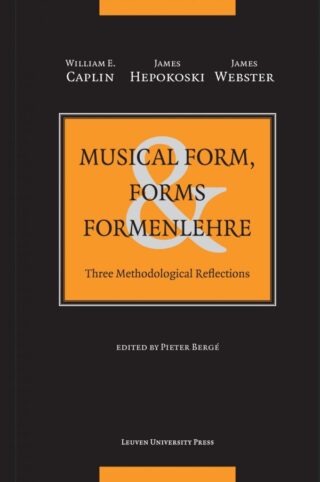
In ‘Musical Form, Forms & Formenlehre: Three Methodological Reflections’, three eminent music theorists consider the fundamentals of musical form. They discuss how to analyze form in music and question the relevance of analytical theories and methods in general. They illustrate their basic concepts and concerns by offering some concrete analyses of works by Mozart (Idomeneo Overture, Jupiter Symphony) and Beethoven (First Symphony, Pastoral Symphony, Egmont Overture, and Die Ruinen von Athen Overture). The volume is divided into three parts, focusing on Caplin’s “theory of formal functions,” Hepokoski’s concept of “dialogic form,” and Webster’s method of “multivalent analysis” respectively. Each part begins with an essay by one of the three authors. Subsequently, the two opposing authors comment on issues and analyses they consider to be problematic or underdeveloped, in a style that ranges from the gently critical to the overtly polemical. Finally, the author of the initial essay is given the opportunity to respond to the comments and to refine further his own fundamental ideas on musical form.
Preface, Ludwig Holtmeier
Prologue
Considering Musical Form, Forms and Formenlehre, Pieter Bergé
Part I. William E. Caplin & The Theory Of Formal Functions
What Are Formal Function, William E. Caplin
Comments on William E. Caplin’s Essay, “What Are Formal Functions?, James Hepokoski
Comments on William E. Caplin’s Essay, “What Are Formal Functions?”, James Webster
Response to the Comments, William E. Caplin
Part II. James Hepokoski & The Concept Of Dialogic Form
Sonata Theory and Dialogic Form, James Hepokoski
Comments on James Hepokoski’s Essay, “Sonata Theory and Dialogic Form”, William E. Caplin
Comments on James Hepokoski’s Essay “Sonata Theory and Dialogic Form”, James Webster
Response to the Comments, James Hepokoski
Part III. James Webster & The Concept Of Multivalent Analysis
Formenlehre in Theory and Practice, James Webster
Comments on James Webster’s Essay “Formenlehre in Theory and Practice”, William E. Caplin
Comments on James Webster’s Essay “Formenlehre in Theory and Practice”, James Hepokoski
Response to the Comments, James Webster
Epilogue
The Future of Formenlehre, Pieter Bergé
Bibliography
About the Authors
Besides its many other merits, 'Musical Form, Forms, and Formenlehre' demonstrates a novel format for cooperative engagement in music-theoretical writing. ... The result is a wonderfully rich and engaging book in which the personalities of the contributors are more evident than in most writing in our field.
Reviewed by Mitch Ohriner, Indiana Theory Review Volume 28
But perhaps the most captivating aspect of the book lies in the responses and rebuttals: each of the contributors was invited to venture comments on his collaborators' essays, and each in turn provides a short response to his colleague's comments. Thus, Hepokoski and Webster respond to Caplin's essay, and Caplin replies in turn, then Caplin and Webster to Hepokoski's, and forth. The exchanges are lively, and their result is to silhouette each analytical system against the others. For his having arranged to cast the book in this "dialogic form," students of the new American Formenlehre will long be in Bergé's debt.
Nathan John Martin, Columbia University, Notes, March 2011
I highly recommend this book on all accounts for the reader interested in formenlehre.
By Halvor Hosar (Norway), Amazon.com
Frequently Asked Questions
What is "Musical Form, Forms & Formenlehre" about?
In ‘Musical Form, Forms & Formenlehre: Three Methodological Reflections’, three eminent music theorists consider the fundamentals of musical form. They discuss how to analyze form in music and question the relevance of analytical theories and methods in general. They illustrate their basic concepts and concerns by offering some concrete analyses of works by Mozart (Idomeneo Overture, Jupiter Symphony) and Beethoven (First Symphony, Pastoral Symphony, Egmont Overture, and Die Ruinen von Athen Overture). The volume is divided into three parts, focusing on Caplin’s “theory of formal functions,” Hepokoski’s concept of “dialogic form,” and Webster’s method of “multivalent analysis” respectively. Each part begins with an essay by one of the three authors. Subsequently, the two opposing authors comment on issues and analyses they consider to be problematic or underdeveloped, in a style that ranges from the gently critical to the overtly polemical. Finally, the author of the initial essay is given the opportunity to respond to the comments and to refine further his own fundamental ideas on musical form.
Who edited "Musical Form, Forms & Formenlehre"?
"Musical Form, Forms & Formenlehre" was edited by Pieter Bergé.
Pieter Bergé is hoogleraar Musicologie aan de KU Leuven en artistiek directeur van Festival 20.21 Leuven. Zijn boeken, zowel wetenschappelijke als populariserende, werden herhaaldelijk bekroond.
Pieter Bergé is Professor of Music Analysis, History and Theory (1750-1900) at the KU Leuven. His main research topics are Arnold Schoenberg, German opera during the Weimar Republic, Formenlehre, instrumental music from 1770-1830, and 'analysis-and-performance'-issues.
Is "Musical Form, Forms & Formenlehre" part of a series?
Yes, "Musical Form, Forms & Formenlehre" is part of the "Studies in Musical Form" series.
What is the Table of Contents for "Musical Form, Forms & Formenlehre"?
Preface, Ludwig Holtmeier
Prologue
Considering Musical Form, Forms and Formenlehre, Pieter Bergé
Part I. William E. Caplin & The Theory Of Formal Functions
What Are Formal Function, William E. Caplin
Comments on William E. Caplin's Essay, “What Are Formal Functions?, James Hepokoski
Comments on William E. Caplin's Essay, “What Are Formal Functions?”, James Webster
Response to the Comments, William E. Caplin
Part II. James Hepokoski & The Concept Of Dialogic Form
Sonata Theory and Dialogic Form, James Hepokoski
Comments on James Hepokoski's Essay, “Sonata Theory and Dialogic Form”, William E. Caplin
Comments on James Hepokoski's Essay “Sonata Theory and Dialogic Form”, James Webster
Response to the Comments, James Hepokoski
Part III. James Webster & The Concept Of Multivalent Analysis
Formenlehre in Theory and Practice, James Webster
Comments on James Webster's Essay “Formenlehre in Theory and Practice”, William E. Caplin
Comments on James Webster's Essay “Formenlehre in Theory and Practice”, James Hepokoski
Response to the Comments, James Webster
Epilogue
The Future of Formenlehre, Pieter Bergé
Bibliography
About the Authors
Related titles
 Franz Schreker. Der Schmied von Gent
Pieter Bergé (Editor), Steven Vande Moortele (Author), Martijn Vincken (Author),
February 2027
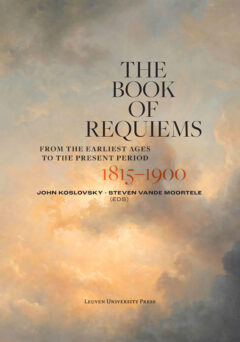 The Book of Requiems, 1815–1900
John Koslovsky (Editor), Steven Vande Moortele (Editor),
December 2026
 Music Theory and Analysis Volume 12 Issue 1, 2025 (Journal Subscription)
John Koslovsky (Editor), Markus Neuwirth (Editor), Derek Remeš (Editor),
May 2025
 Musiceren is topsport
Bert De Cuyper (Author), Griet Baert (Author), Linde Verjans (Author),
December 2021
 Theory into practice
Nicholas Cook (Author), Peter Johnson (Author), Hans Zender (Author),
October 2021