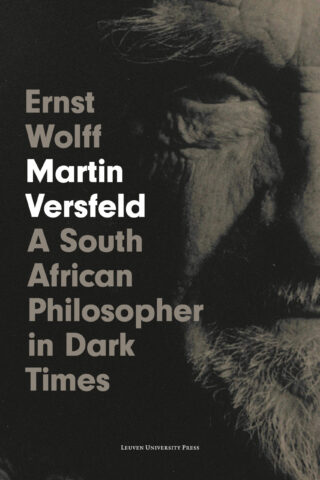

Martin Versfeld
A South African Philosopher in Dark Times
Ernst Wolff (Author),

Category: African Studies, Literature, Philosophy
Language: English
ISBN: 9789462702974
Publication date: September 17, 2021
€27.00 (including 6% VAT)
Buy NowNumber of pages: 224
Size: 234 x 156 x 12 mm

Funded by: KU Leuven Fund for Fair Open Access
Stock item: 143291
Standard delivery time for print books:
For Belgium: 5 to 8 working days
For EU: 2 to 3 weeks
For other countries: 4 to 5 weeks
Category: African Studies, Literature, Philosophy
Language: English
ISBN: 9789461664150
Publication date: October 15, 2021
Download Free EpubNumber of pages: 224
Funded by: KU Leuven Fund for Fair Open Access
Category: African Studies, Literature, Philosophy
Language: English
ISBN: 9789461664143
Publication date: September 7, 2021
Download Free PDFNumber of pages: 224
Funded by: KU Leuven Fund for Fair Open Access
First book-length study of one of the foremost South African philosophers
Martin Versfeld (1909–1995) is one of South Africa’s greatest philosophers, appreciated by academics and activists, poets and the broader public. His masterful prose spans the tension between disquiet and joy. Detractor of the violent trends of modernity, a critic of apartheid from the first hour, he was among the first philosophers of ecology. At the same time he celebrated the generosity of the world and advocated an ethics of simplicity, drawing on mediaeval theology and Eastern wisdom. His philosophy offered food for thought in dark times of the 20th century, as it still does for us in the 21st century.
This first book-length study on Versfeld is an invitation to think with him on justice and exploitation, cultural difference and human nature, religion and the environment, time and connectedness.
Ebook available in Open Access.
This publication is GPRC-labeled (Guaranteed Peer-Reviewed Content).
PREFACE – Between joy and disquiet: Philosophising in dark times
Major publications by Marthinus Versfeld
INTRODUCTIONS 1. “Fertilizer to the last” – Biographical snips(by Ruth Versfeld)
2. What was Versfeld doing when he was doing philosophy? 1. On the warts 2. From autobiography to enigma 3. Genre – Or, how to do things with words 4. Theology: A portrait of the philosopher as an odd fish 5. Polyphony of philosophy: Introductions, liberal translations, historical work 6. Apartheid and other empiresque behaviour 7. A note on celebration 8. On its most intimate lesson 9. Conclusion
STUDIES 3. Self-knowledge and practical reason in a time of political madness 1. Introduction: Self-knowledge in a period of political madness 2. “Gods” and “idols” 3. War, exploitation, racism. Critique of social and political violence 4. Urgency, time and incarnation 5. Unity and decay 6. The concept of unity – Or, a philosophy of incarnation 7. Reception and continuation
4. Versfeld and Nietzsche: Strange bedfellows(by Paul van Tongeren) 1. Introduction 2. Sounding out idols 3. Man, morality and metaphysics 4. Nihilism 5. Conclusion
5. Grasping the truth from where we are 1. Introduction: Flux, stability and where we are 2. Anthropology as first philosophy 3. Traditions and cultural criticism 4. Using a thorn to take out a thorn, and throwing both away 5. Questioning from where we are
6. Versfeld’s dialogue with Eastern thought(By J. S. Krüger) 1. Introduction 2. Groundbreaking early works 3. Midcareer 4. Mature thought 5. Conclusion
7. Poiesis – On the voice of poets, philosophers and other potters 1. On writing 2. Connectedness 3. Creativity, love, generosity 4. Poiesis 5. Silence
8. Reverberations(poems by Marlene van Niekerk and Antjie Krog)
CONCLUSIONS 9. Sanctus Marthinus laudator philosophicus – Or, sitting at the guru’s feet
10. What is living and what is dead of the philosophy of Martin Versfeld? – Or, the philosopher read by a vultur 1. Augustine: Ventriloquism or interpretation as independent thought? 2. Plurality 3. Something or nothing? 4. Close to the earth? 5. Land in Klip en klei – You said, “the obvious”? 6. Ecology: The logos on our common home 7. On subtle critique 8. Ambiguities of anthropology 9. The end
Bibliography
This two-part article explores South African philosopher Martin (Marthinus) Versfeld’s (1909–1995) interpretation (shown to belong within the discipline of the history of ideas) and application (indicated as modern-critical) of medieval philosophy during his uninterrupted career as a lecturer and professor of philosophy at the University of Cape Town (UCT) from 1937 to 1972. [...] This evaluation is the first of its kind in the developing Versfeld scholarship and takes place against the backdrop of a recent and extensive overview of Versfeld’s intellectual legacy and the first monograph on the Capetonian by Leuven philosopher Ernst Wolff (Martin Versfeld: A South African philosopher in dark times, 2021). Johann Beukes, litnet, 2022-10-27, Part
1 and Part
2
Frequently Asked Questions
What is "Martin Versfeld" about?
First book-length study of one of the foremost South African philosophers
Martin Versfeld (1909–1995) is one of South Africa’s greatest philosophers, appreciated by academics and activists, poets and the broader public. His masterful prose spans the tension between disquiet and joy. Detractor of the violent trends of modernity, a critic of apartheid from the first hour, he was among the first philosophers of ecology. At the same time he celebrated the generosity of the world and advocated an ethics of simplicity, drawing on mediaeval theology and Eastern wisdom. His philosophy offered food for thought in dark times of the 20th century, as it still does for us in the 21st century.
This first book-length study on Versfeld is an invitation to think with him on justice and exploitation, cultural difference and human nature, religion and the environment, time and connectedness.
Ebook available in Open Access.
This publication is GPRC-labeled (Guaranteed Peer-Reviewed Content).
Who wrote "Martin Versfeld"?
"Martin Versfeld" was written by Ernst Wolff, Ruth Versfeld, Paul Van Tongeren, Kobus Krüger, Marlene van Niekerk and Antjie Krog.
Ernst Wolff is professor at the Institute of Philosophy at the KU Leuven.
Ruth Versfeld works in teacher education and curriculum development in South Africa.
Paul van Tongeren is emeritus professor of philosophy at the Radboud University, Nijmegen.
Kobus Krüger is emeritus professor of science of religion at the University of South Africa.
Marlene van Niekerk, multiple award-winning novelist and poet, is professor of creative writing at the University of Stellenbosch.
Antjie Krog, multiple award-winning writer, poet and journalist, is a professor at the University of the Western Cape.
Is "Martin Versfeld" available Open Access?
Yes, "Martin Versfeld" is published Open Access. It is available under a BY-NC-ND license.
Who funded the publication of "Martin Versfeld"?
Publication of "Martin Versfeld" was funded by KU Leuven Fund for Fair Open Access
.
What is the Table of Contents for "Martin Versfeld"?
PREFACE – Between joy and disquiet: Philosophising in dark times
Major publications by Marthinus Versfeld
INTRODUCTIONS 1. “Fertilizer to the last” – Biographical snips(by Ruth Versfeld)
2. What was Versfeld doing when he was doing philosophy? 1. On the warts 2. From autobiography to enigma 3. Genre – Or, how to do things with words 4. Theology: A portrait of the philosopher as an odd fish 5. Polyphony of philosophy: Introductions, liberal translations, historical work 6. Apartheid and other empiresque behaviour 7. A note on celebration 8. On its most intimate lesson 9. Conclusion
STUDIES 3. Self-knowledge and practical reason in a time of political madness 1. Introduction: Self-knowledge in a period of political madness 2. “Gods” and “idols” 3. War, exploitation, racism. Critique of social and political violence 4. Urgency, time and incarnation 5. Unity and decay 6. The concept of unity – Or, a philosophy of incarnation 7. Reception and continuation
4. Versfeld and Nietzsche: Strange bedfellows(by Paul van Tongeren) 1. Introduction 2. Sounding out idols 3. Man, morality and metaphysics 4. Nihilism 5. Conclusion
5. Grasping the truth from where we are 1. Introduction: Flux, stability and where we are 2. Anthropology as first philosophy 3. Traditions and cultural criticism 4. Using a thorn to take out a thorn, and throwing both away 5. Questioning from where we are
6. Versfeld’s dialogue with Eastern thought(By J. S. Krüger) 1. Introduction 2. Groundbreaking early works 3. Midcareer 4. Mature thought 5. Conclusion
7. Poiesis – On the voice of poets, philosophers and other potters 1. On writing 2. Connectedness 3. Creativity, love, generosity 4. Poiesis 5. Silence
8. Reverberations(poems by Marlene van Niekerk and Antjie Krog)
CONCLUSIONS 9. Sanctus Marthinus laudator philosophicus – Or, sitting at the guru’s feet
10. What is living and what is dead of the philosophy of Martin Versfeld? – Or, the philosopher read by a vultur 1. Augustine: Ventriloquism or interpretation as independent thought? 2. Plurality 3. Something or nothing? 4. Close to the earth? 5. Land in Klip en klei – You said, “the obvious”? 6. Ecology: The logos on our common home 7. On subtle critique 8. Ambiguities of anthropology 9. The end
Bibliography
What is the DOI for "Martin Versfeld"?
The Digital Object Identifier (DOI) for "Martin Versfeld" is 10.11116/9789461664143.
Related titles
 Orality and Scribal Culture in the High Middle Ages
Timothy B. Noone (Author), Mark J. Clark (Author),
November 2026
 Feminists Resisting Gendered Violence
Hemangini Gupta (Editor), Fiona Mackay (Editor), Jan Breckenridge (Editor), Louise Chappell (Editor), Rachna Mehra (Editor), Rukmini Sen (Editor), Mailin Suchting (Editor),
October 2026
 A City in Practice
Aude Tournaye (Editor), Filip De Boeck (Editor), Picha Collective (Editor),
September 2026
 Summa (Quaestiones ordinariae) art. LXXIII – LXXV
Henry of Ghent (Author), Gordon Wilson (Editor), Juan Carlos Flores (Editor),
September 2026
 The Medieval Aristotle
Nena Bobovnik (Editor), Clelia V. Crialesi (Editor), Lisa Devriese (Editor),
August 2026
 Affect in Translation and Interpreting
Sofía Monzón (Editor), Lucie Spezzatti (Editor), Elisabeth Goemans (Editor),
May 2026
 Research Methods in Literary Reception Studies
Jeroen Dera (Editor), Anne Oerlemans (Editor), Frederik Van Dam (Editor),
May 2026
 Jean Katambayi Mukendi
Johannes Muselaers (Editor), Stéphane Symons (Editor), Anne-Claire Schmitz (Editor), Emma Enderby (Editor),
April 2026
 Comics and the Global South
Andrea Aramburú (Editor), Dibyadyuti Roy (Editor), Joe Sutliff Sanders (Editor),
February 2026
 Thomas Aquinas and Hervaeus Natalis on Concepts and Intentional Objects
Fabrizio Amerini (Author),
February 2026
 Situatedness and Performativity
Raquel Pacheco Aguilar (Editor), Marie-France Guénette (Editor),
November 2025
 Teaching About the Violent Past
Line Kuppens (Author), Justin Sheria Nfundiko (Author),
October 2025
 Transfer Thinking in Translation Studies
Maud Gonne (Editor), Klaartje Merrigan (Editor), Reine Meylaerts (Editor), Heleen van Gerwen (Editor),
September 2025