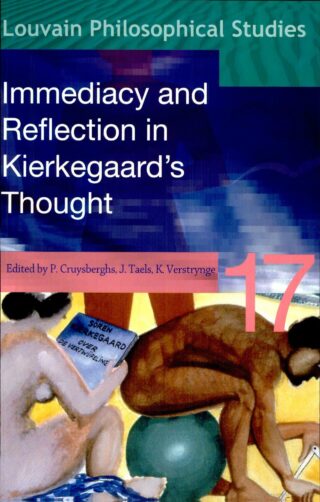
Immediacy and Reflection in Kierkegaard’s Thought
P. Cruysberghs (Author), J. Taels (Author),
Immediacy and Reflection in Kierkegaard’s Thought‘We live in a reflective age.’ That is Søren Kierkegaard’s overall conclusion when evaluating the time he lives in. But his appraisal contains both approval and criticism. On the one hand reflection is a necessary category to deal with the dynamics and the qualities of the modern age, on the other hand it bears a great danger. It is Kierkegaard’s firm conviction that reflection should always relate to a kind of immediacy that safeguards it from becoming hollow and detached from our existential reality. Throughout the voluminous and complex work of Kierkegaard, the notions of ‘immediacy’ and ‘reflection’ play a crucial role. They appear in such an early work as From the Papers of One Still Living as well as in the late Anti-Climacus writings, and indeed their significance or influence can be felt in all philosophical texts published in between. That is not to say that the meaning of the notions is unequivocal. After all, Kierkegaard not only uses the terms in very divergent contexts, but his own understanding of them appears to evolve quite strongly in the course of his oeuvre. Moreover, in spite of their clearly philosophical character, the two notions play an unmistakable role in Kierkegaard’s understanding of religion. They appear frequently in the religious discourses indeed. In short, Kierkegaard’s use of the notions of ‘immediacy’ and ‘reflection’ covers a broad array of meanings and interpretations. The dialectics of immediacy and reflection, of reflection killing immediacy and raising the question of the possibility of a new immediacy is the main theme of Immediacy and Reflection in Kierkegaard’s Thought. The book contains contributions authored by a number of well known Kierkegaard scholars. Kierkegaard’s theory of the ‘existence spheres of life’ provides a first viewpoint on the interplay of immediacy and reflection. Here the philosophical and pseudonymous writings are the main subject of research. If on the other hand one pays a closer look at the significance of a ‘second immediacy’ for a religious attitude to life, The religious discourses come into play when the possibility of a ‘second immediacy’ is taken into consideration. In conclusion the theme of immediacy and reflection is connected to some important trends in the modern and contemporary era. On the one hand it is linked to the philosophical influences Kierkegaard underwent (e.g. from Hegel); on the other hand Kierkegaard is confronted with later thinkers ( Heidegger in particular).
Introduction Must reflection be stopped? Can it be stopped? PAUL CRUYSBERGHS Veni, vidi, vinci: immediacy and reflection as gendered categories in Kierkegaard’s thought SYLVIA WALSH “The unhappiest one” – Merely an inscription? On the relationship between immediacy and language in the work of Kierkegaard DOROTHEA GLà–CKNER A more primitive thinking. Word and speech-act in Kierkegaard JOHAN TAELS Second immediacy. A Kierkegaardian account of faith HEIKO SCHULZ Mediated immediacy? The problem of a second immediacy ARNE GRà˜N Between reflection and the upbuilding: a pattern in Kierkegaard’s discourses ANDREW BURGESS Immediacy and reflection in Works of Love M. JAMIE FERREIRA Modulation: a typology of the present age HARVEY FERGUSON ‘Hysteria of the Spirit’. On melancholy in Kierkegaard KARL VERSTRYNGE Kierkegaard and the role of reflection in second immediacy MEROLD WESTPHAL Demons and demonic. Kierkegaard and Heidegger on anxiety and sexual difference RUDI VISKER Abbreviations Contributors
Frequently Asked Questions
What is "Immediacy and Reflection in Kierkegaard’s Thought" about?
Immediacy and Reflection in Kierkegaard's Thought‘We live in a reflective age.’ That is Søren Kierkegaard’s overall conclusion when evaluating the time he lives in. But his appraisal contains both approval and criticism. On the one hand reflection is a necessary category to deal with the dynamics and the qualities of the modern age, on the other hand it bears a great danger. It is Kierkegaard’s firm conviction that reflection should always relate to a kind of immediacy that safeguards it from becoming hollow and detached from our existential reality. Throughout the voluminous and complex work of Kierkegaard, the notions of ‘immediacy’ and ‘reflection’ play a crucial role. They appear in such an early work as From the Papers of One Still Living as well as in the late Anti-Climacus writings, and indeed their significance or influence can be felt in all philosophical texts published in between. That is not to say that the meaning of the notions is unequivocal. After all, Kierkegaard not only uses the terms in very divergent contexts, but his own understanding of them appears to evolve quite strongly in the course of his oeuvre. Moreover, in spite of their clearly philosophical character, the two notions play an unmistakable role in Kierkegaard’s understanding of religion. They appear frequently in the religious discourses indeed. In short, Kierkegaard’s use of the notions of ‘immediacy’ and ‘reflection’ covers a broad array of meanings and interpretations. The dialectics of immediacy and reflection, of reflection killing immediacy and raising the question of the possibility of a new immediacy is the main theme of Immediacy and Reflection in Kierkegaard’s Thought. The book contains contributions authored by a number of well known Kierkegaard scholars. Kierkegaard’s theory of the ‘existence spheres of life’ provides a first viewpoint on the interplay of immediacy and reflection. Here the philosophical and pseudonymous writings are the main subject of research. If on the other hand one pays a closer look at the significance of a ‘second immediacy’ for a religious attitude to life, The religious discourses come into play when the possibility of a ‘second immediacy’ is taken into consideration. In conclusion the theme of immediacy and reflection is connected to some important trends in the modern and contemporary era. On the one hand it is linked to the philosophical influences Kierkegaard underwent (e.g. from Hegel); on the other hand Kierkegaard is confronted with later thinkers ( Heidegger in particular).
Who wrote "Immediacy and Reflection in Kierkegaard’s Thought"?
"Immediacy and Reflection in Kierkegaard’s Thought" was written by P. Cruysberghs and J. Taels.
Is "Immediacy and Reflection in Kierkegaard’s Thought" part of a series?
Yes, "Immediacy and Reflection in Kierkegaard’s Thought" is part of the "Louvain Philosophical Studies" series. It's book 17 in the series.
What is the Table of Contents for "Immediacy and Reflection in Kierkegaard’s Thought"?
Introduction Must reflection be stopped? Can it be stopped? PAUL CRUYSBERGHS Veni, vidi, vinci: immediacy and reflection as gendered categories in Kierkegaard's thought SYLVIA WALSH "The unhappiest one" - Merely an inscription? On the relationship between immediacy and language in the work of Kierkegaard DOROTHEA GLà–CKNER A more primitive thinking. Word and speech-act in Kierkegaard JOHAN TAELS Second immediacy. A Kierkegaardian account of faith HEIKO SCHULZ Mediated immediacy? The problem of a second immediacy ARNE GRà˜N Between reflection and the upbuilding: a pattern in Kierkegaard's discourses ANDREW BURGESS Immediacy and reflection in Works of Love M. JAMIE FERREIRA Modulation: a typology of the present age HARVEY FERGUSON 'Hysteria of the Spirit'. On melancholy in Kierkegaard KARL VERSTRYNGE Kierkegaard and the role of reflection in second immediacy MEROLD WESTPHAL Demons and demonic. Kierkegaard and Heidegger on anxiety and sexual difference RUDI VISKER Abbreviations Contributors
Related titles
 Orality and Scribal Culture in the High Middle Ages
Timothy B. Noone (Author), Mark J. Clark (Author),
November 2026
 Summa (Quaestiones ordinariae) art. LXXIII – LXXV
Henry of Ghent (Author), Gordon Wilson (Editor), Juan Carlos Flores (Editor),
September 2026
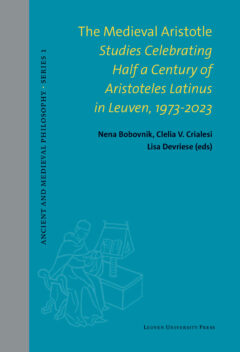 The Medieval Aristotle
Nena Bobovnik (Editor), Clelia V. Crialesi (Editor), Lisa Devriese (Editor),
August 2026

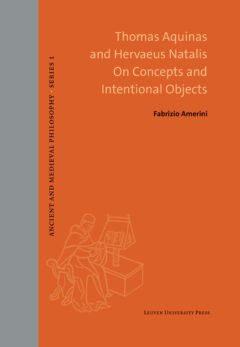 Thomas Aquinas and Hervaeus Natalis on Concepts and Intentional Objects
Fabrizio Amerini (Author),
February 2026
 Epicureanism and Scientific Debates. Epicurean Tradition and its Ancient Reception
Francesca Masi (Editor), Pierre-Marie Morel (Editor), Francesco Verde (Editor),
January 2025

 Quaestiones de divinis praedicamentis XXVIII-XXXII
James of Viterbo (Author), Mark D. Gossiaux (Editor), Christopher D. Schabel (Editor),
June 2024
 Summa (Quaestiones ordinariae) art. LXIII-LXVII
Henry of Ghent (Author), Gordon Wilson (Editor), Girard Etzkorn (Editor), Bernd Goehring (Editor), Linda N. Etzkorn (Assisted by),
February 2024
 Epicureanism and Scientific Debates. Antiquity and Late Reception
Francesca Masi (Editor), Pierre-Marie Morel (Editor), Francesco Verde (Editor),
August 2023
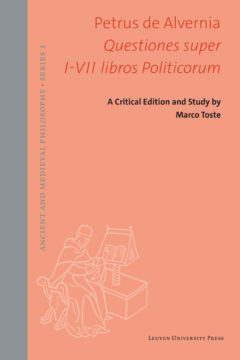 Questiones super I-VII libros Politicorum
Peter of Auvergne (Author), Marco Toste (Editor),
December 2022