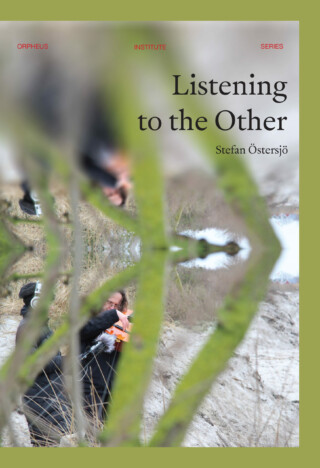
Listening to the Other
Stefan Östersjö (Author),
Series: Orpheus Institute Series
Category: Artistic Practice, Music
Language: English
ISBN: 9789462702295
Publication date: July 1, 2020
€22.50 (including 6% VAT)
Buy NowNumber of pages: 184
Size: 285 x 195 x 15 mm

Stock item: 135745
Standard delivery time for print books:
For Belgium: 5 to 8 working days
For EU: 2 to 3 weeks
For other countries: 4 to 5 weeks
Series: Orpheus Institute Series
Category: Artistic Practice, Music
Language: English
ISBN: 9789461663290
Publication date: July 1, 2020
€34.00 (including 6% VAT)
Buy NowNumber of pages: 184
New modes of listening and methods for contemporary sound art practices
Our contemporary, globalised society demands new forms of listening. But what are these new forms? In Listening to the Other, Stefan Östersjö challenges conventional understandings of the ways musicians listen. He develops a transmodal understanding of listening that is situated in the body—a body that is extended by its mediation through musical instruments and other technologies. Listening habits can turn these tools—and even the body itself—into resistant objects or musical Others. Supported by extensive multimedia documentation and drawing on examples from the author’s own artistic projects spanning electronics, intercultural collaboration, and ecological sound art, this volume enables musicians to learn how to approach musical Others through alternative modes of listening and allows readers to discover artistic methods for intercultural collaboration and ecological sound art practices.
This book is closely linked to a series of cutting-edge artistic works, including a triple concerto recorded with the Seattle Symphony and several video works with ecological sound art. It represents the analytical outcomes of artistic research projects carried out in Sweden, the UK, and Belgium between 2009 and 2015.
This publication is GPRC-labeled (Guaranteed Peer-Reviewed Content).
List of Media Files in the Online Repository
Chapter 1 Situated Listening
Chapter 2 The Question of the Listening Subject: Ecological Perspectives on Sound, Perception, and Musical Performance
Chapter 3 Embodied Interactions in Instrumental Space
Chapter 4 Finding a Shared Voice in Intercultural Collaboration
Chapter 5 Being-in-the-Presence-of the River: Embodied Listening and Eco-Systemic Sound Art
Chapter 6 Thinking-through-Listening
References About the Author Index
"I highly recommend 'Listening to the Other' to anyone who enjoys exploring new ways of thinking. Östersjö’s conversational writing style makes it feel like you’re sitting right alongside him on the riverbed, listening intently to his theories, as he adjusts the strings on the floating guitar, immersing us completely in his world."
Kris Rodriguez, Resonance (2020) 1 (3): 328–331, https://doi.org/10.1525/res.2020.1.3.328
These compelling case studies are put into conversation with an impressive range of theoretical perspectives from musicology, postcolonial theory, sound studies, acoustic ecology, and the work of other artists (such as the Japanese artist Akio Suzuki, whom Östersjö interviews in the book’s audiovisual materials). Clearly, Listening to the Other advances studies of musical performance and distributed creativity. Yet it also contributes to theories of listening based in cognitive science and philosophy. Throughout, Östersjö’s thinking engages 4E cognitive science, according to which cognition is embodied, embedded, enactive, and extended. Here the book might be understood to describe instances of “cognition in the wild,” as in cognitive anthropology. Östersjö also responds to philosophers such as Jean-Luc Nancy and Emmanuel Levinas, and his case studies provide phenomenological insights about situated listening and (inter)subjectivity. Finally (and importantly), this book about musical practice has a practical aim, proposing an ecological, postcolonial ethics of listening. Insofar as listening involves relations with Others, it is already social and political, and Östersjö wishes to bring this aspect of listening to light, to put it to work. “Through musical practices and sound art,” he writes, “we must seek a thinking-through-listening that counters the dominant and anthropocentric powers of present-day politics. Listening to the Other then becomes an act of resistance” (p. 166). Jonathan De Souza, Musicae Scientiae, January 2021, https://doi.org/10.1177/1029864920983965
'Listening to the Other' is both innovative and rigorous as an account of how listening shapes the creative process within particular kinds of collaboration, and its methods will surely prove generative for those attempting similar analyses in a wide range of musical contexts.
Sam Mackay (2021): Listening, difference and the shackles of language, Sound Studies, https://doi.org/10.1080/20551940.2021.1907913
Frequently Asked Questions
What is "Listening to the Other" about?
New modes of listening and methods for contemporary sound art practices
Our contemporary, globalised society demands new forms of listening. But what are these new forms? In Listening to the Other, Stefan Östersjö challenges conventional understandings of the ways musicians listen. He develops a transmodal understanding of listening that is situated in the body—a body that is extended by its mediation through musical instruments and other technologies. Listening habits can turn these tools—and even the body itself—into resistant objects or musical Others. Supported by extensive multimedia documentation and drawing on examples from the author’s own artistic projects spanning electronics, intercultural collaboration, and ecological sound art, this volume enables musicians to learn how to approach musical Others through alternative modes of listening and allows readers to discover artistic methods for intercultural collaboration and ecological sound art practices.
This book is closely linked to a series of cutting-edge artistic works, including a triple concerto recorded with the Seattle Symphony and several video works with ecological sound art. It represents the analytical outcomes of artistic research projects carried out in Sweden, the UK, and Belgium between 2009 and 2015.
This publication is GPRC-labeled (Guaranteed Peer-Reviewed Content).
Who wrote "Listening to the Other"?
"Listening to the Other" was written by Stefan Östersjö.
Stefan Östersjö is chaired professor of Musical Performance at Luleå University of Technology, Piteå School of Music, and associate researcher at the Orpheus Institute.
Is "Listening to the Other" part of a series?
Yes, "Listening to the Other" is part of the "Orpheus Institute Series" series.

Throughout the Orpheus Institute’s various activities there is a clear focus on the development of a new research discipline in the arts, one that addresses questions and topics that are at the heart of musical practice, building on the unique expertise and perspectives of musicians and in constant dialogue with more established research disciplines.
Within this context, the Orpheus Institute launched an international Research Centre in 2007 that acts as a stable constituent within an ever-growing field of enquiry. The Orpheus Research Centre is a place where musical artists can fruitfully conduct individual and collaborative research on issues that are of concern to all involved in artistic practice. It is important that at the centre of the international Orpheus Institute network is a place, a building, a community. As the concepts and methodologies of artistic research in music have evolved, work at Orpheus Institute has found new structures. Since 2012, research has been consolidated into a number of groups focused on specific areas, each led by a principal investigator of substantial international reputation as a practicing musician. The work of Orpheus Institute is disseminated through events, publications and musical performances, and through its active animation of discussion within the sector.
This series of peer-reviewed publications —launched in 2013— encompasses monographs by Research Fellows and associates of the Orpheus Institute, compilations of lectures, texts, and performances from seminars and study days, and edited volumes on topics arising from work at the institute. Research can be presented in digital media as well as printed texts. As a whole, the series is meant to enhance and advance discourse in the field of artistic research in music and to generate future work in this emerging and vital area of study.

Editorial board
William Brooks (Chair, Series Editor), Peter Dejans, Jonathan Impett, Kathleen Coessens, Paulo de Assis, Heike Vermeire, Ed Crooks, Laura Cull, Aurelie Daems
Proposals
Proposals and enquiries can be sent to the series editor William Brooks.
Please make use of the submission form to present your manuscript or proposal to our board.
Authors interested in Open Access can consult the available funding options.
Links & Resources
What is the Table of Contents for "Listening to the Other"?
List of Media Files in the Online Repository
Chapter 1 Situated Listening
Chapter 2 The Question of the Listening Subject: Ecological Perspectives on Sound, Perception, and Musical Performance
Chapter 3 Embodied Interactions in Instrumental Space
Chapter 4 Finding a Shared Voice in Intercultural Collaboration
Chapter 5 Being-in-the-Presence-of the River: Embodied Listening and Eco-Systemic Sound Art
Chapter 6 Thinking-through-Listening
References About the Author Index
Related titles
 Collective Trauma and Future Fantasies
Raika Khorshidian (Editor), Birgit Mersmann (Editor), Cathrine Bublatzky (Editor), Julia Stenzel (Editor),
November 2026

 The Book of Requiems, 1815–1900
John Koslovsky (Editor), Steven Vande Moortele (Editor),
November 2026



 Violence and Trauma in Contemporary Performance
Sofie de Smet (Editor), Marieke Breyne (Editor), Pedzisai Maedza (Editor), Christel Stalpaert (Editor),
May 2025
 Music Theory and Analysis Volume 12 Issue 1, 2025 (Journal Subscription)
John Koslovsky (Editor), Markus Neuwirth (Editor), Derek Remeš (Editor),
May 2025