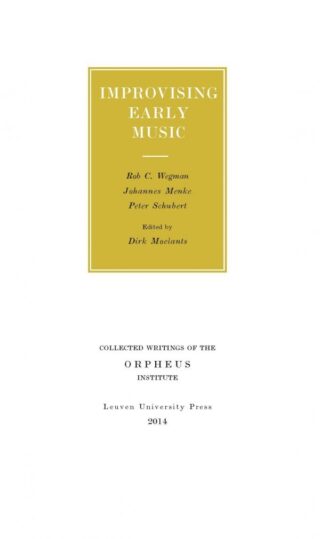
The history of musical improvisation from the late Middle Ages to the early Baroque
Studying improvised music is always a challenge, due to its volatility and unpredictability. But what about studying musical improvisation from before the age of sound recordings? In this book three experts give their view on aspects of musical improvisation in the late medieval, renaissance, and early baroque periods. Historical sources show us how improvisation was an integral part of music education and how closely improvisation and composition were linked. This gives new insights into the way music was played in its original historical context and a new way to look at written scores from the past.
Improvising Early Music will appeal to anyone interested in the historical background of our written musical heritage, and to musicians who want to gain a deeper insight in the way this music was created.
This publication is GPRC-labeled (Guaranteed Peer-Reviewed Content).
Contributors
Johannes Menke (Schola Cantorum Basiliensis, Basel), Peter Schubert (Schulich School of Music, McGill University, Montreal), Rob C. Wegman (Princeton University)
Preface
— Rob C. Wegman What is counterpoint?
— Johannes Menke “Ex centro” improvisation – Sketches for a theory of sound progressions in the early baroque
— Peter Schubert From improvisation to composition: three 16th century case studies
Personalia
Colophon
It is a fascinating, well-edited volume, and according to its editor, it “shows us through historical sources how improvisation was an integral part of music education and how closely improvisation and composition were linked”. [...] On the whole, Improvising Early Music is a thought-provoking publication. All three contributions encouraged me actively to engage with the subject of improvised counterpoint, and Wegman's contribution in particular made me rethink some of the issues that I deal with as a part of my own work.
Alon Schab, Fontes artis musicae, 2016, v.63, no.2
This book is the most valuable introduction to the topic of musical improvisation available now. Even a lay reader can at least get a good sense of the phenomenon of improvisation and of the scholarly approaches to it, though a full understanding of the essays requires knowledge of music and a familiarity with the repertory.
Giovanni Zanovello, Indiana University, Renaissance Quarterly, Volume 69, Number 3, Fall 2016
Frequently Asked Questions
What is "Improvising Early Music" about?
The history of musical improvisation from the late Middle Ages to the early Baroque
Studying improvised music is always a challenge, due to its volatility and unpredictability. But what about studying musical improvisation from before the age of sound recordings? In this book three experts give their view on aspects of musical improvisation in the late medieval, renaissance, and early baroque periods. Historical sources show us how improvisation was an integral part of music education and how closely improvisation and composition were linked. This gives new insights into the way music was played in its original historical context and a new way to look at written scores from the past.
Improvising Early Music will appeal to anyone interested in the historical background of our written musical heritage, and to musicians who want to gain a deeper insight in the way this music was created.
This publication is GPRC-labeled (Guaranteed Peer-Reviewed Content).
Contributors
Johannes Menke (Schola Cantorum Basiliensis, Basel), Peter Schubert (Schulich School of Music, McGill University, Montreal), Rob C. Wegman (Princeton University)
Who wrote "Improvising Early Music"?
"Improvising Early Music" was written by Rob C. Wegman, Johannes Menke and Peter Schubert.
Who edited "Improvising Early Music"?
"Improvising Early Music" was edited by Dirk Moelants.
Dirk Moelants is a viola da gamba player and musicologist working as a Lecturer at the University of Amsterdam and as guest Professor at Ghent University.
Is "Improvising Early Music" part of a series?
Yes, "Improvising Early Music" is part of the "Geschriften van het Orpheus Instituut/Collected Writings of the Orpheus Institute" series. It's book 11 in the series.
In association with

The publications in the series "Collected Writings of the Orpheus Institute" contain musical testimonies and music-theoretical reflections with a strong emphasis on musical practice.
Editorial Board
Peter Dejans, Luk Vaes
What is the Table of Contents for "Improvising Early Music"?
Preface
— Rob C. Wegman What is counterpoint?
— Johannes Menke “Ex centro” improvisation - Sketches for a theory of sound progressions in the early baroque
— Peter Schubert From improvisation to composition: three 16th century case studies
Personalia
Colophon
Related titles
 Franz Schreker. Der Schmied von Gent
Pieter Bergé (Editor), Steven Vande Moortele (Author), Martijn Vincken (Author),
February 2027
 The Book of Requiems, 1815–1900
John Koslovsky (Editor), Steven Vande Moortele (Editor),
December 2026
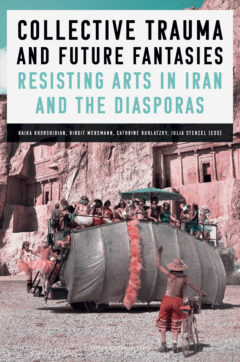 Collective Trauma and Future Fantasies
Raika Khorshidian (Editor), Birgit Mersmann (Editor), Cathrine Bublatzky (Editor), Julia Stenzel (Editor),
November 2026

 Violence and Trauma in Contemporary Performance
Sofie de Smet (Editor), Marieke Breyne (Editor), Pedzisai Maedza (Editor), Christel Stalpaert (Editor),
May 2025
 Music Theory and Analysis Volume 12 Issue 1, 2025 (Journal Subscription)
John Koslovsky (Editor), Markus Neuwirth (Editor), Derek Remeš (Editor),
May 2025