Blog
Nena Vandeweerdt | Women and Work through a Comparative Lens
24th October, 2025 in Author’s corner

Nena Vandeweerdt is a postdoctoral researcher who studies gendered socioeconomic interactions in late medieval and early modern towns. She holds a PhD in History from the KU Leuven and the University of Cantabria. Her work focuses on urban labor markets, everyday life, and the use of digital humanities in historical research.
Women worked. Whether they were formally excluded or not, they found ways to earn a living—because they had to. This may be a familiar point within medieval and early modern gender studies, but it remains an essential one.
Women played a crucial role in medieval and early modern urban economies, yet their labor opportunities varied greatly depending on local institutions. In Women and Work through a Comparative Lens, author Nena Vandeweerdt offers a multifaceted understanding of women’s economic roles in premodern Europe. “I quickly became fascinated—some might say obsessed—with the roles women played in the economy”, she admits.
Briefly and concisely explain in plain language what the book is about.
This book compares the work of women in Biscay (Spain) and Brabant (present-day Belgium) during the fifteenth and sixteenth centuries. Across premodern Europe, women were active in small-scale trade—selling everyday goods such as food, candles, and second-hand items.
Although patriarchal institutions often limited their economic opportunities, most women had to work to support themselves and their families. The types of work they performed, the limitations they faced, and the ways they navigated restrictions varied significantly from city to city.
By comparing women’s labor in small-scale trade in the urban economies of Bilbao (Biscay) and Antwerp and Malines (Brabant), the book offers a deeper understanding of how local contexts shaped women’s roles in the premodern urban economy.
What or who inspired you to choose this topic?
I first stumbled upon the topic of women’s work in 2014, during my Master’s in History at the University of Leuven (Belgium). I quickly became fascinated—some might say obsessed—with the roles women played in the economy and the central place of craft guilds in regulating their work. I still remember the “Eureka” moment when I first found traces of what would become my initial case study: women active in the fifteenth-century Leuven meat trade. That fascination did not end with my thesis. When the opportunity arose to write a PhD project proposal, I jumped at it. I saw it as a chance to finally resolve one of the field’s long-standing historiographical debates—or so I thought.
I designed the project around a North–South comparison, hoping to demonstrate once and for all the similarities and differences in women’s economic positions across Northern and Southern Europe. An empirical comparison of this kind had not been attempted before, and I believed it could shed new light on questions historians had long asked about regional variation in women’s work.
Of course, reality soon set in. Historiographical debates endure for good reason, and one comparative study can’t settle all questions about women’s economic opportunities across the whole of premodern Europe. But by then, my somewhat naïve enthusiasm had already propelled me deep into a project that has continued to motivate me—and that, all these years later, has led to this book.
In what way do you think your book can shape future research in your research field?
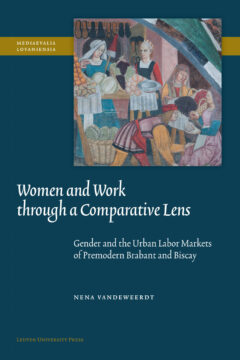
To answer this, you don’t need to look further than the book cover: Women and Work through a Comparative Lens. The title says it all. Since the 1980s, scholars have emphasized the need for comparative research, yet the comparative method is not without challenges—as the book explains in detail. These methodological obstacles have discouraged many researchers from undertaking broad geographical comparisons.
This is precisely where the book contributes new perspectives to the field of medieval and early modern gender studies. By comparing two very distinct regions, it offers a fresh take on the dominant narratives around North–South comparisons. Instead of ranking regions based on which economic activities women could or could not perform, the book shifts the focus to long-standing debates—those discussing women’s access to guilds, informal labor, or legal agency—that have often remained confined to regional case studies.
By opening up the dialogue between different historiographical traditions and showing how comparative work can be both feasible and fruitful, I hope the book encourages scholars to look beyond regional boundaries when interpreting women’s economic roles in the past.
What is your favorite part of the book and why?
Chapter 4 focuses on the—often indirect—testimonies of women’s own words and actions regarding their labor activities. These kinds of sources are rare when studying women’s work, especially among the social classes involved in small-scale trade.
Throughout the book, I examine the many restrictions women faced—from urban governments, craft guilds, and patriarchal structures more broadly. The first three chapters look at how women’s work was organized and constrained in Bilbao, Antwerp, and Malines, primarily from a structural perspective. On a collective level, women themselves had little say in how that structure was shaped. Chapter 4 shifts the focus and tries to rebalance the narrative, giving center stage to the very women whose labor is the subject of the book. The urban world was not simply a male domain into which women awkwardly fit. By highlighting women’s voices and actions, I aim to correct that image—without denying the very real limits placed on them.
What I find especially compelling is the contrast between the cities. In Bilbao, we see women filing petitions, attempting to change regulations, influencing the town council, and—even if unsuccessfully—taking lengthy legal paths to defend their interests. In Antwerp and Malines, women’s voices are mostly absent from the records, but when they do appear, it is through surprisingly effective legal and institutional strategies.
This contrast underscores the complexity of regional comparisons. It could raise the question: What is better? Having limited but relatively stable opportunities, or broader possibilities in a more volatile system where rights can be revoked and no protective mechanisms exist? This dilemma touches on a major pitfall in earlier North–South historiography. Ranking systems as “better” or “worse” may be tempting, but ultimately it oversimplifies the historical realities. Chapter 4 resists that simplicity. Instead, it offers a more layered and nuanced understanding of how labor markets were gendered in the past.
Of course, my enthusiasm for Chapter 4 might come from all of that … But it might also just be that the court records are full of gossip, violence, and illegal trade, which makes them an irresistible read.
How did the writing process for this book go? Did you experience anything surprising, amusing or striking?
This book began its life as a PhD dissertation. After the defense—and a much-needed break during which I focused on other professional opportunities—I returned to the manuscript in January 2024 to prepare it for publication. Coming back to the dissertation with some distance, and after having built a solid theoretical foundation in science communication, helped me see it with fresh eyes. That’s when I quickly realized that the original structure no longer worked. It wasn’t sufficient to make a strong contribution to the field in book form.
Still, I believed in the results and the core argument. So I locked myself in the house for two days, armed with my storyboard, a mountain of sticky notes, and the old dissertation as my only companion. I treated it like a jigsaw puzzle—shuffling chapters, reorganizing themes, and searching for the most logical and engaging structure for the book.
That chaotic, visual process turned out to be surprisingly fruitful. It led to the structure the book has today—one I’m particularly happy with, because it allows the research results and arguments to come through and be followed more easily.
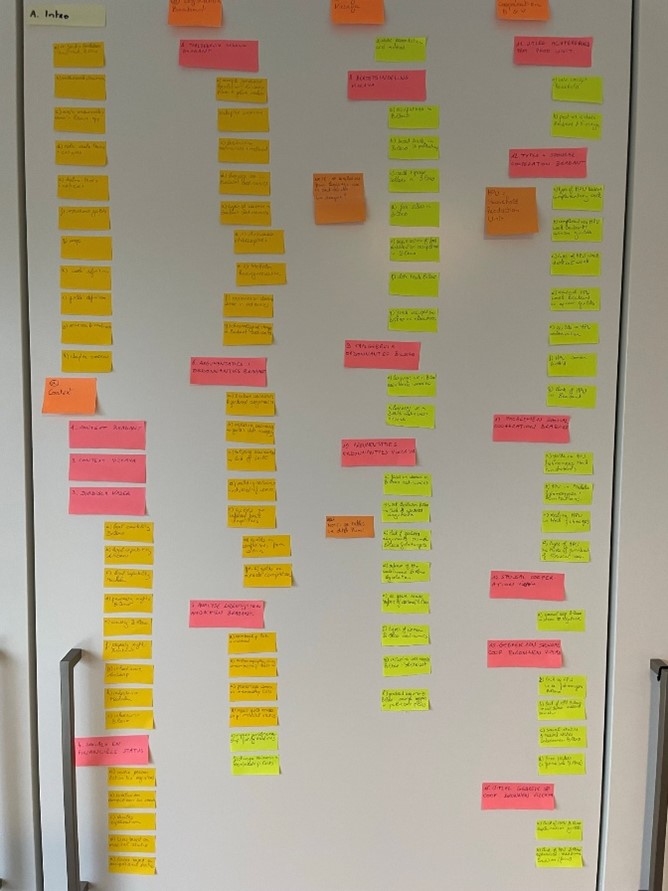
One of the three cabinet doors I used to create the book’s structure
What was the most challenging step in the entire creation process of your book?
I struggled for a long time with the first chapter, and it took quite a while to fully let go of the original dissertation text for that part. The difficulty with a comparative approach like mine is that readers often know something about one case or the other—but rarely about both. That made it essential to provide a strong introduction to the labor markets of both the Biscayan and Brabantine case studies, and to explain women’s positions within them, in order to make the rest of the book accessible.
The challenge was finding the right balance: deciding which background information was necessary for readers to follow the arguments in the later chapters, while not overwhelming them with historical context. At the same time, the chapter also had to begin developing my own analysis and framing. Getting all of that to work together in a single opening chapter was a slow and sometimes frustrating process.
What would have been good advice before you started this book project?
Over the course of the past eight years, the development of this research project has certainly faced its share of obstacles—but then again, hasn’t every project? One thing I’m particularly grateful for is the freedom I was given to experiment—and to fail, if necessary.
Not every avenue led to the results I had hoped for—often, as any historian knows, because the source material turned out to be more limited than expected. But I had the space to try out different qualitative and quantitative methods, and I learned a great deal from those experiments, even when they didn’t always produce clear outcomes.
This is my first book, and I’ve come to believe that the freedom to experiment and occasionally fail is essential for early-career researchers. Unfortunately, that freedom is increasingly under threat due to limited funding, tight project timelines, and growing pressure to deliver measurable success at every stage.
So, while no one gave me this advice explicitly, I think eight-years-ago me was allowed to learn it along the way: challenges will come—and that’s normal. Whether you overcome all of them or only some, you’ll still move forward. And that’s enough.
What would you like readers to remember about your book?
This might not be surprising—nor very different from anyone else who has spent eight years on a single topic—but I hope readers come away with the central conclusion of the book.
In short: my comparative study reveals how institutional organization shaped women’s economic activities and affected their individual experiences. The case studies highlight two very different urban contexts. In Antwerp and Malines, labor was largely organized by socioeconomic institutions—namely craft guilds—and reinforced at the individual level through the household as an economic unit. In contrast, Bilbao’s urban economy was more informally structured, with the town government playing a more direct role in regulating the labor force.
This institutional difference had a profound impact on what women could and could not do—and on what they still tried to do, often operating at the margins of the urban economy to make ends meet.
If all that is too much to remember, then I’d be happy if readers walk away with one simple message: women worked. Whether they were formally excluded or not, they found ways to earn a living—because they had to. This may be a familiar point within medieval and early modern gender studies, but it remains an essential one.
If you could travel through time, where would you want to go to talk about your research/book?
For this question, all the honor goes to the women discussed in my book. If I could travel “anyhow, anywhere, anytime” (in the words of my musical namesake), I’d head straight to the fish market in Bilbao in 1527. There, I might run into many familiar names from the sources—but most of all, I’d seek out Mayora de Iturribalzaga.
Readers of the book will encounter her in almost all chapters, already starting in the opening paragraph. Mayora was a fishmonger who, in the 1520s and 1530s, was involved in a lengthy court case against the Bilbao town council, challenging labor regulations that limited her ability to work. The town ordinances, some scattered source fragments, and—most notably—her legal case provide a fascinating glimpse into the lives and economic strategies of female fishmongers. While she may not be as iconic as the Irish (though possibly fictious) fishwife Molly Malone, she represents a similar group of working women in Bilbao’s sixteenth-century fish trade.
My book owes many pages to the records left behind because of Mayora’s work and litigation. Yet I’m still left with many unanswered questions: Who was she, really? Why did she work? Why did she choose to litigate? Who was in her network? What was her personal life like—especially her relationship with her husband who is strikingly absent from the court documents? Sources on women’s work rarely come from the women themselves, and if I could observe my book’s content from their perspective, through their lived experience, that would be the most valuable insight of all.
Your book is published open access. How did the open access publication process go? What makes open access so attractive for you/your book?
Publishing this book open access was one of my top priorities from the very beginning. Academia shouldn’t be an impenetrable bastion of knowledge—too complex or too expensive to reach the wider public. On the contrary, I believe it should be everyone’s right to access the knowledge that researchers dedicate themselves to producing. Curiosity should be encouraged—not gated behind paywalls.
That’s why I didn’t just choose open access; I also made a conscious effort to write in an accessible style. While this book is certainly an academic work, and avoids simplistic black-and-white narratives, I’ve aimed to present the analyses and arguments in a clear and readable way.
Anyone interested in these histories should be able to read the book—not just in the sense of downloading it freely, but also in terms of actually following and understanding its arguments. That’s the kind of openness I hope to create: both in form and in content.
Do you have any plans yet for another publication? What will it be about?
Not immediately. But ever since writing the dissertation, I’ve remained especially drawn to the case of the fishmongers—particularly those in Malines. Currently, I’m leading a collaboration with the Malines city archives to make the elusive aldermen registers more accessible, using handwritten text recognition (HTR) powered by AI model training.
So far, it has been an incredibly smooth and rewarding collaboration, especially thanks to the dedication of the archive’s volunteer team. The goal is to unlock a corpus of legal and socioeconomic records that has long been difficult to access—one that offers rare insights into the everyday network and transactions of ordinary urban residents, including the fishmongers
If all goes well, this project will not only result in a searchable dataset, but also lay the groundwork for a new publication focused on the lived experiences of Malines’ late medieval and early modern fishmongers.