

Blog
Hemangini Gupta & Fiona Mackay | Feminists Resisting Gendered Violence
2nd October, 2026 in Author’s corner
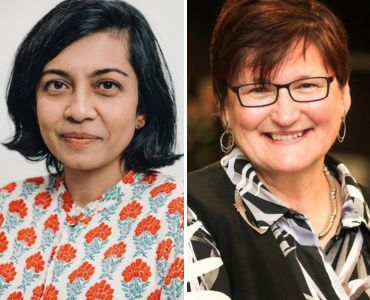
Hemangini Gupta is Senior Lecturer in Gender and Global Politics at the University of Edinburgh. Fiona Mackay is Professor Emerita of Politics and founding director of the interdisciplinary hub, GENDER.ED, at the University of Edinburgh.
The subject of gendered violence is undoubtedly difficult and at times bleak, but we want readers to draw hope, inspiration and energy for action.
How do feminists respond to gendered violence in a changing world? Feminists Resisting Gendered Violence brings together artists, activists, scholars, and community organisers to explore creative and collective forms of resistance. Through essays, artworks, testimonies, and reflections, the volume sheds light on both visible and overlooked forms of violence. A Q&A with the editors.
Briefly and concisely explain in plain language what the book is about.
This book asks: how have feminists addressed gendered violence? As a form of violence that’s both spectacular and hyper visible, as well as ubiquitous, normalized and routine, it presents many challenges. For more than fifty years, feminist movements, locally and transnationally, have broken the silence and stigma surrounding gendered violence. They have honoured and amplified the voices of victim/survivors, and provided shelter, care and support. Over the long haul they have raised awareness and demanded change. Action has taken many forms: some feminists have felt the need to visibilize, calibrate, and account for violence within institutional processes so that policy and law can respond to the scale and nuance of these forms of violence. For other feminists, the law is a site of violence itself; they ask how else might we imagine justice? Feminists have turned to art, installation, poetry, music, and film to respond to gendered violence, to recognize and name it across historical periods, and to address trauma and harm. Feminist scholars have also asked critical and probing questions about how we frame the object of violence, recognizing that issues like “consent” and “victim” tend to naturalize some assumptions and subjects over others.
These are tricky questions and they are at the heart of a six-year Blogathon project (2018-23) that was run collaboratively between the University of New South Wales, Ambedkar University, Delhi and the University of Edinburgh. This anthology presents a curated sample of those blogs to showcase the range and critical depth of transnational thinking on violence. In it, you’ll encounter movements for justice, artistic and creative responses, scholarly thinking, activists making ‘good trouble’, and feminist re-imaginings of what justice might look like.
What or who inspired you to choose this topic?
We were inspired to launch the original blogathon by the generations of feminist action against gendered violence as exemplified by the global campaign 16 Days of Action, which runs each year between November 25th (the international day for the elimination of violence against women) to December 10th (Human Rights Day). After six years, more than 140 posts, and readers from over 100 countries, we wanted to curate a capstone or legacy anthology. We felt that the richness of the collection of essays and images deserved a more permanent platform through which to be shared with as wide an audience as possible.
Learn more about the 16 Days of Activism against Gender-Based Violence campaign >
Did the book turn out the way you imagined it? In what way(s) did it or did it not?
The book is so much more meaningful and beautiful than we could have imagined. As we have each been reading through the proofs, we notice the striking range of essays. For example, you might read a piece on the need to correctly “account” for violence, and another documenting a long-term feminist action project against street sexual violence, and then a third about a refugee artist reflecting on her historic relationship to violence, fleeing a war-torn country, and her journey towards healing. Writers wear many hats, academic-poets, activist-artists, survivor-researchers and so on. Rather than take one stand or approach to gendered violence, as curators we have taken an ecumenical approach, seeking to include a diversity of views. So, the reader will encounter policy makers, feminists in government, artists, activists, academics… they might hold divergent and even conflicting approaches to how best to tackle gendered violence but this generative tension is what makes the book so powerful!
What social impact do you think the book can have, or would you like it to have?
This is a chilling moment when political contestation around gendered violence is rolling back rights and protections around the world. We – and our co-curators in Australia and India – want the collection to contribute to the ongoing campaign as exemplified by the global 16 Days of Action to keep the issue of gendered violence in view, and to assist in feminist efforts to challenge, resist and demand action. The book helps us to understand the local complexity of gendered violence, and to reflect critically on why there might need to be context-relevant and historically sensitive approaches to naming and addressing gendered violence. Finally, it highlights the importance of feminist collaboration across borders.
In what way do you think your book can shape future research in your research field?
The book already takes forward three important strands of feminist thought that are not always brought together and advances them in new directions. First, it takes on the debates around how we name violence. When have people used Gender Based Violence (GBV) and why do some feminists now insist on the term gendered violence? We take up that question by addressing how violence comes to occur through local and everyday mechanisms. Second, we take up the challenge that Saidiya Hartman posed when she asked how we might talk about violence without repeating its force. We approach violence by showing it, but also thinking about the reparative and healing work that might emerge in its wake. Finally, we ask how we might be feminists working within institutions that are often colonial, patriarchal, and violent themselves. Anna Bull’s piece speaks to the theme of “slow activism” and we take this up through essays that reflect on decades’ long movements around domestic shelters, and on campus student activism.
What is your favourite part of the book and why?
We have so many favourite parts! We wanted to bring the blogathon’s strong emphasis on the visual into the book. We could spend hours looking at the many powerful images in the collection, such as the Blue Dress series by South African artist Judith Mason that accompanies Eliza Garney’s essay on art as an alternative record of the gendered violence of apartheid, Nilima Sheikh’s haunting triptych “Carrying Home” that sits alongside Urvashi Butalia’s recounting of the hidden histories of Partition; or the Peruvian arpilleras that illustrate Lydia Cole’s “Textile Testimonies” as well as grace the cover of this book.
We have taken a ‘long view’ of gendered violence. Contributions deal with not only the present and recent past but also the long haul of time; weaving history, memory, and traditional stories and songs throughout the book. These include thought-provoking examples by Scottish musician Karine Polwart and Indian academic Garima Singh who surface gendered violence and resistance in traditional folk songs. Many of the essays, although rooted in a particular location, resonate widely, for example the essay by Indian academics challenging the colonial and patriarchal harms of the law, UK academics’ call to rethink the ‘public story’ of domestic abuse to better reflect the realities of lesbians, gay men, bisexual women and men, trans and non-binary people, and lessons learned from the histories of the Australian women’s movement.
What was the most challenging step in the entire creation process of your book?
The book was selected from a six-year international collaboration and we had some tough choices to make: what should we include, what should we leave out. We would have liked to include them all! Ultimately, we made our selection based on the themes we wanted readers to encounter.
What would you like readers to remember about your book?
We would want them to keep re-reading and re-visiting the book. We all have some favourite books that we never tire of re-reading because there is something fresh to discover about an essay to return to or a photograph or painting: maybe because we want to teach it or use it in some other writing or even just to linger over it a bit. The subject matter is undoubtedly difficult and at times bleak but we want readers also to draw hope, inspiration and energy for action. We draw on the words of contributing artist Masa Hilicisn, whose first-person account of the healing practices of art we find so inspiring: “In Darkness We Find Light”.
Your book will be made open access within three years of publication thanks to Path to Open. What makes open access so attractive for you/your book?
The single most important thing about writing a book is for it to find readers and there is no better way to do this than through Open Access. We are so hopeful that people will come across it and be compelled by it to stay on and read some more.
Related Publications
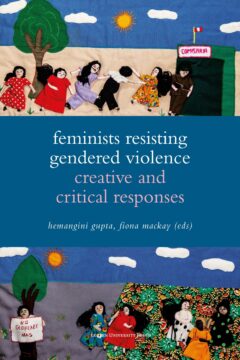 Feminists Resisting Gendered Violence
Hemangini Gupta (Editor), Fiona Mackay (Editor), Jan Breckenridge (Editor), Louise Chappell (Editor), Rachna Mehra (Editor), Rukmini Sen (Editor), Mailin Suchting (Editor),
October 2026