Blog
Henrik von Achen | Cross, Crown and Crusade
30th September, 2026 in Author’s corner
Henrik von Achen is Professor Emeritus of Art History at the University of Bergen. (Photo by Eivind Senneset)
Even seemingly straightforward medieval narratives are filled with meaning on various levels.
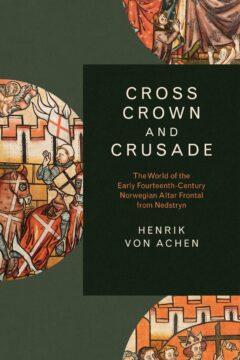
The altar frontal from Nedstryn in Western Norway is a unique medieval artwork and the only known panel painting in Europe to depict an extensive version of the legend of Heraclius and the True Cross. In Cross, Crown and Crusade, Henrik von Achen discusses its origins, meaning, and audience, shedding light on the visual and literary traditions that shaped this remarkable artwork around 1300. Read our Q&A with the author to learn more about the book and the research behind it.
Briefly and concisely explain in plain language what the book is about.
The book discusses the altar frontal from Nedstryn as a medieval panel painting, how it was conceived, produced, and understood. Why was the story of Heraclius and the True Cross chosen, and what literary and visual sources were relevant? How could its audience understand the message it conveyed based on their experience of liturgy and secular literature? What role did the ideas of Christian kingship, knightly virtues, and crusading as both a military and spiritual endeavour, supported by the Holy Cross against all enemies, play? In short, how can we understand why this iconography was chosen, what layers of meaning it conveyed, and how the world around this altar decoration made its message accessible and understandable to its medieval audience?
What or who inspired you to choose this topic?
Being the keeper of the University Museum’s collection of church art for 25 years, this medieval panel painting always interested me, not least because of the layers of meaning embedded in such a straightforward narrative. Furthermore, I was interested in its immediate context and the audience it was meant to address.
Did the book turn out the way you imagined it? In what way(s) did it or did it not?
It did; I believe that it contributes to explaining the frontal and the depth of meaning of this particular narrative. I was always more interested in iconology than iconography, particularly since this iconography is already fairly well known. I also believe that its discussion of the production of such a painting may be helpful when dealing with other medieval altar frontals.
What social impact do you think the book can have, or would you like it to have?
It may be helpful to students and scholars approaching similar works of art, but also in understanding how a medieval audience was able to grasp the deeper meaning of seemingly straightforward narratives.
In what way do you think your book can shape future research in your research field?
I believe that the book may influence other scholars of medieval visual art in their understanding of the basic conditions that underpin any investigation.
What is your favourite part of the book and why?
The inclusion of secular literature on the one hand and the liturgical experience on the other in the frame of reference of the medieval audience, but also the discussion of the production of such a work. The first contributes to a better understanding of its selection and interpretation; the second to a better understanding of the conditions of production and their implications for assessing any medieval altar decoration.
How did the writing process for this book go? Did you experience anything surprising, amusing or striking?
It went smoothly, benefitting from the amount of material now digitized and therefore easily accessible. Unfortunately, the British Library in London was hacked in October 2023, and its digitized collection was inaccessible for a long time.
What would you like readers to remember about your book?
Simply how even seemingly straightforward medieval narratives are filled with meaning on various levels, and also how such a work of art would have been made.
Do you have any plans yet for another publication? What will it be about?
My next project deals with how museums in Norway organized their activities in the early nineteenth century (1810-1850) to collect church art. I would also like to organize my material on the function of the human heart in the visual arts of the seventeenth century and write the story of the religious medal.