The soul-body problem was among the most controversial issues discussed in 13th century Europe, and it continues to capture much attention today as the quest to understand human identity becomes more and more urgent. What made the discussion about this problem particularly interesting in the scholastic period was the tension between the traditional dualist doctrines and a growing need to affirm the unity of the human being. This debate is frequently interpreted as a conflict between the ‘new’ philosophy, conveyed by the rediscovered works of Aristotle and his followers, and doctrinal requirements, especially the belief in the soul’s immortality. However, a thorough examination of Parisian texts, written between approximately 1150 and 1260, leads us to conclusions which may seem surprising. In this book, the study and edition of some little-known texts of Hugh of St-Cher and his contemporaries reveals an extremely rich and colourful picture of the Parisian anthropological debate of the time. This book also offers an opportunity to reconsider some received views concerning medieval philosophy, such as the conviction that the notion of ‘person’ did not play any major role in the anthropological controversies. The study covers a wide range of authors, from Gilbert of Poitiers to Thomas Aquinas, and it is partly based on previously unedited material, published for the first time in the Appendix.
Acknowledgements
Introduction
Part One
Towards the unity of the Human Being
1.1 Accidental union of the soul with the body and unibilitas substantialis of the human soul
1.1.1 The accidental union of the soul with the body
1.1.1.1 Avicenna and early Avicennianism
1.1.1.2 Philip the Chancellor’s Summa de bono
1.1.2 The unibilitas substantialis of the human soul: Hugh of St-Cher and his contemporaries
1.1.2.1 William of Auxerre
1.1.2.2 Hugh of St-Cher’s question De anima
1.1.2.3 Roland of Cremona
1.1.2.4 William of Auvergne
1.1.3 Unibilitas substantialis after Hugh of St-Cher
1.1.3.1 John of La Rochelle
1.1.3.2 Albert the Great
1.1.3.3 Bonaventure
1.1.3.4 Thomas Aquinas
1.2 The human soul and the concept of person
1.2.1 “The human soul is not a person”. The Sentences Commentary of Hugh of St-Cher
1.2.2 Evolution of expressions
1.2.2.1 Gilbert of Poitiers
1.2.2.2 Pseudo-Peter of Poitiers and Simon of Tournai
1.2.2.3 Alan of Lille
1.2.2.4 Stephen Langton
1.2.2.5 William of Auxerre
1.2.2.6 Hugh of St-Cher
1.2.3 “The separated soul is not a person”. Controversies and misunderstandings
1.2.3.1 From the question of universals to the individuality of the soul: Gilbert of Poitiers
1.2.3.2 Simon of Tournai
1.2.3.3 From logic to psychology: Alan of Lille
1.2.3.4 Stephen Langton
1.2.3.5 William of Auxerre
1.2.3.6 Hugh of St-Cher
1.2.3.7 Alexander of Hales
1.2.3.8 Philip the Chancellor
1.2.3.9 From the Summa Halesiana to Thomas Aquinas’s Scriptum in Sententias
Part Two
Between Soul and Body: the Powers of the Soul
Introduction
2.1 The Rational Powers: the Soul as Image of the Trinity
2.1.1 Two Traditions, Two Types of Powers
2.1.2 The identity of the soul with its powers
2.1.2.1 The Augustinian and Pseudo-Augustinian heritage
2.1.2.2 William of Auxerre
2.1.2.3 Hugh of St-Cher
2.1.2.4 An anonymous question (ms. Douai 434, n. 115)
2.1.2.5 Philip the Chancellor and Alexander of Hales
2.1.2.6 Peter of Bar
2.2 The Sensitive and Vegetative Powers
2.2.1 The Union per medium
2.2.1.1 Philip the Chancellor
2.2.1.2 Sources of the doctrine of intermediaries
2.2.1.3 Hugh of St-Cher
2.2.2 The Survival of the Sensitive and Vegetative Powers
2.2.2.1 Hugh of St-Cher
2.2.2.2 Avicenna and Dominicus Gundissalinus
2.2.2.3 Quaestiones antequam esset frater
2.2.2.4 Peter of Bar
2.2.2.5 William of Auvergne
2.3 The Problem of Memory
2.3.1 Two traditions, two types of memory
2.3.2 Philip the Chancellor
2.3.3 The Summa Duacensis
2.3.4 The disputed questions of Peter of Bar
2.3.5 The Gloss of Alexander of Hales
2.3.6 John of La Rochelle
2.3.7 William of Auvergne’s De anima: memory, the immortality of the soul and the resurrection
Conclusion
Appendix : Text Editions
Introduction
(A) The disputed questions (Douai 434)
(B) Hugh of St-Cher’s Sentences Commentary (I, 3)
(C) Abbreviations
Texts
(A) Hugo de Sancto Caro
(B) Hugo de Sancto Caro
(C)
(D) Anonimi Si anima est sue potentie
(E) Petrus de Barro De hiis que ex parte anime manebunt
(F) Anonimi
Bibliography
(A) Journals and Series
(B) Manuscripts
(C) Edited Sources
(D) Studies
Indices
Frequently Asked Questions
What is "The Soul-Body Problem at Paris ca 1200-1250" about?
The soul-body problem was among the most controversial issues discussed in 13th century Europe, and it continues to capture much attention today as the quest to understand human identity becomes more and more urgent. What made the discussion about this problem particularly interesting in the scholastic period was the tension between the traditional dualist doctrines and a growing need to affirm the unity of the human being. This debate is frequently interpreted as a conflict between the ‘new' philosophy, conveyed by the rediscovered works of Aristotle and his followers, and doctrinal requirements, especially the belief in the soul's immortality. However, a thorough examination of Parisian texts, written between approximately 1150 and 1260, leads us to conclusions which may seem surprising. In this book, the study and edition of some little-known texts of Hugh of St-Cher and his contemporaries reveals an extremely rich and colourful picture of the Parisian anthropological debate of the time. This book also offers an opportunity to reconsider some received views concerning medieval philosophy, such as the conviction that the notion of ‘person' did not play any major role in the anthropological controversies. The study covers a wide range of authors, from Gilbert of Poitiers to Thomas Aquinas, and it is partly based on previously unedited material, published for the first time in the Appendix.
Who wrote "The Soul-Body Problem at Paris ca 1200-1250"?
"The Soul-Body Problem at Paris ca 1200-1250" was written by Magdalena Bieniak.
Magdalena Bieniak holds a PhD in Philosophy (University of Padua and University of Paris IV - Sorbonne). She holds a research fellowship at the Department of Philosophy of the University of Padua and is affiliated with the University of Warsaw.
Who translated "The Soul-Body Problem at Paris ca 1200-1250"?
"The Soul-Body Problem at Paris ca 1200-1250" was translated by Raffaella Roncarati.
Is "The Soul-Body Problem at Paris ca 1200-1250" part of a series?
Yes, "The Soul-Body Problem at Paris ca 1200-1250" is part of the "Ancient and Medieval Philosophy - Series 1" series. It's book 42 in the series.
Ancient and Medieval Philosophy - Series 1 presents state-of-the-art research on the history of Western thought from its origins to the beginnings of modernity.
In association with The De Wulf-Mansion Centre.


About the Series
The series' focus lies primarily on the continuity and thematic transitions between ancient, medieval and renaissance thought, but also includes volumes on specific topics related to any of those periods. ‘Philosophy' is understood broadly to include metaphysics, ethics, natural philosophy, epistemology and philosophy of mind, and philosophical theology. Since the series is particularly devoted to making available Latin and Greek source texts, we welcome critical text editions as well as contributions that are based on philological scrutiny of those texts, without losing sight of their philosophical importance.
Ancient and Medieval Philosophy - Series 1 aims to publish at least two volumes a year and accepts monographs as well as thematically coherent edited volumes in English (without excluding the possibility of French, German, or Italian contributions to edited volumes). Manuscripts should be 80.000 to 120.000 words in length.
Readership
Researchers and graduate students in ancient, medieval and renaissance philosophy, in classics and in history.
Editorial Coordinator
Russell Friedman, KU Leuven, Belgium
Editorial Board
Pieter Beullens, KU Leuven, Belgium
Lisa Devriese, KU Leuven, Belgium
Pieter d'Hoine, KU Leuven, Belgium
Jan Opsomer, KU Leuven, Belgium
Jenny Pelletier, KU Leuven, Belgium
Andrea Robiglio, KU Leuven, Belgium
Carlos Steel, KU Leuven, Belgium
Gerd Van Riel, KU Leuven, Belgium
Advisory Board
Brad Inwood, Yale Universityo, USA
Jill Kraye, The Warburg Institute, London, United Kingdom
John Marenbon, University of Cambridge, United Kingdom
Lodi Nauta, University of Groningen, The Netherlands
Timothy Noone (†) , The Catholic University of America, USA
Robert Pasnau, University of Colorado at Boulder, USA
Martin Pickavé, University of Toronto, Canada,
Pasquale Porro, Università degli Studi di Milano, Italy
Geert Roskam, KU Leuven, Belgium
Proposals
Proposals and enquiries can be sent to editorial coordinator Russell L. Friedman. Please send a preliminary abstract (3-4 pp.) and a short bio. Upon approval of this abstract, the full manuscript will be submitted to international peer review.
Please make use of the submission form to present the full manuscript to our board.
Authors interested in Open Access can consult the available funding options.
Links & Resources
What is the Table of Contents for "The Soul-Body Problem at Paris ca 1200-1250"?
Acknowledgements
Introduction
Part One
Towards the unity of the Human Being
1.1 Accidental union of the soul with the body and unibilitas substantialis of the human soul
1.1.1 The accidental union of the soul with the body
1.1.1.1 Avicenna and early Avicennianism
1.1.1.2 Philip the Chancellor's Summa de bono
1.1.2 The unibilitas substantialis of the human soul: Hugh of St-Cher and his contemporaries
1.1.2.1 William of Auxerre
1.1.2.2 Hugh of St-Cher's question De anima
1.1.2.3 Roland of Cremona
1.1.2.4 William of Auvergne
1.1.3 Unibilitas substantialis after Hugh of St-Cher
1.1.3.1 John of La Rochelle
1.1.3.2 Albert the Great
1.1.3.3 Bonaventure
1.1.3.4 Thomas Aquinas
1.2 The human soul and the concept of person
1.2.1 "The human soul is not a person". The Sentences Commentary of Hugh of St-Cher
1.2.2 Evolution of expressions
1.2.2.1 Gilbert of Poitiers
1.2.2.2 Pseudo-Peter of Poitiers and Simon of Tournai
1.2.2.3 Alan of Lille
1.2.2.4 Stephen Langton
1.2.2.5 William of Auxerre
1.2.2.6 Hugh of St-Cher
1.2.3 "The separated soul is not a person". Controversies and misunderstandings
1.2.3.1 From the question of universals to the individuality of the soul: Gilbert of Poitiers
1.2.3.2 Simon of Tournai
1.2.3.3 From logic to psychology: Alan of Lille
1.2.3.4 Stephen Langton
1.2.3.5 William of Auxerre
1.2.3.6 Hugh of St-Cher
1.2.3.7 Alexander of Hales
1.2.3.8 Philip the Chancellor
1.2.3.9 From the Summa Halesiana to Thomas Aquinas's Scriptum in Sententias
Part Two
Between Soul and Body: the Powers of the Soul
Introduction
2.1 The Rational Powers: the Soul as Image of the Trinity
2.1.1 Two Traditions, Two Types of Powers
2.1.2 The identity of the soul with its powers
2.1.2.1 The Augustinian and Pseudo-Augustinian heritage
2.1.2.2 William of Auxerre
2.1.2.3 Hugh of St-Cher
2.1.2.4 An anonymous question (ms. Douai 434, n. 115)
2.1.2.5 Philip the Chancellor and Alexander of Hales
2.1.2.6 Peter of Bar
2.2 The Sensitive and Vegetative Powers
2.2.1 The Union per medium
2.2.1.1 Philip the Chancellor
2.2.1.2 Sources of the doctrine of intermediaries
2.2.1.3 Hugh of St-Cher
2.2.2 The Survival of the Sensitive and Vegetative Powers
2.2.2.1 Hugh of St-Cher
2.2.2.2 Avicenna and Dominicus Gundissalinus
2.2.2.3 Quaestiones antequam esset frater
2.2.2.4 Peter of Bar
2.2.2.5 William of Auvergne
2.3 The Problem of Memory
2.3.1 Two traditions, two types of memory
2.3.2 Philip the Chancellor
2.3.3 The Summa Duacensis
2.3.4 The disputed questions of Peter of Bar
2.3.5 The Gloss of Alexander of Hales
2.3.6 John of La Rochelle
2.3.7 William of Auvergne's De anima: memory, the immortality of the soul and the resurrection
Conclusion
Appendix : Text Editions
Introduction
(A) The disputed questions (Douai 434)
(B) Hugh of St-Cher's Sentences Commentary (I, 3)
(C) Abbreviations
Texts
(A) Hugo de Sancto Caro
(B) Hugo de Sancto Caro
(C)
(D) Anonimi Si anima est sue potentie
(E) Petrus de Barro De hiis que ex parte anime manebunt
(F) Anonimi
Bibliography
(A) Journals and Series
(B) Manuscripts
(C) Edited Sources
(D) Studies
Indices
Related titles
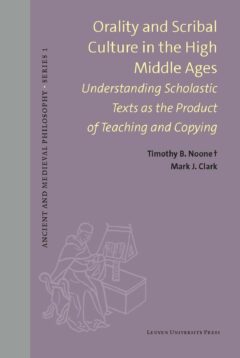 Orality and Scribal Culture in the High Middle Ages
Timothy B. Noone (Author), Mark J. Clark (Author),
November 2026
 Summa (Quaestiones ordinariae) art. LXXIII – LXXV
Henry of Ghent (Author), Gordon Wilson (Editor), Juan Carlos Flores (Editor),
September 2026
 The Medieval Aristotle
Nena Bobovnik (Editor), Clelia V. Crialesi (Editor), Lisa Devriese (Editor),
August 2026

 Thomas Aquinas and Hervaeus Natalis on Concepts and Intentional Objects
Fabrizio Amerini (Author),
February 2026
 Epicureanism and Scientific Debates. Epicurean Tradition and its Ancient Reception
Francesca Masi (Editor), Pierre-Marie Morel (Editor), Francesco Verde (Editor),
January 2025

 Quaestiones de divinis praedicamentis XXVIII-XXXII
James of Viterbo (Author), Mark D. Gossiaux (Editor), Christopher D. Schabel (Editor),
June 2024
 Summa (Quaestiones ordinariae) art. LXIII-LXVII
Henry of Ghent (Author), Gordon Wilson (Editor), Girard Etzkorn (Editor), Bernd Goehring (Editor), Linda N. Etzkorn (Assisted by),
February 2024
 Epicureanism and Scientific Debates. Antiquity and Late Reception
Francesca Masi (Editor), Pierre-Marie Morel (Editor), Francesco Verde (Editor),
August 2023
 Questiones super I-VII libros Politicorum
Peter of Auvergne (Author), Marco Toste (Editor),
December 2022