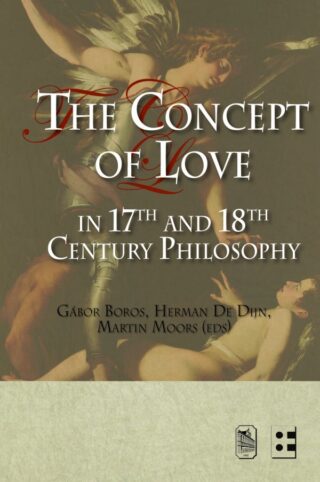
The Concept of Love in 17th and 18th Century Philosophy
Gábor Boros (Editor), Herman De Dijn (Editor), Martin Moors (Editor),
“Love is joy with the accompanying idea of an external cause.” Spinoza’s definition of love (Ethics Book 3, Prop. LIX) manifests a major paradigm shift achieved by seventeenth century Europe in which the emotions, formerly seen as normative “forces of nature,” were embraced by the new science of the mind. We are determined to volition by causes. This shift has often been seen as a transition from a philosophy laden with implicit values and assumptions to a more scientific and value-free way of understanding human action. But is this rational approach really value-free? Today we incline to believe that values are inescapable, and that the descriptive-mechanical method implies its own set of values. Yet the assertion by Spinoza, Malebranche, Leibniz, and Enlightenment thinkers that love guides us to wisdom—and even that the love of a God who creates and maintains order and harmony in the world forms the core of ethical behaviour—still resonates powerfully with us. It is, evidently, an idea we are unwilling to relinquish. This collection of insightful essays emerged from two “ContactFora” organized within the framework of the research project Actuality of the Enlightenment: The Moral Science of Emotions, conducted under the auspices of Koninklijke Vlaamse Academie van Belgie voor Wetenschappen en Kunsten. It offers a range of important and fascinating perspectives on how the triumph of “reason” affected not only our scientific-philosophical understanding of the emotions and especially of love, but our everyday understanding as well.
Introduction
G. Boros, H. De Dijn, M. Moors
Cartesian Subjectivity and Love
Denis Kambouchner
The Role of Amicitia in Political Life
Susan James
L’apparition de l’amour de soi dans l’Éthique
Chantal Jaquet
Spinoza über Liebe und Erkenntnis
Wolfgang Bartuschat
Leibniz on Love
Gábor Boros
Malebranche on Natural and Free Loves
Tad Schmaltz
The Problem of Conscience and Order in the Amour-pur Debate
Dániel Schmal
Love of God and Love of Creatures: The Masham-Astell Exchange
Catherine Wilson
The Theory and Regulation of Love in 17th Century Philosophy
Catherine Wilson
Frances Hutcheson: From Moral Sense to Spectatorial Rights
Aaron Garrett
Philosophy as medicina mentis? Hume and Spinoza on Emotions and Wisdom
Willem Lemmens
The Depth of the Heart -; “even if a bit tumultuous”. On Compassion and Erotic Love in Diderot’s Ethics
Miklós Vassányi
Motivational Internalism: A Kantian Perpective on Moral Motives and Reasons
Heiner Klemme
Kant on: “Love God above all, and your Neighbour as yourself”
Martin Moors
Frequently Asked Questions
What is "The Concept of Love in 17th and 18th Century Philosophy" about?
“Love is joy with the accompanying idea of an external cause.” Spinoza’s definition of love (Ethics Book 3, Prop. LIX) manifests a major paradigm shift achieved by seventeenth century Europe in which the emotions, formerly seen as normative “forces of nature,” were embraced by the new science of the mind. We are determined to volition by causes. This shift has often been seen as a transition from a philosophy laden with implicit values and assumptions to a more scientific and value-free way of understanding human action. But is this rational approach really value-free? Today we incline to believe that values are inescapable, and that the descriptive-mechanical method implies its own set of values. Yet the assertion by Spinoza, Malebranche, Leibniz, and Enlightenment thinkers that love guides us to wisdom—and even that the love of a God who creates and maintains order and harmony in the world forms the core of ethical behaviour—still resonates powerfully with us. It is, evidently, an idea we are unwilling to relinquish. This collection of insightful essays emerged from two “ContactFora” organized within the framework of the research project Actuality of the Enlightenment: The Moral Science of Emotions, conducted under the auspices of Koninklijke Vlaamse Academie van Belgie voor Wetenschappen en Kunsten. It offers a range of important and fascinating perspectives on how the triumph of “reason” affected not only our scientific-philosophical understanding of the emotions and especially of love, but our everyday understanding as well.
Who edited "The Concept of Love in 17th and 18th Century Philosophy"?
"The Concept of Love in 17th and 18th Century Philosophy" was edited by Gábor Boros, Herman De Dijn and Martin Moors.
Gábor Boros is Professor of Philosophy at the Institute of Philosophy of the Faculty of Arts of Lorand Eotvos University Budapest.
Herman De Dijn is Emeritus Professor of Philosophy at the Institute of Philosophy, KU Leuven.
Martin Moors is Professor of Metaphysics and Philosophy of Religion and Head of the Department of Metaphysics and Modern Philosophy at the Institute of Philosophy at KU Leuven.
What is the Table of Contents for "The Concept of Love in 17th and 18th Century Philosophy"?
Introduction
G. Boros, H. De Dijn, M. Moors
Cartesian Subjectivity and Love
Denis Kambouchner
The Role of Amicitia in Political Life
Susan James
L'apparition de l'amour de soi dans l'Éthique
Chantal Jaquet
Spinoza über Liebe und Erkenntnis
Wolfgang Bartuschat
Leibniz on Love
Gábor Boros
Malebranche on Natural and Free Loves
Tad Schmaltz
The Problem of Conscience and Order in the Amour-pur Debate
Dániel Schmal
Love of God and Love of Creatures: The Masham-Astell Exchange
Catherine Wilson
The Theory and Regulation of Love in 17th Century Philosophy
Catherine Wilson
Frances Hutcheson: From Moral Sense to Spectatorial Rights
Aaron Garrett
Philosophy as medicina mentis? Hume and Spinoza on Emotions and Wisdom
Willem Lemmens
The Depth of the Heart -; “even if a bit tumultuous”. On Compassion and Erotic Love in Diderot's Ethics
Miklós Vassányi
Motivational Internalism: A Kantian Perpective on Moral Motives and Reasons
Heiner Klemme
Kant on: “Love God above all, and your Neighbour as yourself”
Martin Moors
What is the DOI for "The Concept of Love in 17th and 18th Century Philosophy"?
The Digital Object Identifier (DOI) for "The Concept of Love in 17th and 18th Century Philosophy" is 10.11116/9789461660183.
Related titles
 Orality and Scribal Culture in the High Middle Ages
Timothy B. Noone (Author), Mark J. Clark (Author),
November 2026
 Summa (Quaestiones ordinariae) art. LXXIII – LXXV
Henry of Ghent (Author), Gordon Wilson (Editor), Juan Carlos Flores (Editor),
September 2026
 The Medieval Aristotle
Nena Bobovnik (Editor), Clelia V. Crialesi (Editor), Lisa Devriese (Editor),
August 2026

 Thomas Aquinas and Hervaeus Natalis on Concepts and Intentional Objects
Fabrizio Amerini (Author),
February 2026
 Epicureanism and Scientific Debates. Epicurean Tradition and its Ancient Reception
Francesca Masi (Editor), Pierre-Marie Morel (Editor), Francesco Verde (Editor),
January 2025

 Quaestiones de divinis praedicamentis XXVIII-XXXII
James of Viterbo (Author), Mark D. Gossiaux (Editor), Christopher D. Schabel (Editor),
June 2024
 Summa (Quaestiones ordinariae) art. LXIII-LXVII
Henry of Ghent (Author), Gordon Wilson (Editor), Girard Etzkorn (Editor), Bernd Goehring (Editor), Linda N. Etzkorn (Assisted by),
February 2024

 Epicureanism and Scientific Debates. Antiquity and Late Reception
Francesca Masi (Editor), Pierre-Marie Morel (Editor), Francesco Verde (Editor),
August 2023
 Questiones super I-VII libros Politicorum
Peter of Auvergne (Author), Marco Toste (Editor),
December 2022