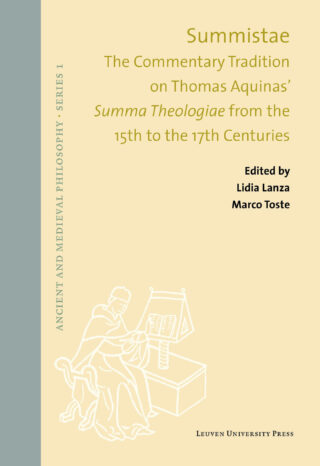
Summistae
The Commentary Tradition on Thomas Aquinas’ Summa Theologiae from the 15th to the 17th Centuries
Lidia Lanza (Editor), Marco Toste (Editor),
Series: Ancient and Medieval Philosophy - Series 1 58
Category: Philosophy
Language: English
ISBN: 9789462702622
Publication date: March 10, 2021
€120.00 (including 6% VAT)
Buy NowNumber of pages: 456
Size: 234 x 156 x 26 mm

Stock item: 140766
Standard delivery time for print books:
For Belgium: 5 to 8 working days
For EU: 2 to 3 weeks
For other countries: 4 to 5 weeks
Series: Ancient and Medieval Philosophy - Series 1 58
Category: Philosophy
Language: English
ISBN: 9789461663702
Publication date: March 10, 2021
€90.00 (including 6% VAT)
Buy NowNumber of pages: 456
The importance of the Summa theologiae on late scholasticism
Thomas Aquinas’ Summa theologiae is one of the classics in the history of theology and philosophy. Beyond its influence in the Middle Ages, its importance is also borne out by the fact that it became the subject of commentary. During the sixteenth century it was gradually adopted as the official text for the teaching of scholastic theology in most European Catholic universities. As a result, university professors throughout Europe and the colonial Americas started lecturing and producing commentaries on the Summa and using it as a starting point for many theological and philosophical discussions. Some of the works of major authors such as Vitoria, Soto, Molina, Suárez and Arriaga are for all intents and purposes commentaries on the Summa. This book is the first scholarly endeavour to investigate this commentary tradition. As it examines late scholasticism against its institutional backdrop and contains studies of unpublished manuscripts and texts, it will remain an authoritative source for the research of late scholasticism.
Contributors: Igor Agostini (University of Salento), Monica Brînzei (CNRS–IRHT, Paris), William Duba (University of Fribourg), Matthew Gaetano (Hillsdale College), Helen Hattab (University of Houston), Lidia Lanza (University of Lisbon), Mauro Mantovani (Salesian Pontifical University), Daniel D. Novotný and Tomáš Machula (University of South Bohemia in České Budějovice), Chris Schabel (University of Cyprus), Jean-Luc Solère (Boston College), Marco Toste (University of Fribourg), Andreas Wagner (Goethe University of Frankfurt), Ueli Zahnd (University of Geneva)
This publication is GPRC-labeled (Guaranteed Peer-Reviewed Content).
Part 1: Framing the commentary tradition
1.The Commentary Tradition on the ‘Summa Theologiae’Lidia Lanza – Marco Toste
2. Thomas Aquinas as Authority and the ‘Summa Theologiae’ as Auctoritas in the Late Middle AgesMonica Brinzei – Chris Schabel
3.The Genesis of a Genre? Late Medieval Commentaries on the ‘Summa Theologiae’Ueli Zahnd
4.Theology in ‘via sancti Thomae’ at the University of Padua and the ‘Summa Theologiae’Matthew Gaetano
Part 2: Discussions in the commentary tradition
5.Remarks on the Debate on ‘Summa Theologiae’ I, q. 2, art. 2 in 17th-Century Dominican TheologyIgor Agostini
6.The Proofs of God’s Existence: The Discussion of the Value of the ‘Five Ways’ in the 16th-Century Iberian Commentaries on the ‘Summa Theologiae’ Mauro Mantovani
7.The Light of Glory in Molina, Vázquez, and SuárezWilliam Duba
8.Creation and Subsistence: Early Modern Commentators on the Subsistence of Prime MatterHelen Hattab
9.Ways of Angelic Location: 16th-Century Dominican Summistae on ‘Summa Theologiae’ I, q. 52, art. 1Daniel D. Novotny – Tomaš Machula
10.From Invincible Ignorance to Tolerance: Arriaga, Vázquez, and BayleJean-Luc Solere
11.The Approach of Some Major Commentators on ‘Summa Theologiae’ II-II, q. 10: ‘De Infidelitate’Andreas Wagner
12.Between Self-Preservation and Self-Sacrifice: The Debate in 16th-Century ScholasticismMarco Toste
13.“Si peccavit per hoc quod fregit ostium, páguelo!”: The Debate on Whether the Prisoner Condemned to Death Can Lawfully Escape in the 16th-Century Commentary Tradition on the ‘Summa Theologiae’Lidia Lanza
Indices
Index of Manuscripts 427
Index of Names ( –19th Century)
Index of Names (19th Century– )
[...] overall the collection is impressive and all the contributions are of a high standard.
Dominic Ryan OP, New Blackfriars, Volume 104, Issue 1110, Mar 2023, https://doi.org/10.1111/nbfr.12812
No fim desta algo inusitadamente longa recensão, creio que ficou bem claro todo o nosso apreço por esta tão relevante publicação e acima de tudo pelo louvável trabalho dos seus editores. Qualquer que seja a sua proveniência – a teologia, a filo-sofia, a história e a história das ideias, o género comentarístico, etc . – encontrará o/a leitor/a um rico manancial de informações e um opulento cadinho de pistas para fu-turas e cada vez mais aprofundadas pesquisas. Resta nos, por isso, deixar sem qual-quer reserva os parabéns e votos de continuação de tão notável e competente inves-tigação aos dois tão jovens investigadores, Lidia Lanza e Marco Toste.
Mário Santiago de Carvalho, Revista Filosófica de Coimbra — n.o 60 (2021), https://impactum-journals.uc.pt/rfc/article/view/10392/7567
A highly instructive, even outstanding, review article by the editors is followed by several detailed case studies.Benjamin Dahlke, Theologische Rundschau (ThR), Jahrgang 87 (2022) / Heft 2, S. 227-237 (11), DOI: 10.1628/thr-2022-0009
Trotzdem zeichnet es den Sammelband aus, eine jedenfalls bis ins frühe 20. Jahrhundert einflussreiche Epoche der Philosophie und Theologie mit wichtigen Beispielen sehr kundig zu präsentieren und damit hoffentlich weitere Forschungen anzuregen. Bernhard Knorn SJ, Zeitschrift für Theologie und Philosophie, Bd. 144 Nr. 3 (2022), DOI: 10.35070/ztp.v144i3.3839
Äußerlich überzeugt der Band durch seine Kompaktheit und Struktur. Alle Beiträge liegen in zumeist sehr gutem Englisch vor; zudem achten die Herausgeber auf eine einheitliche Zitation der Summa Theologiae und anderer historischer Quellen. Die im Anhang befindlichen Indizes verwendeter Handschriften wie auch (vor-)moderner Autoren ermöglichen den raschen Zugriff auf Detailergebnisse. Gabriel J. Theis OP, Wien, Archa Verbi 18 (2021).
Accanto a tutti gli altri meriti già menzionati, un pregio indiscutibile del volume curato da Lidia Lanza e Marco Toste è il bilanciamento molto ben studiato, nell’analisi della tradizione dei commentari, tra le questioni metafisiche e quelle etico-giuridiche (per quanto le une e le altre compaiano, in questa stessa tradizione, in un quadro d’insieme che resta – com’è anche naturale che sia – squisitamente teologico). Maria Evelina Malgieri, «Quaestio», 22 (2022), 533-561, https://doi.org/10.1484/J.QUAESTIO.5.133425
The overall achievement of this volume shows that the tradition of commenting on the *Summa should be studied as a subject in its own right.* Joerg Alejandro Tellkamp, Renaissance Quarterly, 76(1), 316-317, https://doi.org/10.1017/rqx.2023.170
Overall, this collection of essays provides a sampling of the fruitful exchanges that 'Summa' commentators carried on within the centuries indicated. - Romanus Cessario, The Thomist, October 2023, https://muse.jhu.edu/pub/16/article/907650
Le volume comporte deux parties complémentaires. La première montre comment la Somme de théologie est devenue un texte qui fait autorité, comment surgissent ses commentaires et en quelle mesure cette tradition se rattache à la pensée médiévale. La seconde partie comporte, en revanche, des cas d’étude qui montrent, à travers les différentes manières de travailler des auteurs, comment cette tradition philosophique et théologique s’est constituée et a contribué à la pensée moderne. Les différences entre les commentateurs révèlent une approche au texte variée et riche, qui justifie aussi le titre du recueil : il ne s’agit pas nécessairement de thomistes, mais d’auteurs qui, à partir du texte de la Somme de théologie, élaborent des réflexions personnelles, parfois même très différentes des positions de l’ouvrage qu’ils commentent. Le volume ne porte directement ni sur l’étude de la réception de la Somme de théologie ni sur celle de la tradition thomiste pour elle-même (p. 4). Les visées des éditeurs, ainsi exposées au début de l’ouvrage, contribuent à sa belle réussite intellectuelle. - A. O., Revue des Sciences philosophiques et théologiques,Tome 108 N° 1 janv.-mars 2024
Frequently Asked Questions
What is "Summistae" about?
The importance of the Summa theologiae on late scholasticism
Thomas Aquinas’ Summa theologiae is one of the classics in the history of theology and philosophy. Beyond its influence in the Middle Ages, its importance is also borne out by the fact that it became the subject of commentary. During the sixteenth century it was gradually adopted as the official text for the teaching of scholastic theology in most European Catholic universities. As a result, university professors throughout Europe and the colonial Americas started lecturing and producing commentaries on the Summa and using it as a starting point for many theological and philosophical discussions. Some of the works of major authors such as Vitoria, Soto, Molina, Suárez and Arriaga are for all intents and purposes commentaries on the Summa. This book is the first scholarly endeavour to investigate this commentary tradition. As it examines late scholasticism against its institutional backdrop and contains studies of unpublished manuscripts and texts, it will remain an authoritative source for the research of late scholasticism.
Contributors: Igor Agostini (University of Salento), Monica Brînzei (CNRS–IRHT, Paris), William Duba (University of Fribourg), Matthew Gaetano (Hillsdale College), Helen Hattab (University of Houston), Lidia Lanza (University of Lisbon), Mauro Mantovani (Salesian Pontifical University), Daniel D. Novotný and Tomáš Machula (University of South Bohemia in České Budějovice), Chris Schabel (University of Cyprus), Jean-Luc Solère (Boston College), Marco Toste (University of Fribourg), Andreas Wagner (Goethe University of Frankfurt), Ueli Zahnd (University of Geneva)
This publication is GPRC-labeled (Guaranteed Peer-Reviewed Content).
Who edited "Summistae"?
"Summistae" was edited by Lidia Lanza and Marco Toste.
Lidia Lanza is research fellow at the Centre of Philosophy of the University of Lisbon.
Marco Toste is a research fellow at the Institute for Philosophical Studies of the University of Coimbra.
Is "Summistae" part of a series?
Yes, "Summistae" is part of the "Ancient and Medieval Philosophy - Series 1" series. It's book 58 in the series.
Ancient and Medieval Philosophy - Series 1 presents state-of-the-art research on the history of Western thought from its origins to the beginnings of modernity.
In association with The De Wulf-Mansion Centre.


About the Series
The series' focus lies primarily on the continuity and thematic transitions between ancient, medieval and renaissance thought, but also includes volumes on specific topics related to any of those periods. ‘Philosophy' is understood broadly to include metaphysics, ethics, natural philosophy, epistemology and philosophy of mind, and philosophical theology. Since the series is particularly devoted to making available Latin and Greek source texts, we welcome critical text editions as well as contributions that are based on philological scrutiny of those texts, without losing sight of their philosophical importance.
Ancient and Medieval Philosophy - Series 1 aims to publish at least two volumes a year and accepts monographs as well as thematically coherent edited volumes in English (without excluding the possibility of French, German, or Italian contributions to edited volumes). Manuscripts should be 80.000 to 120.000 words in length.
Readership
Researchers and graduate students in ancient, medieval and renaissance philosophy, in classics and in history.
Editorial Coordinator
Russell Friedman, KU Leuven, Belgium
Editorial Board
Pieter Beullens, KU Leuven, Belgium
Lisa Devriese, KU Leuven, Belgium
Pieter d'Hoine, KU Leuven, Belgium
Jan Opsomer, KU Leuven, Belgium
Jenny Pelletier, KU Leuven, Belgium
Andrea Robiglio, KU Leuven, Belgium
Carlos Steel, KU Leuven, Belgium
Gerd Van Riel, KU Leuven, Belgium
Advisory Board
Brad Inwood, Yale Universityo, USA
Jill Kraye, The Warburg Institute, London, United Kingdom
John Marenbon, University of Cambridge, United Kingdom
Lodi Nauta, University of Groningen, The Netherlands
Timothy Noone (†) , The Catholic University of America, USA
Robert Pasnau, University of Colorado at Boulder, USA
Martin Pickavé, University of Toronto, Canada,
Pasquale Porro, Università degli Studi di Milano, Italy
Geert Roskam, KU Leuven, Belgium
Proposals
Proposals and enquiries can be sent to editorial coordinator Russell L. Friedman. Please send a preliminary abstract (3-4 pp.) and a short bio. Upon approval of this abstract, the full manuscript will be submitted to international peer review.
Please make use of the submission form to present the full manuscript to our board.
Authors interested in Open Access can consult the available funding options.
Links & Resources
What is the Table of Contents for "Summistae"?
Part 1: Framing the commentary tradition
1.The Commentary Tradition on the ‘Summa Theologiae’Lidia Lanza – Marco Toste
2. Thomas Aquinas as Authority and the ‘Summa Theologiae’ as Auctoritas in the Late Middle AgesMonica Brinzei – Chris Schabel
3.The Genesis of a Genre? Late Medieval Commentaries on the ‘Summa Theologiae’Ueli Zahnd
4.Theology in ‘via sancti Thomae’ at the University of Padua and the ‘Summa Theologiae’Matthew Gaetano
Part 2: Discussions in the commentary tradition
5.Remarks on the Debate on ‘Summa Theologiae’ I, q. 2, art. 2 in 17th-Century Dominican TheologyIgor Agostini
6.The Proofs of God’s Existence: The Discussion of the Value of the ‘Five Ways’ in the 16th-Century Iberian Commentaries on the ‘Summa Theologiae’ Mauro Mantovani
7.The Light of Glory in Molina, Vázquez, and SuárezWilliam Duba
8.Creation and Subsistence: Early Modern Commentators on the Subsistence of Prime MatterHelen Hattab
9.Ways of Angelic Location: 16th-Century Dominican Summistae on ‘Summa Theologiae’ I, q. 52, art. 1Daniel D. Novotny – Tomaš Machula
10.From Invincible Ignorance to Tolerance: Arriaga, Vázquez, and BayleJean-Luc Solere
11.The Approach of Some Major Commentators on ‘Summa Theologiae’ II-II, q. 10: ‘De Infidelitate’Andreas Wagner
12.Between Self-Preservation and Self-Sacrifice: The Debate in 16th-Century ScholasticismMarco Toste
13.“Si peccavit per hoc quod fregit ostium, páguelo!”: The Debate on Whether the Prisoner Condemned to Death Can Lawfully Escape in the 16th-Century Commentary Tradition on the ‘Summa Theologiae’Lidia Lanza
Indices
Index of Manuscripts 427
Index of Names ( –19th Century)
Index of Names (19th Century– )
Related titles
 Orality and Scribal Culture in the High Middle Ages
Timothy B. Noone (Author), Mark J. Clark (Author),
November 2026
 Summa (Quaestiones ordinariae) art. LXXIII – LXXV
Henry of Ghent (Author), Gordon Wilson (Editor), Juan Carlos Flores (Editor),
September 2026
 The Medieval Aristotle
Nena Bobovnik (Editor), Clelia V. Crialesi (Editor), Lisa Devriese (Editor),
August 2026

 Thomas Aquinas and Hervaeus Natalis on Concepts and Intentional Objects
Fabrizio Amerini (Author),
February 2026
 Epicureanism and Scientific Debates. Epicurean Tradition and its Ancient Reception
Francesca Masi (Editor), Pierre-Marie Morel (Editor), Francesco Verde (Editor),
January 2025
 Quaestiones de divinis praedicamentis XXVIII-XXXII
James of Viterbo (Author), Mark D. Gossiaux (Editor), Christopher D. Schabel (Editor),
June 2024
 Summa (Quaestiones ordinariae) art. LXIII-LXVII
Henry of Ghent (Author), Gordon Wilson (Editor), Girard Etzkorn (Editor), Bernd Goehring (Editor), Linda N. Etzkorn (Assisted by),
February 2024
 Epicureanism and Scientific Debates. Antiquity and Late Reception
Francesca Masi (Editor), Pierre-Marie Morel (Editor), Francesco Verde (Editor),
August 2023
 Questiones super I-VII libros Politicorum
Peter of Auvergne (Author), Marco Toste (Editor),
December 2022