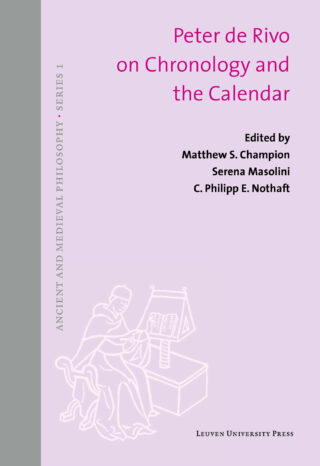
Peter de Rivo on Chronology and the Calendar
Matthew S. Champion (Editor), Serena Masolini (Editor), C. Philipp E. Nothaft (Editor),
Series: Ancient and Medieval Philosophy - Series 1 57.1
Category: Philosophy
Language: English
ISBN: 9789462702448
Publication date: October 14, 2020
€87.00 (including 6% VAT)
Buy NowNumber of pages: 290
Size: 234 x 156 x 22 mm

Stock item: 137252
Standard delivery time for print books:
For Belgium: 5 to 8 working days
For EU: 2 to 3 weeks
For other countries: 4 to 5 weeks
Series: Ancient and Medieval Philosophy - Series 1 57.1
Category: Philosophy
Language: English
ISBN: 9789461663474
Publication date: October 14, 2020
€74.00 (including 6% VAT)
Buy NowNumber of pages: 290
Critical edition of previously unpublished works by a key philosopher of the fifteenth-century Low Countries
Peter de Rivo (c.1420–1499), a renowned philosopher active at the University of Leuven, is today mostly remembered for his controversial role in the quarrel over future contingents (1465–1475). Much less known are his contributions to historical chronology, in particular his attempts to determine the dates of Christ’s birth and death. In 1471, Peter made an original contribution to this long-standing discussion with his Dyalogus de temporibus Christi, which reconciles conflicting views by rewriting the history of the Jewish and Christian calendars. Later in his career, Peter tackled the issue of calendar reform in his Reformacio kalendarii Romani (1488) and engaged in a heated debate with Paul of Middelburg on the chronology of Christ. This book edits the Dyalogus and Reformacio and sets out their context and transmission in an extensive historical introduction.
This publication is GPRC-labeled (Guaranteed Peer-Reviewed Content).
Introduction Chapter 1. Peter de Rivo: A University Professor in Fifteenth-Century Leuven
Chapter 2. The Chronology of Christ’s Life in Peter de Rivo’s Dyalogus de temporibus Christi 1. Background and Sources 2. Peter’s Argument
Chapter 3. Peter de Rivo’s Debate with Paul of Middelburg 1. An Offensive Apology 2. Peter’s Return to Chronology 3. The Clash of 1492 4. The Aftermath 5. Appendix: Texts Relating to Paul of Middelburg in MS Paris, Bibliothèque Mazarine, 300
Chapter 4. Peter de Rivo on Reforming the Ecclesiastical Calendar
Chapter 5. Peter de Rivo’s Dyalogus de temporibus Christi and Reformacio: Manuscripts, Communities, and Reading 1. Notes on the Codices 2. St Martin’s, Leuven 3. The Priory of Bethleem, Herent 4. Reading in the Reformed Religious Houses of the Southern Low Countries 5. Circulation of Texts 6. A Seventeenth-Century Coda
The CodicesPrinciples of Edition
Dyalogus de temporibus Christi Prologus Tractatus 1: <Controversie que sunt circa tempora Christi> Tractatus 2: <De ciclis> Tractatus 3: <Solutiones dictarum controversiarum> Summarium dyalogi Appendix
Reformacio kalendarii Romani Appendix
NotesBibliographyIndex
Auf den Editionstext folgen wenige Kommentarnotizen zu einzelnen Textstellen. Das Werk schließt mit einer vierteiligen Bibliographie (Hss., Drucke vor 1700, Texteditionen, Sekundärliteratur), einem Quellenindex und einem allgemeinen Index, der sich auf historische Orts- und Personennamen sowie wenige einschlägige Begriffe beschränkt. Die Einführung ist spannend geschrieben und bietet wichtige Einblicke, zum Einen in das Kernthema der christlichen Chronologie, die Datierung der Passion, ganz im Sinne der Studien Peters de Rivo, und zum Anderen in die universitäre Streitkultur des ausgehenden MA.
Martin Hellmann, Deutschen Archiv 78-2 (2022)
Petrus de Rivo (ca 1420-1499) fut professeur de rhétorique et de théologie à l’Université de Louvain dans la seconde moitié du 15e s. Sa carrière académique a été marquée par ce qu’on appelle « la Querelle des futurs contingents », une controverse sur la théorie d’Aristote que les propositions annonçant un événement futur ne sont ni vraies ni fausses. Il s’intéressait toutefois aussi à la chronologie et au calendrier, ainsi que le prouvent deux ouvrages imprimés et deux ouvrages manuscrits. En 1489 et en 1492 il a publié notamment deux incunables à Louvain dans le cadre d’une controverse avec Paul de Middelburg sur la chronologie de la Passion du Christ : Opus responsivam ad epistolam apologeticam M. Pauli de Middelburgo de anno, die et feria dominicae passionis (Louvain, (1489)), et Tercius tractatus de anno, die et feria dominicae passionis atque resurrectionis (Louvain, 1492). Les deux ouvrages manuscrits, qui ne sont connus que par des manuscrits uniques, sont édités ici pour la première fois. - Georges Declercq, Revue d'Histoire Ecclésiastique (vol. 118, 2023/1-2)
Frequently Asked Questions
What is "Peter de Rivo on Chronology and the Calendar" about?
Critical edition of previously unpublished works by a key philosopher of the fifteenth-century Low Countries
Peter de Rivo (c.1420–1499), a renowned philosopher active at the University of Leuven, is today mostly remembered for his controversial role in the quarrel over future contingents (1465–1475). Much less known are his contributions to historical chronology, in particular his attempts to determine the dates of Christ’s birth and death. In 1471, Peter made an original contribution to this long-standing discussion with his Dyalogus de temporibus Christi, which reconciles conflicting views by rewriting the history of the Jewish and Christian calendars. Later in his career, Peter tackled the issue of calendar reform in his Reformacio kalendarii Romani (1488) and engaged in a heated debate with Paul of Middelburg on the chronology of Christ. This book edits the Dyalogus and Reformacio and sets out their context and transmission in an extensive historical introduction.
This publication is GPRC-labeled (Guaranteed Peer-Reviewed Content).
Who edited "Peter de Rivo on Chronology and the Calendar"?
"Peter de Rivo on Chronology and the Calendar" was edited by Matthew S. Champion, Serena Masolini and C. Philipp E. Nothaft.
Matthew S. Champion is senior research fellow at the Institute for Religion and Critical Inquiry, Australian Catholic University.
Serena Masolini is postdoctoral researcher at the De Wulf-Mansion Centre for Ancient, Medieval and Renaissance Philosophy, KU Leuven.
C. Philipp E. Nothaft is senior fellow at the Freiburg Institute for Advanced Studies.
Is "Peter de Rivo on Chronology and the Calendar" part of a series?
Yes, "Peter de Rivo on Chronology and the Calendar" is part of the "Ancient and Medieval Philosophy - Series 1" series. It's book 57.1 in the series.
Ancient and Medieval Philosophy - Series 1 presents state-of-the-art research on the history of Western thought from its origins to the beginnings of modernity.
In association with The De Wulf-Mansion Centre.


About the Series
The series' focus lies primarily on the continuity and thematic transitions between ancient, medieval and renaissance thought, but also includes volumes on specific topics related to any of those periods. ‘Philosophy' is understood broadly to include metaphysics, ethics, natural philosophy, epistemology and philosophy of mind, and philosophical theology. Since the series is particularly devoted to making available Latin and Greek source texts, we welcome critical text editions as well as contributions that are based on philological scrutiny of those texts, without losing sight of their philosophical importance.
Ancient and Medieval Philosophy - Series 1 aims to publish at least two volumes a year and accepts monographs as well as thematically coherent edited volumes in English (without excluding the possibility of French, German, or Italian contributions to edited volumes). Manuscripts should be 80.000 to 120.000 words in length.
Readership
Researchers and graduate students in ancient, medieval and renaissance philosophy, in classics and in history.
Editorial Coordinator
Russell Friedman, KU Leuven, Belgium
Editorial Board
Pieter Beullens, KU Leuven, Belgium
Lisa Devriese, KU Leuven, Belgium
Pieter d'Hoine, KU Leuven, Belgium
Jan Opsomer, KU Leuven, Belgium
Jenny Pelletier, KU Leuven, Belgium
Andrea Robiglio, KU Leuven, Belgium
Carlos Steel, KU Leuven, Belgium
Gerd Van Riel, KU Leuven, Belgium
Advisory Board
Brad Inwood, Yale Universityo, USA
Jill Kraye, The Warburg Institute, London, United Kingdom
John Marenbon, University of Cambridge, United Kingdom
Lodi Nauta, University of Groningen, The Netherlands
Timothy Noone (†) , The Catholic University of America, USA
Robert Pasnau, University of Colorado at Boulder, USA
Martin Pickavé, University of Toronto, Canada,
Pasquale Porro, Università degli Studi di Milano, Italy
Geert Roskam, KU Leuven, Belgium
Proposals
Proposals and enquiries can be sent to editorial coordinator Russell L. Friedman. Please send a preliminary abstract (3-4 pp.) and a short bio. Upon approval of this abstract, the full manuscript will be submitted to international peer review.
Please make use of the submission form to present the full manuscript to our board.
Authors interested in Open Access can consult the available funding options.
Links & Resources
What is the Table of Contents for "Peter de Rivo on Chronology and the Calendar"?
Introduction Chapter 1. Peter de Rivo: A University Professor in Fifteenth-Century Leuven
Chapter 2. The Chronology of Christ’s Life in Peter de Rivo’s Dyalogus de temporibus Christi 1. Background and Sources 2. Peter’s Argument
Chapter 3. Peter de Rivo’s Debate with Paul of Middelburg 1. An Offensive Apology 2. Peter’s Return to Chronology 3. The Clash of 1492 4. The Aftermath 5. Appendix: Texts Relating to Paul of Middelburg in MS Paris, Bibliothèque Mazarine, 300
Chapter 4. Peter de Rivo on Reforming the Ecclesiastical Calendar
Chapter 5. Peter de Rivo’s Dyalogus de temporibus Christi and Reformacio: Manuscripts, Communities, and Reading 1. Notes on the Codices 2. St Martin’s, Leuven 3. The Priory of Bethleem, Herent 4. Reading in the Reformed Religious Houses of the Southern Low Countries 5. Circulation of Texts 6. A Seventeenth-Century Coda
The CodicesPrinciples of Edition
Dyalogus de temporibus Christi Prologus Tractatus 1: <Controversie que sunt circa tempora Christi> Tractatus 2: <De ciclis> Tractatus 3: <Solutiones dictarum controversiarum> Summarium dyalogi Appendix
Reformacio kalendarii Romani Appendix
NotesBibliographyIndex
What is the DOI for "Peter de Rivo on Chronology and the Calendar"?
The Digital Object Identifier (DOI) for "Peter de Rivo on Chronology and the Calendar" is 10.11116/9789461663474.
Related titles

 Orality and Scribal Culture in the High Middle Ages
Timothy B. Noone (Author), Mark J. Clark (Author),
November 2026
 Summa (Quaestiones ordinariae) art. LXXIII – LXXV
Henry of Ghent (Author), Gordon Wilson (Editor), Juan Carlos Flores (Editor),
September 2026
 The Medieval Aristotle
Nena Bobovnik (Editor), Clelia V. Crialesi (Editor), Lisa Devriese (Editor),
August 2026

 Thomas Aquinas and Hervaeus Natalis on Concepts and Intentional Objects
Fabrizio Amerini (Author),
February 2026
 Epicureanism and Scientific Debates. Epicurean Tradition and its Ancient Reception
Francesca Masi (Editor), Pierre-Marie Morel (Editor), Francesco Verde (Editor),
January 2025
 Quaestiones de divinis praedicamentis XXVIII-XXXII
James of Viterbo (Author), Mark D. Gossiaux (Editor), Christopher D. Schabel (Editor),
June 2024
 Summa (Quaestiones ordinariae) art. LXIII-LXVII
Henry of Ghent (Author), Gordon Wilson (Editor), Girard Etzkorn (Editor), Bernd Goehring (Editor), Linda N. Etzkorn (Assisted by),
February 2024
 Epicureanism and Scientific Debates. Antiquity and Late Reception
Francesca Masi (Editor), Pierre-Marie Morel (Editor), Francesco Verde (Editor),
August 2023
 Questiones super I-VII libros Politicorum
Peter of Auvergne (Author), Marco Toste (Editor),
December 2022