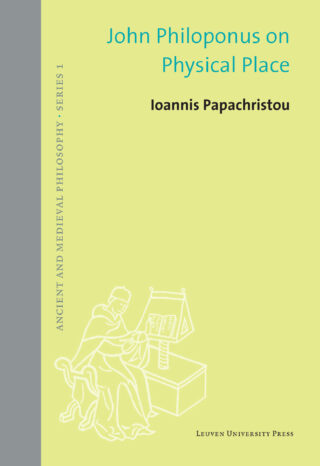
John Philoponus on Physical Place
Ioannis Papachristou (Author),
Series: Ancient and Medieval Philosophy - Series 1 60
Category: Philosophy
Language: English
ISBN: 9789462702745
Publication date: June 16, 2021
€71.50 (including 6% VAT)
Buy NowNumber of pages: 193
Size: 234 x 156 x 14 mm

Stock item: 142616
Standard delivery time for print books:
For Belgium: 5 to 8 working days
For EU: 2 to 3 weeks
For other countries: 4 to 5 weeks
Series: Ancient and Medieval Philosophy - Series 1 60
Category: Philosophy
Language: English
ISBN: 9789461663856
Publication date: June 16, 2021
€61.00 (including 6% VAT)
Buy NowNumber of pages: 193
First philosophical monograph exclusively focusing on John Philoponus’ theory of place and the void.
This book examines the place of physical bodies, a major topic of natural philosophy that has occupied philosophers since antiquity. Aristotle’s conceptions of place (topos) and the void (kenon), as expounded in the Physics, were systematically repudiated by John Philoponus (ca. 485-570) in his philosophical commentary on that work. The primary philosophical concern of the present study is the in-depth investigation of the concept of place established by Philoponus, putting forward the claim that the latter offers satisfactory solutions to problems raised by Aristotle and the Aristotelian tradition regarding the nature of place. Philoponus’ account proposes a specific physical model of how physical bodies exist and move in place, and regards place as an intrinsic reality of the physical cosmos. Due to exactly this model, his account may be considered as strictly pertaining to the study of physics, thereby constituting a remarkable episode in the history of philosophy and science.
This publication is GPRC-labeled (Guaranteed Peer-Reviewed Content).
Acknowledgments Preface
Chapter 1. Form, Method and Structure of the Physics Commentary
1.1 The form of the Physics commentary
1.2 A note on Vitelli’s edition
1.3 The form of the commentary and Philoponus’ philosophical contributions
1.4 Levels of interpretation
1.5 Dividing Aristotle’s Physics into lectures
1.6 Introduction to the digressions
1.7 The argument of the digressions
1.8 A note on Philoponus’ sources and targets in the digressions
Chapter 2. Place as Extension: Problems and Solutions
2.1 Aristotle’s rejection of place as extension
2.2 Themistius’ exegesis of Aristotle’s argument
2.3 Philoponus’ exegesis of Aristotle’s argument
2.4 Philoponus refuting the infinity of places
2.5 Philoponus refuting changing and coinciding places
Chapter 3. The Ontology of Place According to Philoponus
3.1 Three-dimensionality of place
3.2 Place as measure
3.3 Place and the ‘violation’ of nature
3.4 The empty universe
3.5 Place, substance, qualities and quantity
Chapter 4. Philoponus on Void as Place
4.1 The concept of plērōsis
4.2 The void is place
4.3 Motion through void and motion through a corporeal medium
4.4 Motion of bodies in Philoponus’ cosmological system
4.5 Philoponus on physical place
Chapter 5. Philoponus against Aristotle and the Peripatetic Tradition
5.1 Aristotle’s definition of place
5.2 The equality between place and the bodies in it
5.3 The immobility of place
5.4 Motion through surfaces
5.5 The place of the heavens
Epilogue
Bibliography Texts
Translations
Secondary literature
Index Locorum Index Nominum
Overall, Papachristou’s book is a valuable contribution to the study of place, void, and extension in ancient physics in general and of Philoponus’ thought in particular. It offers readers a persuasive interpretation of Philoponus’ theory of place, adding perceptibly to our understanding of the discussion of place and void in ancient physics. Hopefully, it will stimulate further discussions of Philoponus’ notion of extension in his commentaries on Aristotle as well as in his polemical works.Maria Varlamova, Bryn Mawr Classical
Review 2022.06.24
Frequently Asked Questions
What is "John Philoponus on Physical Place" about?
First philosophical monograph exclusively focusing on John Philoponus’ theory of place and the void.
This book examines the place of physical bodies, a major topic of natural philosophy that has occupied philosophers since antiquity. Aristotle’s conceptions of place (topos) and the void (kenon), as expounded in the Physics, were systematically repudiated by John Philoponus (ca. 485-570) in his philosophical commentary on that work. The primary philosophical concern of the present study is the in-depth investigation of the concept of place established by Philoponus, putting forward the claim that the latter offers satisfactory solutions to problems raised by Aristotle and the Aristotelian tradition regarding the nature of place. Philoponus’ account proposes a specific physical model of how physical bodies exist and move in place, and regards place as an intrinsic reality of the physical cosmos. Due to exactly this model, his account may be considered as strictly pertaining to the study of physics, thereby constituting a remarkable episode in the history of philosophy and science.
This publication is GPRC-labeled (Guaranteed Peer-Reviewed Content).
Who wrote "John Philoponus on Physical Place"?
"John Philoponus on Physical Place" was written by Ioannis Papachristou.
Ioannis Papachristou holds a PhD in Philosophy from Humboldt-Universität zu Berlin. He is a post-doctorate researcher in the Project ‘Sourcebook of Byzantine Philosophy’ at the National and Kapodistrian University of Athens.
Is "John Philoponus on Physical Place" part of a series?
Yes, "John Philoponus on Physical Place" is part of the "Ancient and Medieval Philosophy - Series 1" series. It's book 60 in the series.
Ancient and Medieval Philosophy - Series 1 presents state-of-the-art research on the history of Western thought from its origins to the beginnings of modernity.
In association with The De Wulf-Mansion Centre.


About the Series
The series' focus lies primarily on the continuity and thematic transitions between ancient, medieval and renaissance thought, but also includes volumes on specific topics related to any of those periods. ‘Philosophy' is understood broadly to include metaphysics, ethics, natural philosophy, epistemology and philosophy of mind, and philosophical theology. Since the series is particularly devoted to making available Latin and Greek source texts, we welcome critical text editions as well as contributions that are based on philological scrutiny of those texts, without losing sight of their philosophical importance.
Ancient and Medieval Philosophy - Series 1 aims to publish at least two volumes a year and accepts monographs as well as thematically coherent edited volumes in English (without excluding the possibility of French, German, or Italian contributions to edited volumes). Manuscripts should be 80.000 to 120.000 words in length.
Readership
Researchers and graduate students in ancient, medieval and renaissance philosophy, in classics and in history.
Editorial Coordinator
Russell Friedman, KU Leuven, Belgium
Editorial Board
Pieter Beullens, KU Leuven, Belgium
Lisa Devriese, KU Leuven, Belgium
Pieter d'Hoine, KU Leuven, Belgium
Jan Opsomer, KU Leuven, Belgium
Jenny Pelletier, KU Leuven, Belgium
Andrea Robiglio, KU Leuven, Belgium
Carlos Steel, KU Leuven, Belgium
Gerd Van Riel, KU Leuven, Belgium
Advisory Board
Brad Inwood, Yale Universityo, USA
Jill Kraye, The Warburg Institute, London, United Kingdom
John Marenbon, University of Cambridge, United Kingdom
Lodi Nauta, University of Groningen, The Netherlands
Timothy Noone (†) , The Catholic University of America, USA
Robert Pasnau, University of Colorado at Boulder, USA
Martin Pickavé, University of Toronto, Canada,
Pasquale Porro, Università degli Studi di Milano, Italy
Geert Roskam, KU Leuven, Belgium
Proposals
Proposals and enquiries can be sent to editorial coordinator Russell L. Friedman. Please send a preliminary abstract (3-4 pp.) and a short bio. Upon approval of this abstract, the full manuscript will be submitted to international peer review.
Please make use of the submission form to present the full manuscript to our board.
Authors interested in Open Access can consult the available funding options.
Links & Resources
What is the Table of Contents for "John Philoponus on Physical Place"?
Acknowledgments Preface
Chapter 1. Form, Method and Structure of the Physics Commentary
1.1 The form of the Physics commentary
1.2 A note on Vitelli’s edition
1.3 The form of the commentary and Philoponus’ philosophical contributions
1.4 Levels of interpretation
1.5 Dividing Aristotle’s Physics into lectures
1.6 Introduction to the digressions
1.7 The argument of the digressions
1.8 A note on Philoponus’ sources and targets in the digressions
Chapter 2. Place as Extension: Problems and Solutions
2.1 Aristotle’s rejection of place as extension
2.2 Themistius’ exegesis of Aristotle’s argument
2.3 Philoponus’ exegesis of Aristotle’s argument
2.4 Philoponus refuting the infinity of places
2.5 Philoponus refuting changing and coinciding places
Chapter 3. The Ontology of Place According to Philoponus
3.1 Three-dimensionality of place
3.2 Place as measure
3.3 Place and the ‘violation’ of nature
3.4 The empty universe
3.5 Place, substance, qualities and quantity
Chapter 4. Philoponus on Void as Place
4.1 The concept of plērōsis
4.2 The void is place
4.3 Motion through void and motion through a corporeal medium
4.4 Motion of bodies in Philoponus’ cosmological system
4.5 Philoponus on physical place
Chapter 5. Philoponus against Aristotle and the Peripatetic Tradition
5.1 Aristotle’s definition of place
5.2 The equality between place and the bodies in it
5.3 The immobility of place
5.4 Motion through surfaces
5.5 The place of the heavens
Epilogue
Bibliography Texts
Translations
Secondary literature
Index Locorum Index Nominum
What is the DOI for "John Philoponus on Physical Place"?
The Digital Object Identifier (DOI) for "John Philoponus on Physical Place" is 10.11116/9789461663856.
Related titles

 Orality and Scribal Culture in the High Middle Ages
Timothy B. Noone (Author), Mark J. Clark (Author),
November 2026
 Summa (Quaestiones ordinariae) art. LXXIII – LXXV
Henry of Ghent (Author), Gordon Wilson (Editor), Juan Carlos Flores (Editor),
September 2026
 The Medieval Aristotle
Nena Bobovnik (Editor), Clelia V. Crialesi (Editor), Lisa Devriese (Editor),
August 2026

 Thomas Aquinas and Hervaeus Natalis on Concepts and Intentional Objects
Fabrizio Amerini (Author),
February 2026
 Epicureanism and Scientific Debates. Epicurean Tradition and its Ancient Reception
Francesca Masi (Editor), Pierre-Marie Morel (Editor), Francesco Verde (Editor),
January 2025

 Quaestiones de divinis praedicamentis XXVIII-XXXII
James of Viterbo (Author), Mark D. Gossiaux (Editor), Christopher D. Schabel (Editor),
June 2024
 Summa (Quaestiones ordinariae) art. LXIII-LXVII
Henry of Ghent (Author), Gordon Wilson (Editor), Girard Etzkorn (Editor), Bernd Goehring (Editor), Linda N. Etzkorn (Assisted by),
February 2024
 Epicureanism and Scientific Debates. Antiquity and Late Reception
Francesca Masi (Editor), Pierre-Marie Morel (Editor), Francesco Verde (Editor),
August 2023
 Questiones super I-VII libros Politicorum
Peter of Auvergne (Author), Marco Toste (Editor),
December 2022