History and Eschatology in John Scottus Eriugena and his Time
Proceedings of the 10th International Conference of the Society for the Promotion of Eriugenian Studies Maynooth and Dublin August 16-20 2000
James Mc Evoy (Editor), Michael Dunne (Editor),
Preface
by C. Steel
Introduction
by J. McEvoy and M. Dunne
Opening Lecture
Bernard McGinn, “Eriugena Confronts the End. Reflections on Johannes Scottus’s Place in Carolingian Eschatology”
1. History and the Beyond
J.C. Marler, “The Eriugenian Tension between History and Eschatology”
F. Paparella, “La storia in Eriugena come autoscienza divina”
2. Grammar
C. Kavanagh, “The Philosophical Importance of Grammar for Eriugena”
A. Luthala, “Time and the Substantival Verb in Eriugena”
3. Discoveries and Identifications
J. Contreni, “John Scottus and Bede”
P. Dutton, “Eriugena’s Workshop: the Making of the Periphyseon in Rheims 875″
C. Laga, “A Complete Graeco-Latin Index of Maximus Confessor’s Quaestiones ad Thalassium“
J. McEvoy, “John Scottus Eriugena and Thomas Gallus, Commentators on the Mystical Theology“
F. Mosetti Casaretto, “Inutere coelum apertum: l’esordio dell’epistola ad Grimaldum abbatem di Ermenico di Ellwangen fra Ilduino di Saint-Denis e Giovanni Scoto”
G.A. Piemonte, “Some Distinctive Theses of Eriugena’s Eschatology in his Exegesis of the Gospel according to St. Matthew”
4. The Irish Background
T. O’Loughlin “Imagery of the New Jerusalem in the Periphyseon and Eriugena’s Irish Background”
H. Richardson, “Themes in Eriugena’s Writings and Early Irish Arts”
5. Eschatology of the De Praedestinatione
A. Bisogno, “Essentia voluntas et scientia“: esiti escatologici della gnoseologia del De Praedestinatione Liber“
R. Crouse, “Predestination, Human Freedom and the Augustinian Theology of History in Eriugena’s De Divina Praedestinatione“
E. S. N. Mainoldi, “Su alcune fonti ispiratrici della teologia e dell’escatologia del Divina Praedestinatione Liber di Giovanni Scoto Eriugena”
6. Return and Last Things
J.L. Canton Alonso, “Deus omnia in omnibus: les exempla naturalia dans le discours eschatologique de Jean Scot Erigène”
P.A. Dietrich, D.F. Duclow, “Hell and Damnation in Eriugena”
G. d’Onofrio, ” ‘Cuius esse est non posse esse’: la quarta species della natura eriugeniana tra logica, metafisica e gnoseologia”
D. Hadley, “A Twofold Problem in the twofold Eschatology of John Scottus Eriugena”
A.M. Maas, “Mystische Züge in Eriugenas Eschatologie”
M. Harrington, “Eastern and Western Psychological Triads in Eriugena’s Realized Eschatology”
H. Mooney, “Infinitus enim infinite, etiam in purgatissimis mentibus formatur: Die struktur der Begegnung mit dem unendlichen Gott nach Johannes Scottus Eriugena
D. Moran, “Time and Eternity in the Periphyseon“
W. Otten, “The Pedagogical Aspect of Eriugena’s Eschatology: Paradise between the Letter and the Spirit”
V. V. Petroff, “Theoriae of the Return in John Scottus’ Eschatology”
C.Steel, “The Return of the Body into Soul: Philosophical Musings on the Resurrection”
Bibliography
Gerd Van Riel, “Eriugenian Studies, 1995-2000”
Index
Frequently Asked Questions
What is "History and Eschatology in John Scottus Eriugena and his Time" about?
Who edited "History and Eschatology in John Scottus Eriugena and his Time"?
"History and Eschatology in John Scottus Eriugena and his Time" was edited by James Mc Evoy and Michael Dunne.
Is "History and Eschatology in John Scottus Eriugena and his Time" part of a series?
Yes, "History and Eschatology in John Scottus Eriugena and his Time" is part of the "Ancient and Medieval Philosophy - Series 1" series. It's book 30 in the series.
Ancient and Medieval Philosophy - Series 1 presents state-of-the-art research on the history of Western thought from its origins to the beginnings of modernity.
In association with The De Wulf-Mansion Centre.


About the Series
The series' focus lies primarily on the continuity and thematic transitions between ancient, medieval and renaissance thought, but also includes volumes on specific topics related to any of those periods. ‘Philosophy' is understood broadly to include metaphysics, ethics, natural philosophy, epistemology and philosophy of mind, and philosophical theology. Since the series is particularly devoted to making available Latin and Greek source texts, we welcome critical text editions as well as contributions that are based on philological scrutiny of those texts, without losing sight of their philosophical importance.
Ancient and Medieval Philosophy - Series 1 aims to publish at least two volumes a year and accepts monographs as well as thematically coherent edited volumes in English (without excluding the possibility of French, German, or Italian contributions to edited volumes). Manuscripts should be 80.000 to 120.000 words in length.
Readership
Researchers and graduate students in ancient, medieval and renaissance philosophy, in classics and in history.
Editorial Coordinator
Russell Friedman, KU Leuven, Belgium
Editorial Board
Pieter Beullens, KU Leuven, Belgium
Lisa Devriese, KU Leuven, Belgium
Pieter d'Hoine, KU Leuven, Belgium
Jan Opsomer, KU Leuven, Belgium
Jenny Pelletier, KU Leuven, Belgium
Andrea Robiglio, KU Leuven, Belgium
Carlos Steel, KU Leuven, Belgium
Gerd Van Riel, KU Leuven, Belgium
Advisory Board
Brad Inwood, Yale Universityo, USA
Jill Kraye, The Warburg Institute, London, United Kingdom
John Marenbon, University of Cambridge, United Kingdom
Lodi Nauta, University of Groningen, The Netherlands
Timothy Noone (†) , The Catholic University of America, USA
Robert Pasnau, University of Colorado at Boulder, USA
Martin Pickavé, University of Toronto, Canada,
Pasquale Porro, Università degli Studi di Milano, Italy
Geert Roskam, KU Leuven, Belgium
Proposals
Proposals and enquiries can be sent to editorial coordinator Russell L. Friedman. Please send a preliminary abstract (3-4 pp.) and a short bio. Upon approval of this abstract, the full manuscript will be submitted to international peer review.
Please make use of the submission form to present the full manuscript to our board.
Authors interested in Open Access can consult the available funding options.
Links & Resources
What is the Table of Contents for "History and Eschatology in John Scottus Eriugena and his Time"?
Preface
by C. Steel
Introduction
by J. McEvoy and M. Dunne
Opening Lecture
Bernard McGinn, "Eriugena Confronts the End. Reflections on Johannes Scottus's Place in Carolingian Eschatology"
1. History and the Beyond
J.C. Marler, "The Eriugenian Tension between History and Eschatology"
F. Paparella, "La storia in Eriugena come autoscienza divina"
2. Grammar
C. Kavanagh, "The Philosophical Importance of Grammar for Eriugena"
A. Luthala, "Time and the Substantival Verb in Eriugena"
3. Discoveries and Identifications
J. Contreni, "John Scottus and Bede"
P. Dutton, "Eriugena's Workshop: the Making of the Periphyseon in Rheims 875"
C. Laga, "A Complete Graeco-Latin Index of Maximus Confessor's Quaestiones ad Thalassium"
J. McEvoy, "John Scottus Eriugena and Thomas Gallus, Commentators on the Mystical Theology"
F. Mosetti Casaretto, "Inutere coelum apertum: l'esordio dell'epistola ad Grimaldum abbatem di Ermenico di Ellwangen fra Ilduino di Saint-Denis e Giovanni Scoto"
G.A. Piemonte, "Some Distinctive Theses of Eriugena's Eschatology in his Exegesis of the Gospel according to St. Matthew"
4. The Irish Background
T. O'Loughlin "Imagery of the New Jerusalem in the Periphyseon and Eriugena's Irish Background"
H. Richardson, "Themes in Eriugena's Writings and Early Irish Arts"
5. Eschatology of the De Praedestinatione
A. Bisogno, "Essentia voluntas et scientia": esiti escatologici della gnoseologia del De Praedestinatione Liber"
R. Crouse, "Predestination, Human Freedom and the Augustinian Theology of History in Eriugena's De Divina Praedestinatione"
E. S. N. Mainoldi, "Su alcune fonti ispiratrici della teologia e dell'escatologia del Divina Praedestinatione Liber di Giovanni Scoto Eriugena"
6. Return and Last Things
J.L. Canton Alonso, "Deus omnia in omnibus: les exempla naturalia dans le discours eschatologique de Jean Scot Erigène"
P.A. Dietrich, D.F. Duclow, "Hell and Damnation in Eriugena"
G. d'Onofrio, " 'Cuius esse est non posse esse': la quarta species della natura eriugeniana tra logica, metafisica e gnoseologia"
D. Hadley, "A Twofold Problem in the twofold Eschatology of John Scottus Eriugena"
A.M. Maas, "Mystische Züge in Eriugenas Eschatologie"
M. Harrington, "Eastern and Western Psychological Triads in Eriugena's Realized Eschatology"
H. Mooney, "Infinitus enim infinite, etiam in purgatissimis mentibus formatur: Die struktur der Begegnung mit dem unendlichen Gott nach Johannes Scottus Eriugena
D. Moran, "Time and Eternity in the Periphyseon"
W. Otten, "The Pedagogical Aspect of Eriugena's Eschatology: Paradise between the Letter and the Spirit"
V. V. Petroff, "Theoriae of the Return in John Scottus' Eschatology"
C.Steel, "The Return of the Body into Soul: Philosophical Musings on the Resurrection"
Bibliography
Gerd Van Riel, "Eriugenian Studies, 1995-2000"
Index
Related titles
 Orality and Scribal Culture in the High Middle Ages
Timothy B. Noone (Author), Mark J. Clark (Author),
November 2026
 Summa (Quaestiones ordinariae) art. LXXIII – LXXV
Henry of Ghent (Author), Gordon Wilson (Editor), Juan Carlos Flores (Editor),
September 2026
 The Medieval Aristotle
Nena Bobovnik (Editor), Clelia V. Crialesi (Editor), Lisa Devriese (Editor),
August 2026

 Thomas Aquinas and Hervaeus Natalis on Concepts and Intentional Objects
Fabrizio Amerini (Author),
February 2026
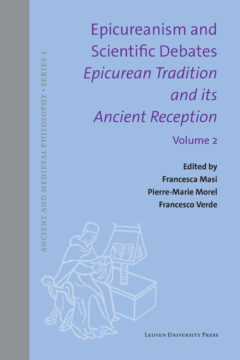 Epicureanism and Scientific Debates. Epicurean Tradition and its Ancient Reception
Francesca Masi (Editor), Pierre-Marie Morel (Editor), Francesco Verde (Editor),
January 2025
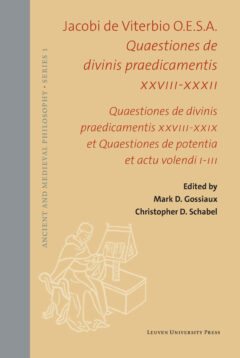 Quaestiones de divinis praedicamentis XXVIII-XXXII
James of Viterbo (Author), Mark D. Gossiaux (Editor), Christopher D. Schabel (Editor),
June 2024
 Summa (Quaestiones ordinariae) art. LXIII-LXVII
Henry of Ghent (Author), Gordon Wilson (Editor), Girard Etzkorn (Editor), Bernd Goehring (Editor), Linda N. Etzkorn (Assisted by),
February 2024
 Epicureanism and Scientific Debates. Antiquity and Late Reception
Francesca Masi (Editor), Pierre-Marie Morel (Editor), Francesco Verde (Editor),
August 2023
 Questiones super I-VII libros Politicorum
Peter of Auvergne (Author), Marco Toste (Editor),
December 2022