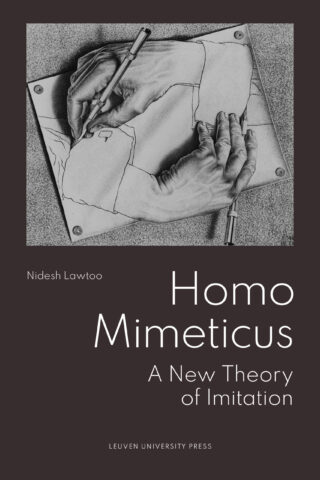

Homo Mimeticus
A New Theory of Imitation
Nidesh Lawtoo (Author),

Category: Media and Visual Culture, Philosophy
Language: English
ISBN: 9789462703469
Publication date: November 11, 2022
€28.00 (including 6% VAT)
Buy NowNumber of pages: 358
Size: 234 x 156 x 17 mm
Number of illustrations: 10
Illustrations and other content description:
Illustrated b/w

Funded by: ERC
KU Leuven Fund for Fair Open Access
Stock item: 151083
Standard delivery time for print books:
For Belgium: 5 to 8 working days
For EU: 2 to 3 weeks
For other countries: 4 to 5 weeks
Category: Media and Visual Culture, Philosophy
Language: English
ISBN: 9789461664785
Publication date: November 11, 2022
Download Free EpubNumber of pages: 358
Number of illustrations: 10
Illustrations and other content description:
Illustrated b/w
Funded by: ERC
KU Leuven Fund for Fair Open Access
Category: Media and Visual Culture, Philosophy
Language: English
ISBN: 9789461664778
Publication date: November 8, 2022
Download Free PDFNumber of pages: 358
Number of illustrations: 10
Illustrations and other content description:
Illustrated b/w
Funded by: ERC
KU Leuven Fund for Fair Open Access
Genealogy of one of the most ancient and
influential concepts in western thought: Mimesis
Imitation is, perhaps more than ever, constitutive of human originality. Many things have changed since the emergence of an original species called Homo sapiens, but in the digital age humans remain mimetic creatures: from the development of consciousness to education, aesthetics to politics, mirror neurons to brain plasticity, digital simulations to emotional contagion, (new) fascist insurrections to viral contagion, we are unconsciously formed, deformed, and transformed by the all too human tendency to imitate—for both good and ill. Crossing disciplines as diverse as philosophy, aesthetics, and politics, Homo Mimeticus proposes a new theory of one of the most influential concepts in western thought (mimesis) to confront some of the hypermimetic challenges of the present and future.
Written in an accessible yet rigorous style, Homo Mimeticus appeals to both a specialized and general readership. It can be used in courses of modern and contemporary philosophy, aesthetics, political theory, literary criticism/theory, media studies, and new mimetic studies.
Ebook available in Open Access.
This publication is GPRC-labeled (Guaranteed Peer-Reviewed Content).
Watch the recording of the book launch: https://youtu.be/3fRhGvbv0Pg
Introduction: Drawing Mimetic Studies
PART 1 — GENEALOGIES: FOUNDATIONS Chapter 1: Birth of Homo Mimeticus Chapter 2: Vita Mimetica in the Cave Chapter 3: Sameness and Difference Replayed
PART 2 — AESTHETICS: CASE STUDIES Chapter 4: The Plasticity of Mimesis Chapter 5: On Animal and Human Mimicry Chapter 6: The Human Chameleon
PART 3 — POLITICS: MIMETIC RE-TURNS Chapter 7: Banality of Evil/Mimetic Complexity Chapter 8: Vibrant Mimesis Chapter 9: The Age of Viral Reproduction
Coda: The Complexity of Mimesis: A Dialogue with Edgar Morin
Notes Bibliography Index
Nidesh Lawtoo
Nidesh Lawtoo is a philosopher and cultural critic, professor of Modern European Literature and Culture at Leiden University.
This book will make an important contribution to the discussion of mimesis in the humanities and in the social sciences. It will find readers in many countries convincing new generations of the importance of mimetic processes for human development. - Christoph Wulf, Free University of Berlin
*Homo Mimeticus is a transdisciplinary study that includes findings from philosophy, psychology, the arts (especially dramatics), politics, and the natural sciences, particularly neuroscience. Its reference horizon ranges from Plato’s idealist criticism of mimesis to Nietzsche’s “gay science,” and Derrida’s deconstructive approach to Jane Bennett’s new materialism. Lawtoo goes far beyond the traditional version of mimesis as realist representation.* - Philipp Wolf, Journal of Modern Literature, vol. 48 no. 1, 2024, p. 178-190., https://dx.doi.org/10.2979/jml.00065
Lawtoo’s definition of a new transdisciplinary field called ‘mimetic studies’ is of crucial significance to comparative literature scholars and many others. - Mark Pizzato, MLN, Volume 140, Number 5, December 2025, pp. 1285-1289, https://doi.org/10.1353/mln.2025.a981051
Its ancient subject mimesis has attracted a great deal of attention within the past three decades. Yet what singles out this book is its attempt at writing a new and systematic theory of mimesis. - Philipp Wolf, Journal of Modern Literature, Volume 48, Number 1, Fall 2024, pp. 178-190, https://doi.org/10.2979/jml.00065
The book develops this concept through various manifestations. Most importantly, the warp and weft kind of relationship between them is traced through Nietzsche to late twentieth-century neuroscientific discovery of mirroring neurons. The range of associations and their conceptual brilliance indeed makes a series of fine beads tied by a brilliant silver thread. - Dhrubajyoti Sarkar, Nesir, no. 9, (2025): 507-510, https://doi.org/10.64957/nesir.1804884
Frequently Asked Questions
What is "Homo Mimeticus" about?
Genealogy of one of the most ancient and
influential concepts in western thought: Mimesis
Imitation is, perhaps more than ever, constitutive of human originality. Many things have changed since the emergence of an original species called Homo sapiens, but in the digital age humans remain mimetic creatures: from the development of consciousness to education, aesthetics to politics, mirror neurons to brain plasticity, digital simulations to emotional contagion, (new) fascist insurrections to viral contagion, we are unconsciously formed, deformed, and transformed by the all too human tendency to imitate—for both good and ill. Crossing disciplines as diverse as philosophy, aesthetics, and politics, Homo Mimeticus proposes a new theory of one of the most influential concepts in western thought (mimesis) to confront some of the hypermimetic challenges of the present and future.
Written in an accessible yet rigorous style, Homo Mimeticus appeals to both a specialized and general readership. It can be used in courses of modern and contemporary philosophy, aesthetics, political theory, literary criticism/theory, media studies, and new mimetic studies.
Ebook available in Open Access.
This publication is GPRC-labeled (Guaranteed Peer-Reviewed Content).
Watch the recording of the book launch: https://youtu.be/3fRhGvbv0Pg
Who wrote "Homo Mimeticus"?
"Homo Mimeticus" was written by Nidesh Lawtoo.
Nidesh Lawtoo is a philosopher and cultural critic, professor of Modern European Literature and Culture at Leiden University.
Is "Homo Mimeticus" available Open Access?
Yes, "Homo Mimeticus" is published Open Access. It is available under a BY-NC-ND license.
Who funded the publication of "Homo Mimeticus"?
Publication of "Homo Mimeticus" was funded by ERC
KU Leuven Fund for Fair Open Access
.
What is the Table of Contents for "Homo Mimeticus"?
Introduction: Drawing Mimetic Studies
PART 1 — GENEALOGIES: FOUNDATIONS Chapter 1: Birth of Homo Mimeticus Chapter 2: Vita Mimetica in the Cave Chapter 3: Sameness and Difference Replayed
PART 2 — AESTHETICS: CASE STUDIES Chapter 4: The Plasticity of Mimesis Chapter 5: On Animal and Human Mimicry Chapter 6: The Human Chameleon
PART 3 — POLITICS: MIMETIC RE-TURNS Chapter 7: Banality of Evil/Mimetic Complexity Chapter 8: Vibrant Mimesis Chapter 9: The Age of Viral Reproduction
Coda: The Complexity of Mimesis: A Dialogue with Edgar Morin
Notes Bibliography Index
Related titles


 Orality and Scribal Culture in the High Middle Ages
Timothy B. Noone (Author), Mark J. Clark (Author),
November 2026
 Feminists Resisting Gendered Violence
Hemangini Gupta (Editor), Fiona Mackay (Editor), Jan Breckenridge (Editor), Louise Chappell (Editor), Rachna Mehra (Editor), Rukmini Sen (Editor), Mailin Suchting (Editor),
October 2026

 Summa (Quaestiones ordinariae) art. LXXIII – LXXV
Henry of Ghent (Author), Gordon Wilson (Editor), Juan Carlos Flores (Editor),
September 2026
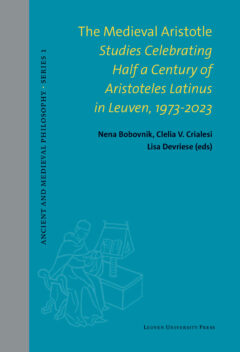 The Medieval Aristotle
Nena Bobovnik (Editor), Clelia V. Crialesi (Editor), Lisa Devriese (Editor),
August 2026
 Cinema in Post-War Belgium
Gertjan Willems (Editor), Bjorn Gabriels (Editor), Bénédicte Rochet (Editor),
May 2026
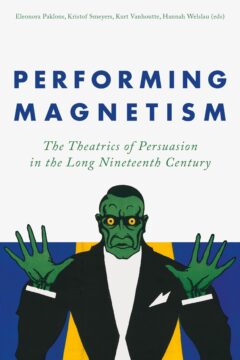 Performing Magnetism
Eleonora Paklons (Editor), Kristof Smeyers (Editor), Kurt Vanhoutte (Editor), Hannah Welslau (Editor),
May 2026
 Comics and the Global South
Andrea Aramburú (Editor), Dibyadyuti Roy (Editor), Joe Sutliff Sanders (Editor),
February 2026

 Thomas Aquinas and Hervaeus Natalis on Concepts and Intentional Objects
Fabrizio Amerini (Author),
February 2026
 The Visionary Art of Franco-Belgian Comics, 1930s to 1960s
Hugo Frey (Editor), Maaheen Ahmed (Editor),
September 2025
 Violence and Trauma in Contemporary Performance
Sofie de Smet (Editor), Marieke Breyne (Editor), Pedzisai Maedza (Editor), Christel Stalpaert (Editor),
May 2025