

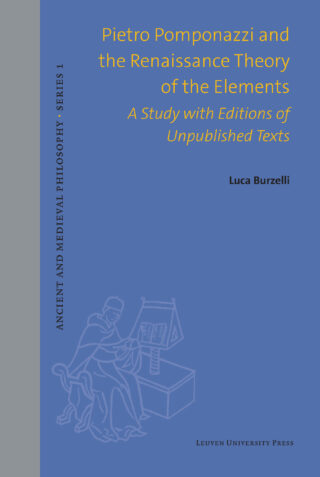

Pietro Pomponazzi and the Renaissance Theory of the Elements
A Study with Editions of Unpublished Texts
Luca Burzelli (Author),

Series: Ancient and Medieval Philosophy - Series 1 66
Category: Philosophy
Language: English
ISBN: 9789462704152
Publication date: July 15, 2024
€85.00 (including 6% VAT)
Buy NowNumber of pages: 335
Size: 234 x 156 x 20 mm

Funded by: KU Leuven Fund for Fair Open Access
Universität Siegen
Stock item: 161315
Standard delivery time for print books:
For Belgium: 5 to 8 working days
For EU: 2 to 3 weeks
For other countries: 4 to 5 weeks
Series: Ancient and Medieval Philosophy - Series 1 66
Category: Philosophy
Language: English
ISBN: 9789461665607
Publication date: July 10, 2024
Download Free PDFNumber of pages: 335
Funded by: KU Leuven Fund for Fair Open Access
Universität Siegen
First ever editions of texts on the elements from Pomponazzi’s lectures on De coelo, De sensu, Meteorologica and De generatione et corruptione.
In medieval and early modern natural philosophy, very few issues were as controversial as the nature of the elements. From the thirteenth up until the sixteenth century, European thinkers discussed this problem with growing interest. Defining the nature of the elements was key to deciphering the very structure of the universe and the essence of things. Along with five primary texts, here edited for the first time, this book discusses one of the most original contributions to this debate, that of Renaissance philosopher Pietro Pomponazzi (d. 1525). Pomponazzi’s account, developed in university lectures, holds significance for two reasons. First, it provides a thorough description of the most influential doctrines on the elements presented by medieval scholars, opening a window onto three hundred years of prior discussions on the topic. Second, Pomponazzi also develops his own views on the issue, explicitly defining them as ‘heretical’ to emphasise his departure from all opinions expressed before him.
Ebook available in Open Access. This publication is GPRC-labeled (Guaranteed Peer-Reviewed Content).
Preface
Acknowledgments
List of Abbreviations
Part One – Essay
I Historical background
1. The elements from antiquity to the Middle Ages
1.1 Introduction
1.2 Aristotle on elements and mixtures
1.3 Towards the medieval debate: intellectuals and methods
2. Four main theories of the elements in the Middle Ages
2.1 Alexander of Aphrodisias
2.2 Avicenna
2.3 Averroes
2.4 The Common Opinion
3. The status quaestionis on the elements at the turn of fifteenth and sixteenth century
II Pietro Pomponazzi on the elements
1. Stages of Pomponazzi’s teaching on the elements
2. Pomponazzi’s reconstruction of the medieval debate
3. The interpretation of Avicenna
3.1 Exposition and sources
3.2 Pomponazzi vs Avicenna
4. The interpretation of Averroes and the Averroists
4.1 Exposition and sources
4.2 Pomponazzi vs Averroes
4.3 The comparison with Averroes in the single quaestio (T.6)
4.4 Concluding remarks
5. The Common Opinion
5.1 Exposition and sources
5.2 Pomponazzi vs the Common Opinion
5.3 Final remarks on the Common Opinion
6. Pomponazzi on the elements
6.1 The mixing process and the genesis of mixtures
6.2 Pomponazzi’s sources
6.3 Solution of the aporias of the Common Opinion
6.4 Classification of mixtures
6.5 Final conjectures on mixtures
6.6 An overall judgement
III Philological and stylistic aspects of the Edition
1. The present edition: texts and copyists
2. Recensio codicum
3. Descriptio codicum
3.1 Text 1 (Winter 1520/21)
3.2 Texts 2–3 (Winter 1521/22)
3.3 Text 4 (November 1523)
3.4 Text 5 (April 1525)
3.5 Text 6 (uncertain date)
4. Stylistic aspects of Pomponazzi’s lectures
4.1 In between a commentary and a treatise
4.2 Structure of the quaestiones
4.3 Teaching devices
5. The Critical Editions
Part two – Texts
I. Text 1 – Excerpts from the lecture on De coelo III
II. Text 2 – Excerpts from the lecture on De generatione et corruptione I
III. Text 3 – Excerpts from the lecture on De generatione et corruptione II
IV. Text 4 – Excerpts from the lecture on Meteora IV
V. Text 5 – Excerpts from the lecture on De sensu et sensato
VI Text 6 – Quaestio de remanentia elementorum in mixto
Major dates in the life of Pietro Pomponazzi
Bibliography
Indexes
Luca Burzelli
Luca Burzelli is postdoctoral researcher in History of Philosophy at the Department of Philosophy of the University of Siegen, and member of the De Wulf-Mansion Centre at the KU Leuven. He received the Thomas Ricklin International Award 2024 for his book ‘Pietro Pomponazzi and the Renaissance Theory of the Elements: A Study with Editions of Unpublished Texts’.
Burzelli’s fine study should find a secure place among histories of Renaissance philosophy. He elucidates the philosophical issues and the larger intellectual context with admirable clarity and rigor. The texts offer insight not just about the question of elements, but also about Pomponazzi’s classroom manner, his views about the epistemology of natural philosophy, his pushback against theologians and physicians, and his integration of a panoply of medieval and ancient sources. The last years of Pomponazzi’s life were filled with tumult and acclaim, and we now have a better idea of how his university lectures corresponded to those controversies. - Craig Martin, Vivarium 63, 2 (2025): 180-185, doi: https://doi.org/10.1163/15685349-06302004
Frequently Asked Questions
What is "Pietro Pomponazzi and the Renaissance Theory of the Elements" about?
First ever editions of texts on the elements from Pomponazzi’s lectures on De coelo, De sensu, Meteorologica and De generatione et corruptione.
In medieval and early modern natural philosophy, very few issues were as controversial as the nature of the elements. From the thirteenth up until the sixteenth century, European thinkers discussed this problem with growing interest. Defining the nature of the elements was key to deciphering the very structure of the universe and the essence of things. Along with five primary texts, here edited for the first time, this book discusses one of the most original contributions to this debate, that of Renaissance philosopher Pietro Pomponazzi (d. 1525). Pomponazzi’s account, developed in university lectures, holds significance for two reasons. First, it provides a thorough description of the most influential doctrines on the elements presented by medieval scholars, opening a window onto three hundred years of prior discussions on the topic. Second, Pomponazzi also develops his own views on the issue, explicitly defining them as ‘heretical’ to emphasise his departure from all opinions expressed before him.
Ebook available in Open Access. This publication is GPRC-labeled (Guaranteed Peer-Reviewed Content).
Who wrote "Pietro Pomponazzi and the Renaissance Theory of the Elements"?
"Pietro Pomponazzi and the Renaissance Theory of the Elements" was written by Luca Burzelli.
Luca Burzelli is postdoctoral researcher in History of Philosophy at the Department of Philosophy of the University of Siegen, and member of the De Wulf-Mansion Centre at the KU Leuven. He received the Thomas Ricklin International Award 2024 for his book ‘Pietro Pomponazzi and the Renaissance Theory of the Elements: A Study with Editions of Unpublished Texts’.
Is "Pietro Pomponazzi and the Renaissance Theory of the Elements" part of a series?
Yes, "Pietro Pomponazzi and the Renaissance Theory of the Elements" is part of the "Ancient and Medieval Philosophy - Series 1" series. It's book 66 in the series.
Ancient and Medieval Philosophy - Series 1 presents state-of-the-art research on the history of Western thought from its origins to the beginnings of modernity.
In association with The De Wulf-Mansion Centre.


About the Series
The series' focus lies primarily on the continuity and thematic transitions between ancient, medieval and renaissance thought, but also includes volumes on specific topics related to any of those periods. ‘Philosophy' is understood broadly to include metaphysics, ethics, natural philosophy, epistemology and philosophy of mind, and philosophical theology. Since the series is particularly devoted to making available Latin and Greek source texts, we welcome critical text editions as well as contributions that are based on philological scrutiny of those texts, without losing sight of their philosophical importance.
Ancient and Medieval Philosophy - Series 1 aims to publish at least two volumes a year and accepts monographs as well as thematically coherent edited volumes in English (without excluding the possibility of French, German, or Italian contributions to edited volumes). Manuscripts should be 80.000 to 120.000 words in length.
Readership
Researchers and graduate students in ancient, medieval and renaissance philosophy, in classics and in history.
Editorial Coordinator
Russell Friedman, KU Leuven, Belgium
Editorial Board
Pieter Beullens, KU Leuven, Belgium
Lisa Devriese, KU Leuven, Belgium
Pieter d'Hoine, KU Leuven, Belgium
Jan Opsomer, KU Leuven, Belgium
Jenny Pelletier, KU Leuven, Belgium
Andrea Robiglio, KU Leuven, Belgium
Carlos Steel, KU Leuven, Belgium
Gerd Van Riel, KU Leuven, Belgium
Advisory Board
Brad Inwood, Yale Universityo, USA
Jill Kraye, The Warburg Institute, London, United Kingdom
John Marenbon, University of Cambridge, United Kingdom
Lodi Nauta, University of Groningen, The Netherlands
Timothy Noone (†) , The Catholic University of America, USA
Robert Pasnau, University of Colorado at Boulder, USA
Martin Pickavé, University of Toronto, Canada,
Pasquale Porro, Università degli Studi di Milano, Italy
Geert Roskam, KU Leuven, Belgium
Proposals
Proposals and enquiries can be sent to editorial coordinator Russell L. Friedman. Please send a preliminary abstract (3-4 pp.) and a short bio. Upon approval of this abstract, the full manuscript will be submitted to international peer review.
Please make use of the submission form to present the full manuscript to our board.
Authors interested in Open Access can consult the available funding options.
Links & Resources
Is "Pietro Pomponazzi and the Renaissance Theory of the Elements" available Open Access?
Yes, "Pietro Pomponazzi and the Renaissance Theory of the Elements" is published Open Access. It is available under a BY-NC-ND license.
Who funded the publication of "Pietro Pomponazzi and the Renaissance Theory of the Elements"?
Publication of "Pietro Pomponazzi and the Renaissance Theory of the Elements" was funded by KU Leuven Fund for Fair Open Access
Universität Siegen
.
What is the Table of Contents for "Pietro Pomponazzi and the Renaissance Theory of the Elements"?
Preface
Acknowledgments
List of Abbreviations
Part One – Essay
I Historical background
1. The elements from antiquity to the Middle Ages
1.1 Introduction
1.2 Aristotle on elements and mixtures
1.3 Towards the medieval debate: intellectuals and methods
2. Four main theories of the elements in the Middle Ages
2.1 Alexander of Aphrodisias
2.2 Avicenna
2.3 Averroes
2.4 The Common Opinion
3. The status quaestionis on the elements at the turn of fifteenth and sixteenth century
II Pietro Pomponazzi on the elements
1. Stages of Pomponazzi’s teaching on the elements
2. Pomponazzi’s reconstruction of the medieval debate
3. The interpretation of Avicenna
3.1 Exposition and sources
3.2 Pomponazzi vs Avicenna
4. The interpretation of Averroes and the Averroists
4.1 Exposition and sources
4.2 Pomponazzi vs Averroes
4.3 The comparison with Averroes in the single quaestio (T.6)
4.4 Concluding remarks
5. The Common Opinion
5.1 Exposition and sources
5.2 Pomponazzi vs the Common Opinion
5.3 Final remarks on the Common Opinion
6. Pomponazzi on the elements
6.1 The mixing process and the genesis of mixtures
6.2 Pomponazzi’s sources
6.3 Solution of the aporias of the Common Opinion
6.4 Classification of mixtures
6.5 Final conjectures on mixtures
6.6 An overall judgement
III Philological and stylistic aspects of the Edition
1. The present edition: texts and copyists
2. Recensio codicum
3. Descriptio codicum
3.1 Text 1 (Winter 1520/21)
3.2 Texts 2–3 (Winter 1521/22)
3.3 Text 4 (November 1523)
3.4 Text 5 (April 1525)
3.5 Text 6 (uncertain date)
4. Stylistic aspects of Pomponazzi’s lectures
4.1 In between a commentary and a treatise
4.2 Structure of the quaestiones
4.3 Teaching devices
5. The Critical Editions
Part two – Texts
I. Text 1 – Excerpts from the lecture on De coelo III
II. Text 2 – Excerpts from the lecture on De generatione et corruptione I
III. Text 3 – Excerpts from the lecture on De generatione et corruptione II
IV. Text 4 – Excerpts from the lecture on Meteora IV
V. Text 5 – Excerpts from the lecture on De sensu et sensato
VI Text 6 – Quaestio de remanentia elementorum in mixto
Major dates in the life of Pietro Pomponazzi
Bibliography
Indexes
Related titles
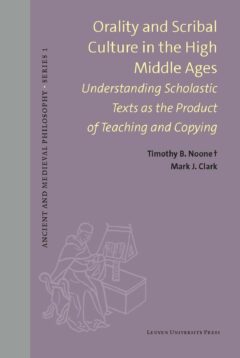 Orality and Scribal Culture in the High Middle Ages
Timothy B. Noone (Author), Mark J. Clark (Author),
November 2026
 Summa (Quaestiones ordinariae) art. LXXIII – LXXV
Henry of Ghent (Author), Gordon Wilson (Editor), Juan Carlos Flores (Editor),
September 2026
 The Medieval Aristotle
Nena Bobovnik (Editor), Clelia V. Crialesi (Editor), Lisa Devriese (Editor),
August 2026
 Thomas Aquinas and Hervaeus Natalis on Concepts and Intentional Objects
Fabrizio Amerini (Author),
February 2026
 Epicureanism and Scientific Debates. Epicurean Tradition and its Ancient Reception
Francesca Masi (Editor), Pierre-Marie Morel (Editor), Francesco Verde (Editor),
January 2025
 Quaestiones de divinis praedicamentis XXVIII-XXXII
James of Viterbo (Author), Mark D. Gossiaux (Editor), Christopher D. Schabel (Editor),
June 2024
 Summa (Quaestiones ordinariae) art. LXIII-LXVII
Henry of Ghent (Author), Gordon Wilson (Editor), Girard Etzkorn (Editor), Bernd Goehring (Editor), Linda N. Etzkorn (Assisted by),
February 2024
 Epicureanism and Scientific Debates. Antiquity and Late Reception
Francesca Masi (Editor), Pierre-Marie Morel (Editor), Francesco Verde (Editor),
August 2023
 Questiones super I-VII libros Politicorum
Peter of Auvergne (Author), Marco Toste (Editor),
December 2022
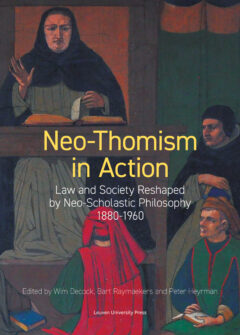 Neo-Thomism in Action
Wim Decock (Editor), Bart Raymaekers (Editor), Peter Heyrman (Editor),
December 2021