Blog
Mehdi Berriah & Arjan Post | Ibn Taymiyya’s Thought
19th March, 2026 in Author’s corner
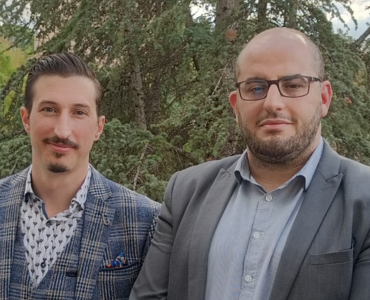
Arjan Post (left) is Associate Professor of Arabic and Islamic Studies at KU Leuven, and Mehdi Berriah (right) is a researcher in Islamic Studies and Islamic History at the French Institute for the Near East (Ifpo).
Ibn Taymiyya cannot be reduced to the simplified image that is often associated with his name today.
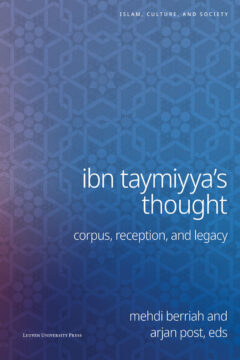
In this book, editors Mehdi Berriah and Arjan Post trace the key strands of medieval scholar Ibn Taymiyya’s thought and show how his writings have been interpreted, transformed, challenged, and reappropriated over time. The volume provides fresh insights into his enduring relevance in debates on Islam, authority, and religious thought. A Q&A with the editors.
Briefly and concisely explain in plain language what the book is about.
This volume explores the thought and impact of Ibn Taymiyya, one of the most influential Muslim scholars of the medieval period. Rather than approaching his work through a single theme, the book brings together a series of studies that examine different dimensions of his intellectual production and legacy. The chapters look at the formation of the Taymiyyan corpus, the debates in which Ibn Taymiyya was involved, the ways his writings were read and reinterpreted by later scholars, and his impact within modern society. By combining these perspectives, the volume aims to provide a more historically grounded and nuanced understanding of his thought and its legacy.
What or who inspired you to choose this topic?
The idea for this volume emerged from ongoing discussions about the place of Ibn Taymiyya in the history of Islamic thought. Although he is one of the most frequently cited medieval Muslim scholars today, his writings are often approached through partial or simplified readings. The project was therefore motivated by a desire to return to the texts themselves and to explore both the diversity of his corpus and the variety of ways in which his ideas have been interpreted over time. Bringing together specialists working on different aspects of his thought seemed a natural way to address this complexity.
Did the book turn out the way you imagined it? In what way(s) did it or did it not?
Yes, we believe it is a very fitting collection of different topics related to Ibn Taymiyya, arranged in a fitting and logical order. Together, they provide anyone with an interest in Taymiyyan studies with a wide range of perspectives from different fields of expertise.
What social impact do you think the book can have, or would you like it to have?
We hope the book contributes to a more informed and historically grounded understanding of Ibn Taymiyya. His name is often associated with contemporary debates, sometimes in simplified or polemical ways. By examining his writings in their historical and intellectual contexts, the volume seeks to encourage a more nuanced discussion of his legacy and of the broader traditions of Islamic scholarship to which he belonged.
In what way do you think your book can shape future research in your research field?
This volume does not attempt to offer a definitive interpretation of Ibn Taymiyya. Instead, it brings together different approaches that highlight the richness and diversity of the Taymiyyan corpus. Several chapters revisit well-known texts from new perspectives, while others draw attention to writings that have received less scholarly attention. In that sense, the book hopefully encourages further work on Ibn Taymiyya and, more broadly, on the intellectual and scholarly environments in which his ideas were produced, transmitted, and debated.
What is your favourite part of the book and why?
What we particularly appreciate in this volume is the diversity of perspectives it brings together. Ibn Taymiyya is often reduced to a few well-known positions, whereas the book shows how many different ways his thought can be approached. We find this especially valuable, because it allows the reader to move beyond simplified images and to see the richness of the questions his works raise.
How did the writing process for this book go? Did you experience anything surprising, amusing or striking?
As with many edited volumes, the process took time, but it was intellectually very stimulating from beginning to end. What was most striking was to see how differently contributors approached the same author depending on their sources, methods, and questions. That was perhaps the most rewarding aspect of the project: the volume gradually took shape not as a single interpretation, but as a conversation between different scholarly perspectives.
What was the most challenging step in the entire creation process of your book?
As with many edited volumes, one of the main challenges was coordinating the different contributions while maintaining a coherent structure for the book as a whole. Each chapter approaches Ibn Taymiyya from a different angle, so the difficulty was not only editorial but also intellectual: making sure that these perspectives could speak to each other and form a meaningful dialogue.
What would have been good advice before you started this book project?
Greater attention could have been devoted to defining the guidelines for our authors. Although we did establish a basic set of instructions, such as conventions for referencing, bibliography, and transliteration, a more detailed set of guidelines would, in hindsight, have reduced some of the editorial work. It became clear during the editing process that authors still differed in a number of aspects of academic style. Since the aim was to achieve as much coherence as possible across the contributions, more precise guidelines would have facilitated this objective.
What would you like readers to remember about your book?
If there is one thing readers should remember, it is that Ibn Taymiyya cannot be reduced to the simplified image that is often associated with his name today. His writings belong to a complex intellectual landscape and engage with a wide range of theological, legal, and philosophical debates of his time. By looking closely at his texts and at the ways they were received and interpreted over time, the volume invites readers to approach his thought as part of a broader scholarly tradition rather than through isolated quotations or later interpretations.
If you could travel through time, where would you want to go to talk about your research/book?
To early 14th century Damascus to talk to Ibn Taymiyya himself and see not only how he would judge our understanding of his ideas, but also hear his thoughts on the way his ideas will be discussed, adopted, and politicized over the course of the centuries after his passing. As a bonus, this time travel would enable us to meet with the rich scholarly crowd of early Mamluk Damascus and visit the most important Islamic institutions of that time, some of which no longer exist today.
Your book is published open access. How did the open access publication process go? What makes open access so attractive for you/your book?
We wanted to publish open access to more easily reach a wider audience for our volume. We were able to pay the fee for open access thanks to the KU Leuven Fund for Fair Open Access, together with the Research Foundation Flanders (FWO) through its PhD project “Questioning the Quiescence of the Ottoman Ḥanbalīs.” The application for the former fund was much easier than anticipated and was a very welcome stimulus to push through with our ambition to publish the volume open access.