

Blog
Hilde Heynen & Lucía C. Pérez-Moreno | Architecture & Feminist Critical Theory
13th February, 2026 in Author’s corner
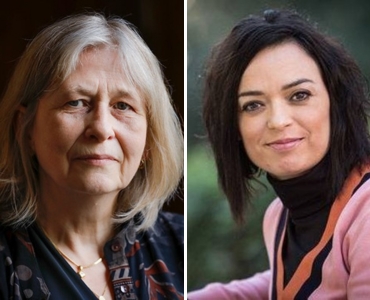
Hilde Heynen is Professor Emerita of Architectural Theory at KU Leuven. Lucía C. Pérez-Moreno is Professor of Architectural History focusing on women, gender studies, and feminist theory at the University of Zaragoza.
As women architects, we face society in a different way than our male colleagues, and that situation makes it important to rethink what we should do and fight for.
Architecture & Feminist Critical Theory collects Hilde Heynen’s most significant texts from three decades of intellectual work, centred on three feature concepts: mimesis, dwelling, and displacement. It offers incisive reflections on architects’ roles in shaping societies and the alliance between ideology, societal structures of injustice, political economy, housing, and the built environment.
Briefly and concisely explain in plain language what the book is about.
HH: This book contains a selection of my writing across an intellectual trajectory that spans more than 30 years. The selection is made by Lucía Pérez-Moreno and myself. Lucía also wrote an introduction, while I wrote an afterword.
LCPM: It is a selection of the very best writing by Hilde Heynen, thematically organized so the reader can understand the importance of her intellectual understanding of the architect’s role in shaping society.
What or who inspired you to choose this topic?
HH: Lucía’s urge that my work should be accessible in Spanish was the prompt for preparing a selection of my writings to be translated into Spanish. While we are still working on that translation, we decided that it was also interesting to publish the collection in English already, since many of the texts did exist already in that language. Hence we approached Leuven University Press, and they were interested in our project.
LCPM: My longstanding interest in the relationship between architecture and feminist philosophy, together with my desire to make visible the intellectual work of women in architecture, has shaped my academic trajectory.
This interest in Hilde’s work began during my Master’s studies at Columbia University (2007–08), where I served as a teaching assistant to Professor Joan Ockman and read extracts from Hilde’s writings in her seminars. Later, during my PhD studies in Spain, my supervisor, Professor María Teresa Muñoz (ETSAM, Madrid), encouraged me to read Hilde’s book Architecture & Modernity: A Critique. I clearly remember María Teresa telling me that Hilde’s work was “the great one.”
From that point on, my engagement with Hilde’s work has continued to grow. In 2012, I had the chance to hear her for the first time at an EAHN meeting in Brussels. I was too cautious to introduce myself, but I was profoundly impressed by her presence. More than a decade later, I finally had the opportunity to work with her — my dream come true. Adding to this, I discovered the amazing person behind the ‘great woman’.
Did the book turn out the way you imagined it?
HH: The book turned out very well. I really love the look and feel of it, and I am quite proud that Lucía and I made it happen.
LCPM: The experience turned out to be much better than I had imagined. The entire process unfolded smoothly, and I believe we both enjoyed it: our conversations about her texts, my revisions and questions driven by doubts and curiosity, and Hilde observing how I interpreted her work. It was a truly fascinating process.
What social impact do you think the book can have?
HH: The book is open access, which is very important to me. Thanks to the subsidies of the KU Leuven Fund for Fair Open Access, we managed to make it widely available. That means that architectural students, PhD students, and scholars in architectural theory and history everywhere in the world who are capable of reading English now have access to the better part of my work. Since that work is about the societal impact of architecture, I hope that many of its readers are inspired to approach architecture in a different, more inclusive, and more critical way.
LCPM: I am not entirely sure. I suggested to Hilde that we compile her work because I sincerely believe it is essential to discuss the social impact of architecture. Initially, I proposed translating some of her writings into Spanish, as I am convinced that her ideas should be better known in Spain and Latin America. Somehow, while selecting the articles to translate into English, we did this book first! I am currently working on the Spanish translation of the book.
In what way can your book shape future research?
HH: I hope the book will be an inspiration for younger, feminist-minded researchers who can expand the field of architectural history and theory in order to decolonize it and make it more open and inclusive.
LCPM: Two aspects are especially important to me: first, I hope it will inspire many young women interested in architecture and feminist philosophy to pursue and deepen their work in this field; second, I believe we must revive the debate on the social engagement of architects.
I truly believe that architectural theory is very important and that, somehow, it is disappearing from the curricula of Schools of Architecture — which I think is a great mistake. I miss courses in which we theoretically reflect on what our role in society is, especially from a feminist perspective. As women architects, we face society differently from our male colleagues, and that situation makes it important to rethink what we should do and fight for.
What is your favourite part of the book and why?
HH: My favorite section is section 5, about ‘Housing & Feminist Theory’. This is because it contains several unsolicited texts that explored my feminist interests and thus modified my earlier insights into topics such as modernity and modernism.
It starts with a reading-against-the-grain of Adorno’s concept of mimesis, trying to make it productive for feminist theories. It also contains my theoretical analysis of the interconnection between modernity and domesticity, which taught me a lot about feminist perspectives.
There is a chapter in this section where Els De Vos and I apply a high-end theoretical concept such as ‘the uncanny’ to the mundane realities of suburban garages, showing the relevance of architectural theory for understanding everyday life.
LCPM: The first (Architecture & Critical Theory) and the fifth section (Housing & Feminist Theory). This is where I see the relevance of theory in architecture and where Hilde’s shift toward feminist thought becomes especially clear. I like both sections very much because they feed into one another.
My favourite chapter is number 19, “Modernity and Domesticity: Tensions and Contradictions”; it is a magnificent example of a clear intellectual-logical narrative.
How did the writing process for this book go? Did you experience anything surprising, amusing or striking?
HH: To me it was very rewarding to revisit my earlier work, and to see that it was more consistent than I would have guessed. I really appreciated Lucía’s introduction, which was spot-on in identifying what have been driving concepts throughout my whole trajectory (mimesis, dwelling, and displacement). It was also great fun to see her organise the book into six sections that were interconnected by using the same terms in different constellations, making a full circle between the first section on ‘Architecture & Critical Theory’ and the last on ‘Feminist Theory & Architecture’.
LCPM: It was really nice and also fun. I learned a lot by delving into Hilde’s writing. It is dense and profound but also refreshing. She writes in such a clear way that philosophical concepts become understandable. It is really satisfying when you can grasp complex theories. It was also very nice to see how much we agreed on many points. I think we both enjoyed our discussions a lot.
What was the most challenging step in the entire creation process of your book?
HH: Deciding what would be in and what would be out. The content could have been different, and some of my friends made suggestions that in the end didn’t make it into the selection.
LCPM: Probably the complexity of some philosophical concepts.
What would have been good advice before you started this book project?
HH: I think this process worked very smoothly. My advice to others: make sure you are good friends with the person who is editing the book! It is very rewarding and nurturing to go through a process like this with someone who is not only an exceptional scholar but also a great human being and a fantastic friend.
LCPM: AI can help a lot for revising citations and bibliography! Use it!
What would you like readers to remember about your book?
HH: How feminism is critically relevant to architecture and to architectural theory.
LCPM: Women’s intellectuality is crucial, and we must recover, read, understand, and reflect on the experiences of our foremothers and intellectual references.
If you could travel through time, where would you want to go to talk about your research/book?
HH: The Bauhaus in the 1920s would be a good place.
LCPM: Probably 2007, while I was studying at Columbia University. I would love to discuss this book with Joan Ockman; I admire her greatly and think she would be proud of it.
Your book is published open access. How did the open access publication process go? What makes open access so attractive for you/your book?
HH: See above.
LCPM: Open access is great! Knowledge can flow!
Do you have any plans yet for another publication? What will it be about?
HH: My long-term project is to write a theoretical book about architecture and the ethics of care.
LCPM: I have two publications on the table: (1) the translation of this book into Spanish and (2) an edited volume about the representation of women architects in cinema in the 20th century.
Related Publications
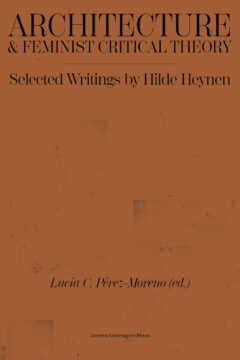 Architecture & Feminist Critical Theory
Hilde Heynen (Author), Lucía C. Pérez-Moreno (Editor),
November 2025
