Blog
Jens van de Maele | Behind Office Doors
21st January, 2026 in Author’s corner

Jens van de Maele is a postdoctoral member of the research group Modernity and Society 1800–2000 at KU Leuven.
Ordinary users – especially low‑ranking staff, and thus mainly women – rarely had a say in how their workplaces were designed, even though they spent the most time there.
From filing cabinets and air conditioning to EU offices and colonial bureaucracies, the book Behind Office Doors traces how design, technology and organisational thinking shaped 20th-century office life. It argues for the development of historical office studies, showing how the design and management of offices have shaped cultures of work. “The office was a key site of social, technological and cultural change in the twentieth century. Everyday office life deserves far more historical attention.” A Q&A with editor Jens van de Maele.
Briefly and concisely explain in plain language what the book is about.
Behind Office Doors is a book about what happens inside office buildings – not in terms of iconic architecture, but in the everyday experiences of the people who use these spaces. The office is where many people spend a significant part of their lives, yet it is striking how little historical research has been devoted to it. This absence is all the more remarkable because the office has been a crucial site of modernity: a place where new managerial ideas and bureaucratic procedures were first developed before spreading beyond their original context. These practices created norms of efficiency and administration that later structured public services, consumer interactions and even domestic routines.
Offices are environments structured by technology, design, managerial thinking and social norms, all of which influence how people work, interact and carry out their daily tasks. In this volume, these experiences are understood as the outcome of workers’ own routines and strategies, combined with the conditions established by designers, managers and technical experts. To explore this interaction, the book brings together historical case studies from different countries that show how workers dealt with – and were shaped by – light, noise, climatisation, furniture, hierarchy and surveillance. It also examines how architects, managers and experts organised office life through layouts, standards and technologies – from filing cabinets to air‑conditioning, cubicles and open‑plan landscapes. Such interventions usually solved certain problems while generating new ones.
A central theme is that ordinary users – especially low‑ranking staff, and thus mainly women – rarely had a say in how their workplaces were designed, even though they spent the most time there. The book argues that studying use and users provides a richer understanding of office history than focusing solely on famous designers and landmark buildings. Overall, Behind Office Doors shows that the office was a key site of social, technological and cultural change in the twentieth century, and that everyday office life deserves far more historical attention.
What or who inspired you to choose this topic?
It is strange how some interests stay with you throughout life. As a child, I was fascinated by everything to do with the built environment – roads, towers, factories and so on. I often wondered why my primary school building felt so unheimlich! Austere, sombre 1950s architecture, characteristic of much Belgian reconstruction, and nothing like the adage Albert Hammond (ironically) sang in his 1973 song Free Electric Band: “The school was big and newly built and filled with light and air.” When it came to choosing a university degree, I opted for history – I didn’t have the mathematical skills for architecture, and at an information day I had heard someone say historians can study “anything”. That proved true; as a student, I found my niche in seminars that focused on the history of urban greenspaces and social housing. I wrote a master’s thesis on the public green policy of my hometown, Leuven, which was later published.
The next step was a PhD. A position opened at Ghent University’s Department of Architecture and Urban Planning, for research on the history of Belgian government architecture, which suited me well. The project was initially very ambitious – all government-commissioned buildings, nationwide, throughout the twentieth century. I soon realised I had to narrow it down, so I decided to leave aside provincial headquarters, magistrates’ courts, research labs and postal sorting centres, to name just a few examples. Instead, I focused on ministerial office buildings in Brussels during the interwar period. This choice stemmed from a central question: how did ideas about the “ideal” functioning of government – and thus the “perfect” civil servant – translate into ideas about “ideal” architecture? That question gained particular relevance when I found out that, in the 1930s, a proposal was put forward to concentrate all Belgian civil servants in a single vast modernist office block. Strikingly, even Le Corbusier was approached for the commission – something few would expect today, given the prevailing view that Belgian government has always been more reactionary than progressive in its approach to architecture. My research, which combined political, managerial and architectural history, was published in 2025 as a monograph (Architectures of Bureaucracy).
My interest in the managerial determinants of office buildings then led me to write a research proposal on the history of the European Union’s administrative complexes in Brussels and Luxembourg, which I submitted in 2021 with colleagues from KU Leuven and the University of Luxembourg to FWO and Luxembourg’s FNR. The proposal, with the acronym “BUREU”, was successfully funded, and Behind Office Doors grew out of a two-day workshop we held in November 2023 as part of the project. The edited volume takes up the same central question: how can we move beyond the often normative debates about the aesthetics of office buildings? More broadly, how can we avoid discussing these buildings only when they are presented as representative of grand ideals – such as democracy and transparency in the case of EU architecture? Instead, the book looks at all kinds of office buildings – not just EU examples – as spaces that shape everyday life, asking how they were used and experienced by the people who work in them, and how they were originally imagined and planned.
Did the book turn out the way you imagined it? In what way(s) did it or did it not?
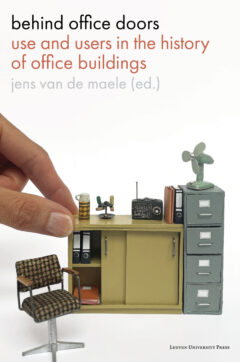
I think the book has turned out beautifully, both in its content and design, and I would like to take this opportunity to thank the contributing authors, as well as Siska Vastesaeger for creating the wonderful cover image. Working with the staff at Leuven UP was a real pleasure, and I can only express my appreciation for the speed and professionalism of everyone involved.
What social impact do you think the book can have, or would you like it to have?
Several chapters were written with a clear sense of social commitment, explicitly aiming to engage with contemporary problems – I am thinking of Petra Seitz’s reflections on capitalism in her analysis of labour relations at the Herman Miller furniture company, and Amy Thomas’s discussion of gender issues in relation to office design. Yet, in fact, all contributions – sometimes with greater historical distance and sometimes with a touch of irony – underscore that the “human condemned to work” (to paraphrase Belgian architectural theorist Geert Bekaert, who once spoke of the “human condemned to dwell”) is not only bound to labour but also often hindered by the very environments in which that labour is performed. Their voice is rarely heard, even as relentless productivity is expected. In that sense, the entire volume can be read as a historically grounded critique of various important 20th‑century phenomena: efficiency obsessions, the primacy of managerial thinking, the top‑down nature of design. At the same time, we need to be realistic about the actual social impact an academic book in a field like architectural history – even one that is open access – can have. If the book enables readers to better articulate the constraints and frictions they encounter in their own working environments, that is already a worthwhile outcome.
In what way do you think your book can shape future research in your research field?
First, the focus on use deserves further exploration. Too often, the user perspective is reconstructed from top‑down materials created by managers and designers, and the volume reflects that constraint to some extent as well: primary sources produced directly by office workers themselves – especially low-ranking ones – remain largely absent. This is partly due to the difficulty of locating such material (if it exists at all), yet it is striking how rarely methods such as oral history and workplace archaeology are employed, even though they could help address this gap. I hope the book encourages researchers to pursue such perspectives more actively.
Second, by bringing together contributions from different scholarly traditions, the book shows how valuable it is to combine such perspectives when analysing the office as a historical phenomenon in architectural, social and cultural terms. In the introduction, I refer to this as “historical office studies”: a field that treats the office as an autonomous object of study within an interdisciplinary framework. I hope the book can contribute to the further shaping of that field.
Third, the geographical scope of research needs to expand. The volume itself doesn’t go quite far enough in this respect: cases from the Global South and the communist world, for instance, are missing. Of course, this reflects the response to our call for papers, but it also points to structural inequalities that determine who can fully participate in “Western” academia. Consequently, there are huge opportunities for future research to broaden the field geographically.
What is your favourite part of the book and why?
One sentence that has especially stayed with me appears in Nicola Bishop’s chapter on representations of the office in popular culture, such as novels and television series. Among the many vivid and sometimes darkly humorous quotations she includes, a brief exchange from David Nobbs’s The Fall and Rise of Reginald Perrin (1976-79) stands out. Every morning Perrin leaves his suburban home after his wife cheerfully tells him to “have a good day at the office”, and he invariably replies that he “won’t”! It conveys, in just a few words, the quiet resignation with which office work often had to be endured.