Blog
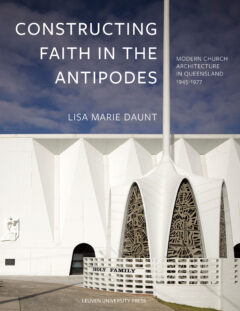
Lisa Marie Daunt | Constructing Faith in the Antipodes
16th December, 2025 in Author’s corner
Lisa Marie Daunt earned her PhD in March 2021 from the University of Queensland, Australia. An architect and architectural historian, Lisa’s work combines new design, heritage conservation, research and writing.
This book seeks to counter the culture cringe that many have for religious architecture in Australia, by presenting what are some of the most remarkable works of architecture built in Queensland during the post-war decades.
In Constructing Faith in the Antipodes, Lisa Daunt shows how Queensland’s church architecture was shaped by its unique time and place, offering a perspective distinct from northern hemisphere accounts of modernism. In this Q&A, Daunt shares how the research began, how the book took shape, and why its impact matters today.
Briefly and concisely explain in plain language what the book is about.
Over 1,650 churches were built in Queensland, Australia, between 1945 and 1977. They constitute some of the best modern architecture in the state and reveal tensions surrounding modernism’s role in cultural expression and regional identity. While much research has focused on post-war modern church architecture in the Global North, little has been done on the Global South.
This book offers a particular perspective on modernist church architecture, differing from accounts of buildings in the northern hemisphere, as it highlights how church architecture in Queensland was shaped by its very specific time and place – a young and developing state covering a vast area of land, sparsely populated, highly multi-denominational and located in the antipodes.
Modern architectural developments and emergent religious ideas did not simply transfer to Queensland. Rather, architectural ideas were circulated globally, allowing for a global narrative. This landmark study seeks to broaden views and methods for future research, both locally and internationally. Richly illustrated, Constructing Faith in the Antipodes combines both a chronological and a thematic approach to narrate modern church architectural history and offers a fascinating glimpse into a distinct collection of modern church buildings.
What or who inspired you to choose this topic?
I first started researching modern church architecture in 1999 for my undergraduate architectural thesis at the University of Queensland. The topic then was Brisbane’s 1960s church architecture, which was selected after my father suggested church buildings are interesting. John Macarthur, who supervised my undergraduate research, advised me that there was very limited research for 1960s churches. Having found a research gap to attempt to fill, I started collecting church opening dates to ascertain how many were built in this period in Brisbane and gathering research by others, much from Europe, though mostly the UK and also the US. I enjoyed this research and the task of writing the thesis. However, after submission of my undergraduate thesis in 2000 and gaining my degree, I then focused on architectural practice for 15 years.
In late-2015 a call for a doctoral candidate to research Queensland’s post-war churches by the University of Queensland’s School of Architecture drew me back to research. I was looking for a change, away from large scale government infrastructure projects, to focus again on community orientated design and architectural history. The doctorate became the perfect opportunity, and the topic was one I already had contributed to, my undergraduate thesis already cited in various local heritage citations and heritage studies. During the doctorate my supervisors – Janina Gosseye, John Macarthur and Sven Sterken – encouraged me to write with the intention of authoring a monograph. The doctorates examiners provided comments for future publication. The doctorate was never just that, it was the first draft of the book. My supervisors then were also a mix of Australian and Belgian academics, and the beginning of my connection to KU Leuven.
Did the book turn out the way you imagined it? In what way(s) did it or did it not?
From my perspective, the book has turned out exceptionally well. It has kept its integrity and has improved as it went through the various steps from doctoral thesis to published monograph. Improvements included greater clarity on the research’s position within the global context – as a study and what it gives and adds to the field of research on modern church architecture – as well as definition as to why the publication of this research matters for the retention and conservation of the buildings.
A further chapter was also added on modern religious art. This chapter was initially developed during my doctoral research, but care of the word limit imposed by University of Queensland, the decision was made to leave it out, then. This further chapter was always intended as part of the monograph; in fact, the volume would not be complete (in my opinion) without it.
What social impact do you think the book can have, or would you like it to have?
When buildings are demolished or heavily altered, many memories can be forgotten as well. The post-war years was a particular time where the shocks of world wars continued to have impacts on the lives of people all around the world. Australia may have been a distance from Europe but did not escape the effects of war. Studying community-focused buildings, like churches, we can gain a deep understanding of the social, cultural and religious history of the period. This is a building typology where social value was highly significant, however, in today’s more secular times, this can be too quickly forgotten.
The history of modernism is also not well known amongst the Australian community, beyond academia and those focused on this field of study. There is still a love it or hate it attitude prevalent for modern architecture. This monograph contributes answers to some questions frequently raised on modern architecture and for a building type most have experience directly (for better or for worse).
In what way do you think your book can shape future research in your research field?
This book seeks to provide a detailed understanding locally (for Queensland and Australia) on modern church architecture. This should counter ill-informed decisions of the past, too often informed only by a passing knowledge on the topic (most often only narrowly considered).
This book also seeks to counter the culture cringe that many have for religious architecture in Australia, by presenting what are some of the most remarkable works of architecture built in Queensland during the post-war decades.
More broadly, this book aims to garner interest from Europe and the United States, by providing new details for how these centres affected architecture elsewhere. The cascade of ideas and also the transferring of ideas back from the antipodes to Europe is understudied. So, I hope that other studies will follow this one and consider further the to date under explored networks of ideas, and how architecture connects people, communities and architecture all across the globe.
I thank Leuven University Press and KADOC for enthusiastically pursuing this publication with me.