

Blog
Hugo Frey and Maaheen Ahmed | The Visionary Art of Franco-Belgian Comics, 1930s to 1960s
1st December, 2025 in Author’s corner

Hugo Frey and Maaheen Ahmed at the opening of the exhibition ‘Visionary Comics: The collection of Alain Van Passen’ at Comic Art Museum in Brussels on 16 September 2025. Picture by Daniel Fouss.
Instead of reflecting well-known comics from this period, the catalogue makes the strategic choice of unearthing some of the most unusual, surprising and even stunning pages.
Based on the Alain Van Passen collection at Ghent University, the exhibition catalogue ‘The Visionary Art of Franco-Belgian Comics, 1930s to 1960s’ offers an insightful introduction to French-language comics of the mid-20th century. In this Q&A, editors Hugo Frey and Maaheen Ahmed share stories behind these lost and visionary comics.
Briefly and concisely explain in plain language what the book is about.
Focusing on comics magazines published between 1935 and 1965, this catalogue’s ten concise and colourful chapters reveal a ‘lost world’ of little-known often forgotten French and Belgian comics, as well as the translations and reworkings of American, British and Italian strips.
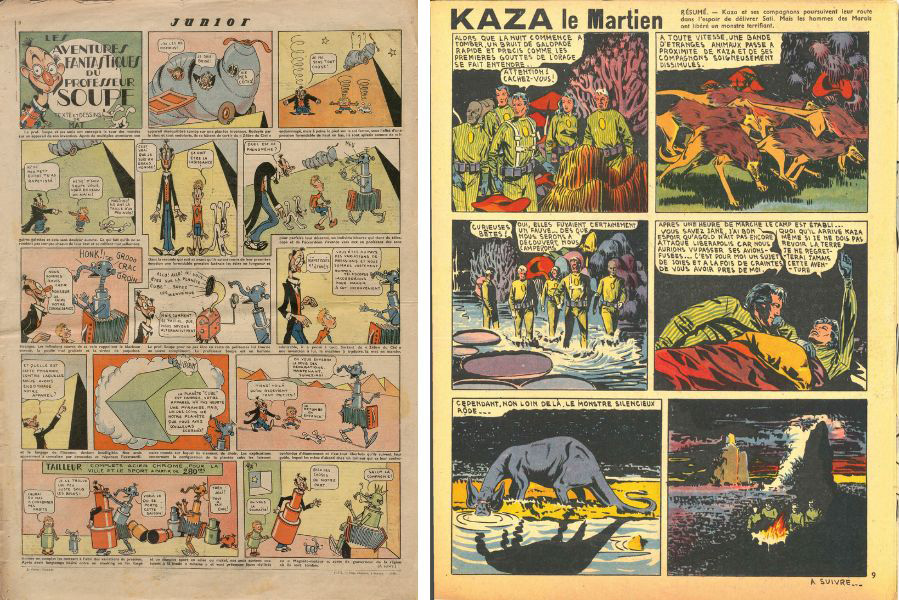
Selection of illustrations from the book
What or who inspired you to choose this topic?
The project was born from two different research trajectories. On the one hand, Maaheen Ahmed has been involved in the acquisition and valorisation of a unique comics archive at Ghent University – the Alain Van Passen collection. Active from the earliest days of European comics clubs, Van Passen specialized in French-language materials published in Belgium and in France from the 1930s onwards. His work as a collector is remarkable not only for its chronological and thematic scope but also for the pristine quality of many of the items. Thanks to the help of Philippe Capart, specialist of comics and visual culture and Ghent University’s Faculty Library of Arts and Philosophy, this vast corpus of works is now available for public access. On the other hand, Hugo Frey has pursued an interest in untrained art and the borderlines between art brut and comics creation inspired by, among others, Marc Steene, Roger Cardinal and Dan Nadel. From the outset it was clear to us that the Van Passen collection represented a vast treasure trove of too often overlooked, even surreal and visionary comics pages, as well as unique insight into the rich history of comics.
As we show in the catalogue, the Van Passen collection offers novel possibilities for exploring French-language comics history, not least by bringing to the surface remarkable artistry and storytelling that has been too often overlooked in favour of better-known classics. There are numerous odd and elaborate pages that seem highly avant-garde and innovative to contemporary eyes but which were not too unusual for a moment in comics history when the medium was still testing out numerous possibilities. Our search into the past for lost gems also revealed poignant life stories of comics greats whose careers never survived the abrupt hiatus in publication during WWII or bridged the moment when comics periodicals declined and the album began dominating the market. The catalogue invites readers to discover or learn more about magazines such as Junior, Bimbo, Bravo!, O.K and Héroïc-Albums, which inspired and trained an entire generation of artists and to (re-)encounter wacky comic strips such as Mat’s (Marcel Turlin) “Professeur Soupe,” René Pellos’ wildly fantastic “Futuropolis” or his superhero, “Atomas” or the richly coloured, surreal space opera, “Kaza le Martien” by Kline (Roger Chevallier).
Do you have any reading suggestions to share (books, blogs, journals, …) for anyone who wants to know more about the subject?
We strongly recommend Philippe Capart’s richly illustrated Du Privé au Public: la collection Van Passen versée à l’Université de Gand (Crypte Tonique no. 16, 2023), which offers in-depth insight into Van Passen’s life and adventures in collecting as well as the evolution of the comics collecting scenes in Belgium and beyond. The book has been translated into English and Dutch, with the help of the COMICS team at Ghent University. For more insight into the French context, we recommend Julie Demange’s thesis, Les premiers groupes d’amateurs de bandes dessinées, en France, dans les années 1960-70 : naissance de la bédéphilie ? (Université Paris I Panthéon-Sorbonne, 2023).
Of course the exploration for different, lost, odd, crazy comics also owes a great deal to the work of Dan Nadel who was kind enough to write a short preface to the catalogue and whose latest book is on the underground comics artist Robert Crumb. Nadel’s Art out of Time: Unknown Comics Visionaries, 1900-1969 (Abrams 2006) and Art in Time: Unknown Comic Book Adventures, 1940-1980 (Abrams 2010)were particularly inspiring reads.
The Swiss group of researchers, Alain Boillat, Françoise Revaz, Marine Borel, Raphaël Oesterlé’s critical anthology Case, strip, action! Les feuilletons en bandes dessinées dans les magazines pour la jeunesse (1946–1959) (Infolio, 2016) is a particularly rich and exciting read, mapping the narrative tools and cinematic connections of comics series.
The historian Thierry Crépin’s “Haro sur le gangster!”: la moralisation de la presse enfantine 1934–1954 (CNRS, 2001) sheds light on the hurdles faced by comics magazines, especially with the increasing prominence of US American comcis (and imitations thereof) through the period covered by our catalogue.
Sylvain Lesage’s extensive history L’Effet livre: Métamorphoses de la bande dessinée (Presses universitaires François-Rabelais, 2019) traces the rise and dominance of the album format, which will eventually supersede the comics magazines.
Last but not least, Pascal Ory’s Le Petit Nazi illustré: propagande et bande dessinée dans Le Téméraire (1943–1944) (Nautilus, 1979), is a groundbreaking study into the censorship and propaganda unfolding through Le Téméraire, published during the German occupation of France.
How did the writing process for this book go? Did you experience anything surprising, amusing or strange?
The quest for visionary comics was a group effort, involving four additional colleagues, all of whom contributed a chapter (Jan Baetens, Benoît Crucifx, Felipe Muhr and Eva Van de Wiele). Structured around the key popular genres and tropes in comics in the period from the 1930s to 1960s, the catalogue explores comics stories framed by war, aviation, superheroes, slapstick comedy, dinosaurs, adaptations of literary classics, science fiction and fantasy and pure visual experimentation. Stock characters, such as the many comic depictions of eccentric scientists and anthropomorphic animals, form additional chapters in the catalogue. In focusing on one these aspects, our main rule was to locate missing classics or unexpectedly fascinating pages.
The catalogue also includes interviews with Alain Van Passen and Philippe Capart. Both recount the amazing quality and historical import of the collection, while Alain also shares his original fascination with comics. Alain’s collecting began during the rise of serious comic fandom in the early 1960s and he reflects also on the emerging Belgian comics fan community that was networking and engaging with other European comics clubs, especially the Parisian Club des bandes dessinées. Van Passen was part of an extended circle of collectors based in Belgium and was part of the Belgian Comics Club from its inception.[1] Like many of his contemporaries, Alain’s engagement with comics was also part of a deep fascination with popular culture per se, encompassing cinema and other forms of popular culture, including fantasy and science fiction. What further shines through Alain’s memories is his profound knowledge and appreciation of the cultural heritage of comics. This was never a case of collecting for collecting’s sake but a lifelong appreciation and in-depth consideration of the material.
What would you like readers to remember about your book?
The catalogue offers a genuinely original, alternative approach to French-language comics from the 1930s to 1960s. Instead of reflecting well-known comics from this period, the catalogue makes the strategic choice of unearthing some of the most unusual, surprising and even stunning pages. Our framing of comics genres and tropes draws attention to the truly remarkable, unusual images, which we try to contextualize, as far as possible, within the historical moments of their production. More often than not these enquiries invite new and sustained research on individual creators and the outlets for their talents – the many visually diverse comics and their periodicals that have now receded into oblivion.
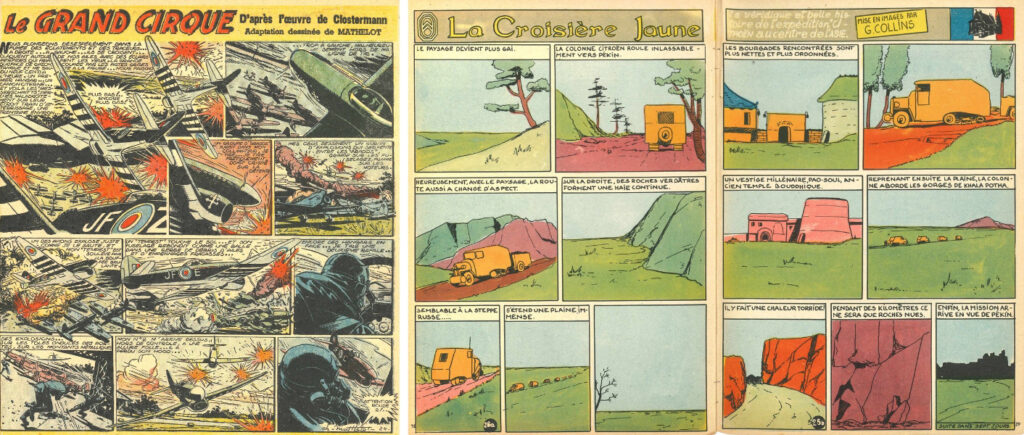
Selection of illustrations from the book
Do you have any plans yet for another publication? What will it be about?
Yes! Both of us have been quite busy. Maaheen has just completed a critical guide to the fascinating comics artist Lynda Barry, which will come out with Bloomsbury, as part of its Critical Guides to Comics series, in February 2026. Hugo has co-authored with Jan Baetens, The Look of the 1960s: Barbarella and Pulp Pop Comics which is also about to come out with University of Texas Press.
Hugo Frey is professor of cultural and visual history at the University of Chichester.
Maaheen Ahmed is an associate professor of comparative literature at Ghent University.
[1] Errata, p. 250. Van Passen did not found the Belgian Comics Club but was one of several founding members. It was Pierre Vankeer who was encouraged by Lacassin to form the club; p. 265 Michel Ferrol’s name was misspelled as Michel Ferrand.
Related Publications
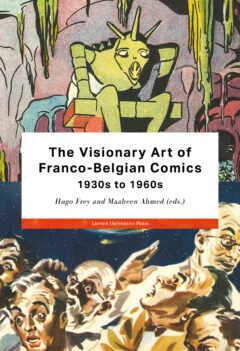 The Visionary Art of Franco-Belgian Comics, 1930s to 1960s
Hugo Frey (Editor), Maaheen Ahmed (Editor),
September 2025