Blog
Bram De Maeyer | Building for Belgium
22nd October, 2025 in Author’s corner

Bram De Maeyer is an architectural historian interested in diplomatic architecture. He is a voluntary researcher at the Faculty of Architecture (KU Leuven), where he earned his PhD in 2023.
The anecdote of a Belgian diplomat secretly moving the misplaced foundation stone of the Brasília embassy at night perfectly illustrates the importance of prestige and the fear of losing face in diplomatic circles. This theme runs like a thread throughout the book.
In Building for Belgium author Bram De Maeyer examines the Belgian Ministry of Foreign Affairs’ embassy-building programme from 1945 to 2020. More than the outcome of a deliberate policy, the programme has been shaped by incidental decisions, private ambitions and personal tastes of Belgian diplomats, ministry officials and politicians. “I sincerely hope this book contributes to fostering a more historically minded approach within the Belgian Ministry of Foreign Affairs—particularly in its real estate department.”, De Maeyer notes in this Q&A.
Briefly and concisely explain in plain language what the book is about.
This book sheds light on the embassy-building programme of the Belgian Ministry of Foreign Affairs from 1945 to 2020. Through a series of case studies, it examines the architectural conception, construction, and use of purpose-built Belgian embassies. It explores the extent to which the Ministry has intentionally invested in embassy architecture as a means of conveying diplomatic messages and projecting the nation’s image abroad.
What or who inspired you to choose this topic?
This book is the culmination of my PhD research at the Faculty of Architecture of KU Leuven. Between 2017 and 2023, I worked on the PhD project Designing Embassies for Middle Powers: The Architecture of Belgian Diplomacy in a Globalizing World, under the supervision of Professor Fredie Floré and Professor Anne-Françoise Morel. In 2017, I came across a job opening for a PhD researcher to study Belgian embassy buildings. Being interested in the relationship between architecture and political representation, I applied for the position—and, as they say, the rest is history.
Did the book turn out the way you imagined it? In what way(s) did it or did it not?
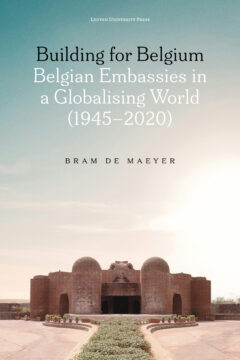
Absolutely—the book has exceeded my expectations. It’s beautifully edited, and the cover captures the imagination with its striking depiction of the Belgian embassy in New Delhi. As part of the redrafting process, I had to reduce the number of illustrations. I was concerned that the interplay between text and image might suffer as a result, but I’m glad to see that this is not the case.
What social impact do you think the book can have, or would you like it to have?
I sincerely hope this book contributes to fostering a more historically minded approach within the Belgian Ministry of Foreign Affairs—particularly in its real estate department. Over the years, the Ministry has periodically destroyed or discarded valuable documentation related to Belgian embassy buildings. This approach to preservation—or rather, the lack of one—reflects a broader absence of historical awareness within the Ministry regarding the heritage value of its diplomatic architecture. This is especially problematic in cases where embassy buildings are sold before their histories have been properly documented by academic research. I hope this book can help turn the tide.
In what way do you think your book can shape future research in your research field?
This book has contributed to shifting the perspective on embassy-building programmes from those of world powers to those of smaller state actors, such as Belgium. It is my sincere hope that it serves as a stepping stone for further research—both on the embassy-building efforts of small states in general and on the Belgian case in particular. Building for Belgium offers a close reading and initial interpretation of the design and construction of Belgian embassies. Expanding the discussion to include additional embassy projects may confirm, refine, or challenge the findings presented here and bring other important cases to light. I firmly believe that this book is by no means the final word on the fascinating and still understudied subject of (Belgian) diplomatic architecture.
What is your favourite part of the book and why?
My favourite part is the foundation stone-laying ceremony of the Belgian embassy in Brasília in 1960. Amidst the jubilant atmosphere that prevailed during the event, the Belgian and Brazilian delegations failed to pay close attention to where the stone was actually placed. In a clumsy turn of events, it was accidentally laid on the adjacent plot of land that had been allocated to Iran.
Once the mistake was discovered, the Belgian diplomatic corps feared it would spread like wildfire and turn Belgium into a laughingstock within diplomatic circles. As such, a Belgian diplomat quietly moved the foundation stone to the correct plot under cover of night.
This anecdote perfectly illustrates the importance of prestige and the fear of losing face in diplomatic circles. This theme runs like a thread throughout the book.
How did the writing process for this book go? Did you experience anything surprising, amusing or striking?
The bulk of the writing process took place during the final stages of my PhD trajectory. The writing stage largely coincided with the COVID lockdowns. In fact, the lockdown was ideally suited to write a book as there were significantly fewer distractions and social obligations. It provided the rare luxury of uninterrupted time for deep thinking and writing. During the writing process, I frequently listened to music. Some song titles even made their way into the book. Readers who manage to identify them are welcome to send me an email—though unfortunately, no reward is included.
What was the most challenging step in the entire creation process of your book?
The most challenging step was trimming the word count of my PhD dissertation to meet the limit set by Leuven University Press. It was no small feat to determine which parts had to be cut. With a heavy heart, I ultimately decided to remove the first chapter of my dissertation altogether. Writing, as the saying goes, is about killing your darlings. In my case, it felt more like mass murder.
What would have been good advice before you started this book project?
I would tell my former self that one does not simply redraft a PhD dissertation into a book. The two serve different purposes and speak to different audiences. As always, I underestimated how much time and effort the process would ultimately require. I would also remind myself not to be so hard on myself when I fell behind schedule while redrafting. The rewriting took place during my spare time—in the evenings, on weekends, and even during holidays.
What would you like readers to remember about your book?
Building for Belgium has demonstrated that one should be warry not to succumb to the fiction that an embassy-building programme is by default carefully guided and closely monitored by the state. Belgium provides a telling case in point with its incidental and ad hoc building policy and practice. Belgium’s embassy-building programme has not marked by the search for a dominant architectural aesthetic to express national identity abroad but instead by incidental decisions fueling an already ad hoc building programme.
If you could travel through time, where would you want to go to talk about your research/book?
If possible, I would like to pay a visit to my friend, Ambassador Robert Silvercruys. Traveling back to the Washington, D.C. in the 1950s, we would have a pleasant chat by the fireplace in his ambassadorial residence. Seated in his comfortable Louis XVI armchair, I would share my insights on his building plans and offer some advice on how to speed up the construction of his cherished chancery and silence his critics within the Ministry.
Your book is published open access. How did the open access publication process go? What makes open access so attractive for you/your book?
This book has been sponsored by the KU Leuven Fund for Fair Open Access. As a researcher, I know firsthand the frustration of encountering an interesting article or book locked behind a paywall with an exorbitant price tag. Since most academic research—including my PhD—has been publicly funded, it only makes sense that this work should circulate as widely as possible, ideally reaching all those interested in the topic of embassy architecture.
Do you have any plans yet for another publication? What will it be about?
Following a well-deserved break, I will embark on a new book project in 2026. It has long been my dream to write a book about the planned Belgian pavilion for the 1942 World’s Fair in Rome. Although the fair never took place due to the outbreak of the Second World War, the Belgian government had already developed advanced plans for a national pavilion on the Roman fairgrounds. This book will examine the architectural conception of the pavilion against the backdrop of Belgian diplomatic relations with Fascist Italy and the looming onset of another global conflict. The working title is already in place: Building Castles in the Sky: The Belgian Pavilion at the 1942 World’s Fair of Rome. Now, it’s time to write the pages.