Blog
Burcu Dogramaci | London Exile
11th August, 2025 in Author’s corner
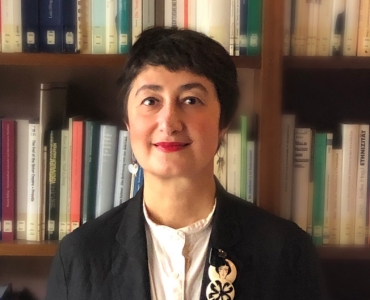
Burcu Dogramaci is professor of art history and director of the Käte Hamburger Research Centre global dis:connect at the Ludwig-Maximilians-Universität München.
‘London Exile’ aims to contribute to a rewriting of the history of modern art and to expose the significance of global connections and cross-border migration movements.
In her book London Exile Burcu Dogramaci explores the British capital of the 1930s and 1940s as a sanctuary for modern artists. She sheds light on how the arrival of exiles transformed London’s art scene and, conversely, how the experience of displacement and the city shaped the work of émigrés in fields such as art, architecture, and photography.
Briefly and concisely explain in plain language what the book is about.
The book London Exile looks at the British capital as a place of refuge for modernist artists. In the 1930s and 1940s, London was a metropolis of artistic exile and a place of refuge from Nazi persecution. The city offered its new arrivals opportunities and challenges: exiles founded galleries, publishing houses and magazines, cooperated with local artists, organised exhibitions, published, and connected through networks. Artistic and theoretical production emerged in close dialogue with the urban space. London Exile is dedicated to the diverse work of émigrés in art, architecture, and photography in dialogue with their city of exile and deal with unusual places: the London Zoo, Golders Green Crematorium, Hyde Park, Finchley Road, the house of the architect Ernö Goldfinger as an exhibition venue, the home of the psychoanalyst Sigmund Freud, and London street markets. The book brings art history, urban studies, and exile research into a productive dialogue and contributes to a new understanding of the history of modern art.
What or who inspired you to choose this topic?
During the so-called refugee summer of 2015, many people fleeing Syria and other countries arrived in Berlin and began to build a new life there. Restaurants and cafés opened, as did places dedicated to art and culture. Refugees come to big cities because others may have arrived there before them, they find connections to communities, and there are more work opportunities. I wondered whether cities were also a point of attraction for historical exiles. My research, which began in the early 2010s, confirmed this: London was an important destination for artists fleeing persecution in the 1930s and 1940s. At the same time London Exile is the result of a long-term research project dedicated to six global metropolises as places of refuge for modern artists: funded by an ERC Consolidator Grant, the project “Relocating Modernism: Global Metropolises, Modern Art and Exile (METROMOD)” at the Ludwig-Maximilians-Universität München (2017-2023) shed light on the interconnections of exile movements and cities – from Shanghai to Istanbul, from Buenos Aires to London.
Did the book turn out the way you imagined it? In what way(s) did it or did it not?
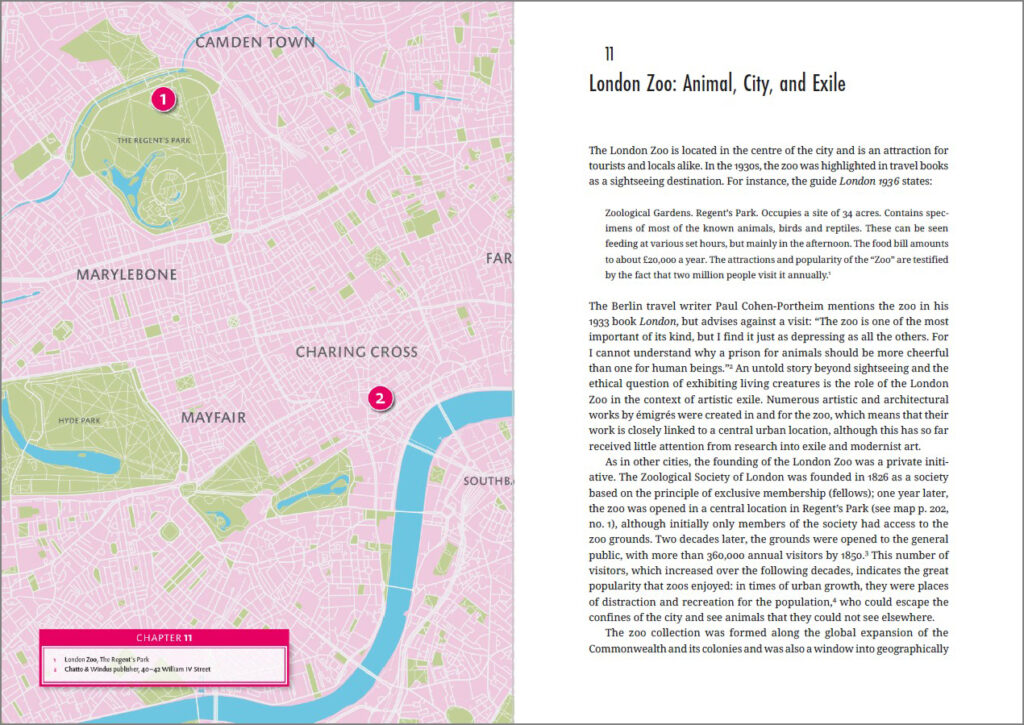
Yes, the book has taken on a form that I find thoroughly satisfying. The volume may have become somewhat voluminous, but each chapter can also stand on its own. The city maps that precede each chapter highlight my city-centred perspective, which brings together exile and research on modern art.
What social impact do you think the book can have, or would you like it to have?
In times when migration has become an affective that provokes negative reactions, my book aims to emphasise that migration and flight have a long history. In other words, flight phenomena are not singular, but flight could be considered as a conditio humana. My examination of historical flight phenomena refers to the 1930s and 1940s with refugee movements within Europe and from Europe to the rest of the world, spurred by dictatorship and war. This research could help to approach flight movements of our time with understanding and tolerance. Cities provide specific conditions for artistic “arrival,” as they are places of diversity and heterogeneity that allow for difference. In cities, refugees, exiles and migrants may identify themselves as Berliners or Copenhageners after a relatively short time without a document of belonging – such as a passport in a national context. This applies not only to contemporary migration movements, but also to historical ones – such as London in the 1930s and 1940s.
In what way do you think your book can shape future research in your research field?
For this book, recent findings from post-migrant research and sociological and cultural studies engaging urban research have been adapted for this historical topic. The book thus emerged within a triangle of exile and (post-)migration research, modernity and urban research. London Exile aims to contribute to a rewriting of the history of modern art and to expose the significance of global connections and cross-border migration movements – in other words, to write a history of art on the move.
What is your favourite part of the book and why?
My favourite part is the chapter on London Zoo as an important location for the work of émigré artists, as it shows that there are hidden or lesser-known stories of escape in unusual places that only come to light through careful examination and research.