

Blog
Herman Westerink and Philippe Van Haute | Seduction, Drive and Repetition
30th July, 2025 in Author’s corner
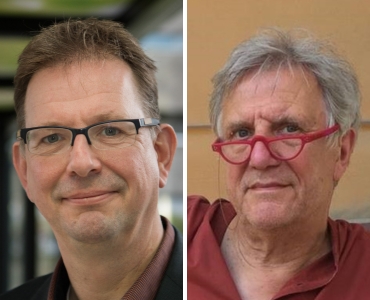
Herman Westerink is endowed and associate professor at the Center for Contemporary European Philosophy at Radboud University Nijmegen. Philippe Van Haute (†) was full professor at the Center for Contemporary European Philosophy, Radboud University Nijmegen, and extraordinary professor at the University of Pretoria.
Trauma comes to the fore as the key topic in his thinking and this makes Freud again relevant for contemporary discussions of individual and collective trauma.
Seduction, Drive and Repetition makes the compelling argument that the key to understanding Freud’s clinical writings and psychoanalytical theories lies in his trauma theory. The authors argue that Freud never truly abandoned his initial trauma theory – the seduction theory – in favour of the Oedipus complex and the primacy of fantasy. A Q&A with author Herman Westerink.
Briefly and concisely explain in plain language what the book is about.
The book is about Freud’s trauma theory in both his clinical writings and metapsychology. The book claims that central to Freudian thought is the notion of trauma. The development of his thinking can largely be understood from further reflections on trauma in both individual life and the development of the human species and culture.
What or who inspired you to choose this topic?
The book took inspiration from previous project and the search for a non-oedipal psychoanalytic theory.
Did the book turn out the way you imagined it? In what way(s) did it or did it not?
The book turned out the way we imagined it. Our readings of key texts in Freud’s oeuvre confirm our initial intuitions and hypothesis.
What social impact do you think the book can have, or would you like it to have?
The book will (hopefully) revitalize Freudian theory as a theory that cannot be reduced to an oedipal theory. Trauma comes to the fore as the key topic in his thinking and this makes Freud again relevant for contemporary discussions of individual and collective trauma
In what way do you think your book can shape future research in your research field?
The book on the metaphysics of trauma is likely to shape future research in trauma studies and continental metaphysics in particular. The book also rewrites the historiography of psychoanalysis.
What is your favourite part of the book and why?
The favourite parts are the chapters on Beyond the Pleasure Principle and Moses and Monotheism. These are the most groundbreaking chapters.
How did the writing process for this book go? Did you experience anything surprising, amusing or striking?
The book was a joint adventure for both authors, and challenge to our collaboration, and a test of friendship. We succeeded! It was an absolute joy working together and stimulating each other’s thought.
What was the most challenging step in the entire creation process of your book?
The most challenging part of the project was the reading of Beyond the Pleasure Principle and trying to get a grip on that text.
What would you like readers to remember about your book?
Readers should remember how rich and multi-facetted Freud’s thinking is. What is truly amazing in Freud is the flexibility and honesty of his thinking, and the capacity to always critically engage with one’s own ideas.
If you could travel through time, where would you want to go to to talk about your research/book?
I would like to go back to the seventies and discuss Freud with Foucault and Deleuze.
Do you have any plans yet for another publication? What will it be about?
The next major project will be a monograph on Freud’s Beyond the Pleasure Principle.
Seduction, Drive and Repetition: Freud’s Metaphysics of Trauma is the English translation of Verleiding, drift en herhaling: Freuds metafysica van het trauma, Herman Westerink, Philippe Van Haute (Boom 2022).
Related Publications
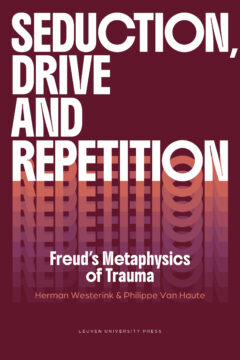 Seduction, Drive and Repetition
Herman Westerink (Author), Philippe Van Haute (Author),
September 2025