

Blog
David John Boyd and Julie Briand-Boyd | Superhero Comics and Scottish Identity
16th June, 2025 in Author’s corner
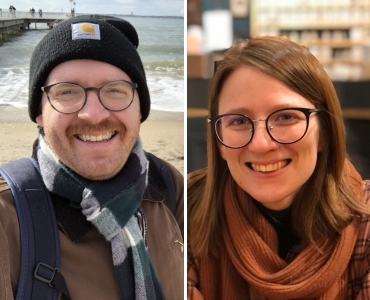
David John Boyd and Julie Briand-Boyd are post-doctoral research fellows at the Stirling Maxwell Centre of the University of Glasgow.
Frank Quitely is widely celebrated in the comics world, but far less attention has been paid to how deeply his work engages with the cultural, historical, and visual identity of Glasgow and Scotland.
Superhero Comics and Scottish Identity explores the life and career of Glasgow-born, Eisner Award-winning, and internationally acclaimed Marvel, DC, and Image Comics artist Frank Quitely. In this work authors David John Boyd and Julie Briand-Boyd investigate questions of historical and contemporary expressions of Scottishness in transcultural comics genres such as superhero, science fiction, and fantasy. “What began as a portrait of a Glaswegian artist evolved into a broader meditation on how local identity and global aesthetics intersect in the comics form.”, explain the authors.
Briefly and concisely explain in plain language what the book is about.
Superhero Comics and Scottish Identity reveals the hidden intersections between global superhero stories and the local rhythms of Scottish life through the visionary art of Glasgow’s own Frank Quitely. Quitely’s vivid imagery and distinct style quietly grapples with Scotland’s historical memory, urban landscapes, and conflicted sense of cultural identity. Whether depicting Batman wrestling with his Scottish ancestry or Superman soaring above symbolic Glaswegian landmarks, Quitely’s comics elegantly blur cultural borders, challenging readers to reconsider what it truly means to be Scottish in an era of American superheroes and global narratives. This book celebrates Quitely’s subtle yet powerful visual storytelling as a significant contribution to contemporary conversations about place, identity, and cultural imagination.
What or who inspired you to choose this topic?
The initial spark came from conversations we had with Frank Quitely at conferences and exhibitions between 2015 and 2017, marked by his curated retrospectives at the Hunterian Museum and Kelvingrove Art Gallery and Museum. Seeing his work framed within Glasgow’s cultural institutions – not just as comics art, but as part of a national visual heritage – prompted us to think more deeply about the relationship between superhero narratives and Scottish identity. But the real catalyst was reading Batman: The Scottish Connection, a comic book Quitely illustrated with Alan Grant. It struck us as much more than a tourist-tinged spin-off; it was a dense, ironic, self-aware grappling with history, memory, and diaspora, rendered through the unlikely medium of Batman. That comic, combined with the richness of Frank’s visual imagination and our ongoing dialogue, made it clear that this was a story worth telling: how Scotland haunts the superhero genre from the inside out.
Did the book turn out the way you imagined it? In what way(s) did it or did it not?
It turned out far better than we had imagined: richer, more layered, and more far-reaching. Initially, we thought we were writing a focused cultural study of Frank Quitely’s Scottishness in comics. But as we followed the threads of his art, the book naturally expanded outward. We found ourselves tracing global influences across Belgian bande dessinée, Japanese manga, American superhero traditions, and post-industrial visual culture. What began as a portrait of a Glaswegian artist evolved into a broader meditation on how local identity and global aesthetics intersect in the comics form.
What social impact do you think the book can have, or would you like it to have?
At its core, this book is about drawing attention to Frank Quitely’s remarkable ability to encode Scottish history, class experience, and cultural memory into the globally recognisable language of superhero comics. We hope it helps people see how his work speaks to Glasgow’s post-industrial legacy, to the creativity that persists amid economic austerity, and to the quieter forms of political reflection embedded in visual storytelling. In the wake of Brexit, with a stalled independence movement and rising economic hardship, there’s a sense that Scotland is drifting, culturally and politically. We don’t claim this book offers a solution. But we do hope it reminds readers that cultural work matters, that the imagination is a political force, and that artists like Quitely are helping us think through what it means to be Scottish today: neither trapped in nostalgia nor entirely absorbed by global media flows, but negotiating something more strange, ambivalent, and open-ended, through the practice, theorisation and education of the arts.
In what way do you think your book can shape future research in your research field?
We hope it contributes to a broader shift in taking popular and commercial artists seriously, not as exceptions, but as essential cultural voices. Frank Quitely is widely celebrated in the comics world, but far less attention has been paid to how deeply his work engages with the cultural, historical, and visual identity of Glasgow and Scotland. By treating his art with the same critical care afforded to canonical painters or filmmakers, we want to encourage future researchers to think beyond traditional hierarchies of “high” and “low” culture.
Comics artists like Quitely are not just entertainers: they are participants in the aesthetic and civic development of their communities, cities and nations, and their work deserves to be studied as such. We hope this book helps open the door for more serious engagement with visual culture as a means of narrating and negotiating national identity in the 21st century.
What is your favourite part of the book and why?
David’s favourite part is Part 3: The Bottled City of Glasgow. It’s where the book becomes most speculative and expansive. The title riffs on Kandor, the shrunken Kryptonian city from Superman lore, and uses that image to explore how Glasgow exists in Quitely’s imagination as both miniature and mythic, local and global, past and possible future. That section allowed us to trace the transnational circuits of influence – across America, France, Belgium, Japan – while also thinking about how a city like Glasgow can be represented through commercial art without being flattened or caricatured.
Julie’s favourite part is Part 1: Sketching Scotland. This section explores how Quitely’s visual idiom constructs a nuanced portrait of Scottishness through close attention to facial expression, gesture, and place. This part of the book demonstrates how comics can act as critical sites of cultural reflection, allowing questions of memory, history, and belonging to unfold without being fixed.
How did the writing process for this book go? Did you experience anything surprising, amusing or striking?
Co-writing a book as a husband-and-wife duo – especially with a toddler and a newborn in the mix – is no easy feat. We wrote this across Scotland and France, juggling family life, time zones, and the usual academic constraints. But somehow, we found a rhythm. The process was deeply personal for us as well. Glasgow is the city where we met and became a family, and this book is a love letter to the city and the nation of Scotland, a place we will always refer to as home.
In the writing process specifically, what truly surprised us was how generous and intellectually open Frank Quitely was from the very beginning. He didn’t just give us interviews: he gave us context, artwork, stories, and reflections that transformed the book. His thoughtfulness and precision as a visual storyteller came through in conversation just as clearly as it does on the page.
What was the most challenging step in the entire creation process of your book?
The hardest part was writing about Scottish identity with care, precision, and humility. As a Scottish American and Breton co-authoring team, we weren’t looking in from the outside, nor fully speaking from within. We were somewhere in between. But that in-betweenness gave us a particular responsibility: to be attentive, thoughtful, and committed to Scotland’s cultural future, without overreaching. We didn’t want to define Scotland; we wanted to support and bolster it. And that meant listening to its history, to its people, and above all, to the ways Frank Quitely’s art renders those contradictions visible in subtle, complex, and profound ways.
What would have been good advice before you started this book project?
Good advice? Don’t rush the final stages. Give the book space to breathe, especially after you think you’re finished.
The research and writing process were intense but invigorating; the real work came in shaping it all into a clear, polished, and readable book. That takes time, distance, and fresh eyes. We were extremely fortunate to work with such a generous and patient editorial team at Leuven University Press. Their insight and professionalism helped guide the manuscript into its final form, and I can’t overstate how important that collaborative trust was.
What would you like readers to remember about your book?
We’d like readers to come away with a renewed appreciation for Frank Quitely as a vital figure in the Scottish arts tradition, someone who belongs alongside the country’s great visual storytellers, in both the fine arts and comics art traditions.
At the same time, we remain sceptical of the idea of canons, of how they’re formed, who they include, and who they leave out. But that’s part of the point: this book is an invitation to reimagine what a national arts tradition can look like in the twenty-first century. Quitely’s work isn’t just popular or global; it’s deeply rooted in the textures of Glasgow, in the political shadows of post-industrial Scotland, and in the imaginative futures of its people. We hope readers see that, and remember him as a comics artist, a civic leader, and a cultural thinker, too.
If you could travel through time, where would you want to go to to talk about your research/book?
If we had to choose, we’d travel not too far back, maybe to post-war Glasgow, during the decline of the shipyards, when comics were being passed around like currency among working-class kids. We’d like to sit in on one of those moments where American superhero comics – meant as disposable ballast on cargo ships – sparked the imagination of Scottish readers, from the young and old alike. That, after all, is the soil Frank Quitely’s art grew out of: the transatlantic drift of culture, the local interpretation of global forms, and the power of image to offer something more than escape.
Your book will be published open access in a few years from now. What makes open access so attractive for you/your book?
Our book is part of the JSTOR’s Path to Open programme, which means it will become freely accessible within three years of publication. That model struck a meaningful balance between sustainability and access, and we’re deeply grateful to Leuven University Press and its partners for making it possible.
Open access is especially important for a book like this – one that engages with comics, popular culture, and national identity – because it invites a broader readership beyond the academy. We want this book to be read by fans, artists, students, and curious Glaswegians who might see their own city reflected in Frank Quitely’s work. For us, open access isn’t just a publishing option; it’s a form of cultural commitment, aligned with the very themes of accessibility and public imagination that the book explores.
Do you have any plans yet for another publication? What will it be about?
Yes, David’s next book is titled Deleuze and Global Animation: Estranged Cinema, forthcoming with Edinburgh University Press. It explores how animated films from across the world push beyond the limits of traditional film theory, especially Gilles Deleuze’s famous writings on cinema. The book traces how animation introduces new ways of thinking about movement, embodiment, and visual expression, and it brings together case studies from Africa, Asia, the Americas, Europe, and Oceania. It’s both a philosophical reflection and a celebration of global animation as a form of radical, estranged, and imaginative world-making.
Related Publications
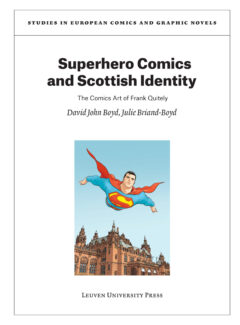 Superhero Comics and Scottish Identity
David John Boyd (Author), Julie Briand-Boyd (Author),
July 2025