

Blog
Raf Van Rooy | Student Notes from Latin Europe (1400–1750)
28th April, 2025 in Author’s corner
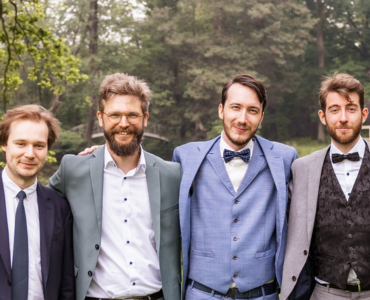
The four editors of the volume ‘Student Notes from Latin Europe (1400–1750)’. From left to right: Xander Feys, Raf Van Rooy, Andy Peetermans, Maxime Maleux
Investigating student notes from so many centuries ago is a complex challenge, especially because they come in so many forms and you need a lot of skills to tackle them.
In ‘Student Notes from Latin Europe (1400–1750)’, a diverse group of specialists explores the technical and practical challenges of reading, interpreting, and editing student notes. The volume also highlights how these sources can enrich a wide range of historical research. “Our workshop showed that there was a need for a research companion for scholars starting in the field,” explains one of the editors, Raf Van Rooy.
Briefly and concisely explain in plain language what the book is about.
The book is about the notes students took during their classes in early modern Europe, mostly in Latin, but also in other languages (Greek, vernacular, …). To all students who read this: please preserve your own student notes for future historians!
What or who inspired you to choose this topic?
Our long-standing fascination with the Leuven Collegium Trilingue led us to delve into its student notes, which inspired a workshop on the topic. This workshop attracted international specialists working on various regions and institutions and showed the need for a research companion for researchers starting in the field.
Do you have any reading suggestions to share (books, blogs, journals, …) for anyone who wants to know more about the subject?
For the Trilingue, there are two excellent PhD theses by two of the editors (Xander Feys and Maxime Maleux), which offer a list of relevant scholarship (as does our companion, of course!). Our website www.dalet.be also offers a digital gateway to student notes from the Trilingue in the sixteenth century, whereas Magister Dixit constitutes a database of dictates from Leuven. KU Leuven Libraries Expo has relevant blogposts as well. On the broader topic, there are so many books and publications to mention, especially the work of Ann Blair, Tony Grafton, and their numerous talented students. But much ground-breaking work is also being done in Germany, Italy, and France, for instance. Library blogs also offer interesting reading about annotated books.
How did the writing process for this book go? Did you experience anything surprising, amusing or strange?
Since we did not opt for traditional conference proceedings, this book took a relatively long time to materialize (4 years since the online workshop in 2021). As editors, we sometimes regretted this decision because it required an extra effort. Looking back, however, we are very happy with the result and with the fact that we did go that extra mile. Many of the contributors share this view. Several of them have indicated to us that they wished this book had existed when they started working on early modern student notes!
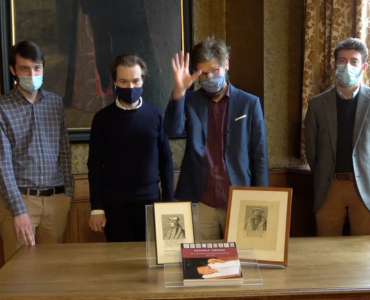
As an anecdote: the pandemic forced us to organize the workshop online, but we really wanted to show the participants the holdings of our special collections at KU Leuven Libraries. That’s why we organized a virtual excursion to our special collections through a filmed book showcasing, available at https://www.youtube.com/watch?v=KciXKhxHhV0. The picture below is taken from this video recording.
What would you like readers to remember about your book?
There are so many things to remember! The main takeaway is that investigating student notes from so many centuries ago is a complex challenge, especially because they come in so many forms and you need a lot of skills to tackle them. But it is a challenge worth taking up, because it offers a host of new perspectives on early modern history, which are highlighted in the second part of the book.
Do you have any plans yet for another publication? What will it be about?
Two of the editors (Maxime & Xander) will be turning their dissertations into monographs to make them more widely accessible. Raf is starting a monograph on the uses of Latin and Greek in the early Renaissance (1397-1536), in the work of Erasmus of Rotterdam and others, e.g. Greek migrants of the period working in Italy and elsewhere. He’s also working with a team on the publication of a 1565 praise of Antwerp in Ancient Greek.
Related Publications
 Student Notes from Latin Europe (1400–1750)
Xander Feys (Editor), Maxime Maleux (Editor), Andy Peetermans (Editor), Raf Van Rooy (Editor),
May 2025
