Blog
Rudy Jos Beerens | Painters and Communities in Seventeenth-Century Brussels
16th September, 2024 in Author’s corner

Rudy Jos Beerens, PhD, is an art historian and curator at the RKD — Netherlands Institute for Art History in The Hague.
I wanted to take things further by exploring the broader networks that shaped painters’ careers—going beyond the usual case studies of individual artists to reveal the patterns that connected them all.
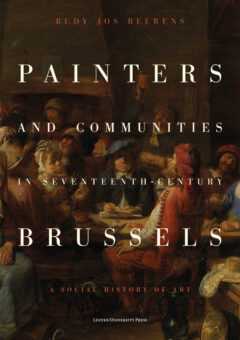
In seventeenth-century Brussels, the careers of painters were shaped not only by their artistic talents but also by the communities to which they belonged. Author Rudy Jos Beerens explores the intricate relationship between the social structures and artistic production of the 353 painters who became masters in the Brussels Guild of Painters, Goldbeaters, and Stained-Glass Makers between 1599 and 1706.
Briefly and concisely explain in plain language what the book is about.
This book explores how 17th-century Brussels painters were shaped by the people and communities around them. It looks at how their social connections influenced not just their careers, but also the art they created—revealing the ways their environments played a major role in their success.
What or who inspired you to choose this topic?
My work with Project Cornelia, a digital art history initiative led by Koenraad Brosens at KU Leuven, sparked this book. Since 2012, the team has been diving deep into how social and economic ties shaped the artistic world of early modern Flemish artists—initially focusing on Brussels and Antwerp’s tapestry industries. When I joined in 2016, I realized these social dynamics were just as relevant to painters. Art historians were already uncovering fascinating stories about who knew whom, but many studies missed the bigger picture. I wanted to take things further by exploring the broader networks that shaped painters’ careers—going beyond the usual case studies of individual artists to reveal the patterns that connected them all. It’s like zooming out on a puzzle to see how all the pieces fit together.
Do you have any reading suggestions to share (books, blogs, journals, …) for anyone who wants to know more about the subject?
Very little has been written about Brussels painting. The city and its artists have long been overshadowed by Antwerp. However, there are some great resources available. For example, Koen Brosens has written extensively about Brussels tapestry. There are fascinating monographs on Brussels painters like Michaelina Wautier by Katlijne van der Stighelen, Michael Sweerts by Lara Yeager-Crasselt, and Denijs van Alsloot by Sabine van Sprang. For those interested in methodology, The Routledge Companion to Digital Humanities and Art History is a fantastic resource, alongside works by Diana Seave Greenwald, Angela Jager, Weixuan Li, Claartje Rasterhof, Sandra van Ginhoven, and others who explore materialist perspectives in art history.
How did the writing process for this book go? Did you experience anything surprising, amusing or strange?
Despite the pandemic throwing a spanner in the works towards the end of my PhD, the writing process for this book went quite smoothly. It took me to places I would otherwise never have gone, and especially during the early years when I spent a lot of time in the archives, the surprises quickly piled up.
I encountered centuries-old doodles in the margins of archival documents and stumbled upon lively accounts of failed transactions, disputes, and detailed descriptions of collaborations and work processes.
Working with these often handwritten sources gave me a unique feeling of getting very close to the artists themselves. It added a new dimension to the art now displayed in museums and highlighted the complex, often surprisingly relatable lives behind those canvases and panels. The archival discoveries not only enriched my understanding but also made the whole process more engaging and personal—a feeling I aimed to capture in my book whenever the discussion allowed.
What would you like readers to remember about your book?
While I hope readers will remember that, for many master painters in seventeenth-century Brussels, communities were as crucial to their success as their artistic talents, I hope above all to highlight how combining quantitative data analysis with qualitative case studies can offer new insights into art history.
Do you have any plans yet for another publication? What will it be about?
Yes, I’m currently researching how Gouda transformed into one of the largest tapestry centers in The Netherlands between 1580 and 1620. This fascinating shift was largely driven by an influx of skilled refugees from Oudenaarde and its surroundings, who brought their tapestry-making expertise to Gouda.
In this research, I’m investigating how these artists managed to seamlessly introduce their labor- and capital-intensive industry to a new city. I’ll examine the strategies they employed to achieve success and the impact of their migration on spreading Flemish artistic traditions throughout the Northern Netherlands.
Much like my previous work on Brussels painters, this project will blend quantitative and qualitative methods to uncover fresh insights into this vibrant period of artistic and economic transformation.