Blog
Pamela Karimi | Women, Art, Freedom
6th September, 2024 in Author’s corner

Pamela Karimi is an associate professor of history of art and architecture at Cornell University. Her expertise lies primarily in the art, architecture and visual culture of the modern and contemporary Middle East.
During the peak of the Woman, Life, Freedom uprising, the anonymous art activism on the streets, in art colleges across universities, and by prominent artists who openly expressed solidarity was overwhelming.
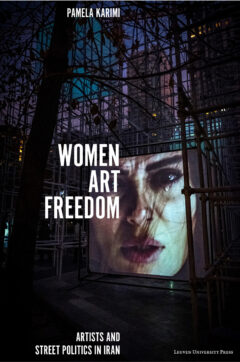
Women, Art, Freedom offers an insightful look at the 2022 Woman, Life, Freedom uprising in Iran, sparked by the tragic murder of Jina Mahsa Amini at the hands of the “morality police” for violating hijab rules. Engaging with primarily Iran-based artists, Pamela Karimi uncovers their role in shaping guerrilla interventions and street occupations and in articulating distinct forms of peaceful civil disobedience. “This book is ultimately about peaceful resistance and the elegant, deliberate skills required to cultivate it.”, states Karimi.
Briefly and concisely explain in plain language what the book is about.
The book explores art and activism on the streets of Tehran and other major cities during the Fall 2022 uprising in Iran, known as “Woman, Life, Freedom.” This movement is considered by many to be the first quasi-revolution in the world centered entirely on freedom and women’s rights. Iran’s art scene is always vibrant and dynamic, with artists from various disciplines—ranging from theater and performance to installation and street art—long engaged in everyday acts of resistance and peaceful demands for greater freedom of expression and civil liberties. During the 2022 uprising, this group of artists became particularly active. Beyond the extraordinary bravery of the youth, especially young women who protested in the streets, artists played a central role in communicating the uprising’s message. This book explores the art produced during, before, and after the peak of this historic movement.
What or who inspired you to choose this topic?
During the peak of the Woman, Life, Freedom uprising, the anonymous art activism on the streets, in art colleges across universities, and by prominent artists who openly expressed solidarity was overwhelming. Many artists were arrested, detained, or were subjected to physical punishment, such as lashes. Professors at universities lost their jobs or were suspended from their positions at various institutions. Galleries lost their licenses or were forced to close their doors due to their support for the protesters. These events deeply inspired me to learn more about the courageous individuals behind these acts of bravery.
Initially, it was challenging to identify some of the key players, as many operated in disguise or under pseudonyms. However, after extensive research and interviews with those closely connected to the art scene in Iran, I was able to track down many of them.
Did the book turn out the way you imagined it? In what way(s) did it or did it not?
The book turned out exactly as I had envisioned it. As an architect, my primary interest was in how artists interact with public spaces, particularly streets and other urban environments. Initially, I wasn’t sure how much information I could gather about this type of spatial movement involving art and creativity. However, after spending hundreds of hours speaking with artists and other creative agents, I was able to shape the book as I had hoped—focusing predominantly on the lens of spatial behavior and activism.
I also envisioned presenting the book through “acts,” much like a theatrical play. I chose acts instead of traditional chapters or sections for two reasons. First, “acts” better capture the spontaneous and performative nature of these interventions, as opposed to something formal or static. Second, many of these activities are still unfolding, so the movement is far from over and remains a work in progress. The ten “acts” through which I tell the story of art and activism in Iran perfectly capture the ongoing essence of the Woman, Life, Freedom uprising.
What social impact do you think the book can have, or would you like it to have?
I hope the book conveys the level of sophistication involved in the fight for freedom and democracy in Iran and other parts of the world. Often, we encounter protests through snapshots on social media or in the mainstream media, where they can appear chaotic, as if people are simply reacting without much forethought or planning. My book aims to show that these protests are the result of years of practice and, for lack of a better word, “planning.” To effectively challenge authorities, confront bigotry, and stand up to dictatorship, careful strategy and even counterstrategy is essential.
While many artistic acts of protest might seem spontaneous, my book reveals that they are deeply rooted in years of expertise, practice, and knowledge passed down by previous generations of artists or honed by the same artists through years of engagement with political and activist art. I hope readers will understand how informed and deliberate the people of Iran are about their demands and needs. I hope the readers come to realize that Iranians are fully capable of shaping their own future without necessarily relying on intervention from foreign powers, which often comes with ulterior motives and military force.
This book is ultimately about peaceful resistance and the elegant, deliberate skills required to cultivate it.
In what way do you think your book can shape future research in your research field?
The field of art history has long been dominated by a Western-centric canon. In our classrooms, practices, pedagogy, and publications, the focus often leans heavily towards art and theories that originate in the Western hemisphere or developed countries. We frequently discuss the European Avant-Garde, American artists involved in the civil rights movement, feminist actions, and the Vietnam War, but we rarely engage with or give proper recognition to activism that is homegrown in other parts of the world. This imbalance is unhealthy.
In today’s globalized world, it’s crucial to honor the bravery of artists worldwide and study them in the way they deserve—not merely through the lens of Western art theory, but through themes and ideas that are meaningful to the artists themselves within their local contexts. This isn’t to say that global artists are indifferent to Western art and theory—they are very much engaged with these ideas. However, it’s important to examine how these concepts are translated into different cultural contexts and what they signify in those settings.
My book is an effort to explore this, focusing on how artistic ideas and activism are translated and expressed in Iran—how artists there perceive the world and how they navigate the unique circumstances they find themselves in.
What is your favourite part of the book and why?
My favourite part of the book is a chapter where I introduce the work of a group of artists who come from a background in poetry and literature but have ventured into performative poetry, known in Persian as she’r ejra. Discovering this group of artists was a revelation for me. Iran is often more recognized for its rich poetry and literary traditions than its visual arts, so bridging these two genres was an absolute pleasure—something rarely explored by other art historians.
How did the writing process for this book go? Did you experience anything surprising, amusing or striking?
The writing process for this book was like a rollercoaster. On one hand, speaking with artists filled me with excitement and elation, inspired by their bravery, creativity, and cleverness. On the other hand, it was deeply distressing to learn about the heavy price some paid for their involvement in art and activism during a political movement that shook the world.
A fascinating aspect of the process was engaging in discussions with male artists who are steadfast supporters of women’s rights, with many even identifying as feminists. They embraced feminism not only in the conventional sense but also in a way that is understood and practiced in Iran.
As a result, what began as a book about women and art evolved into something broader—not just art created by women or art focusing on women’s themes, but art that addresses “parafeminist” issues, to borrow a term from art historian Amelia Jones.
What would you like readers to remember about your book?
I want my readers to remember the immense effort it took to make a feminist movement possible. I also hope they appreciate the way I’ve packaged a complex situation into 10 “acts” and how I’ve connected these acts to the politics of space. Some people closely observing the Woman, Life, Freedom uprising might feel they already know everything and don’t need to read another book about it. But what this book achieves, in my humble opinion, is a unique way of telling the story of this complex movement.
Even if some readers are familiar with the art discussed (though I doubt they know all of it, as much of it remains unknown to outside observers and is only fully understood within the closed circles of Iranian artists), they can still learn something about the art of storytelling. Words matter, and how you tell a story matters.
If you could travel through time, where would you want to go to talk about your research/book?
I’m a realist, so I don’t indulge in impossible dreams. But if I could (financially and politically speaking), I would cross geographic boundaries and travel to countries where people are still fighting desperately for basic human rights. I wish I could embark on a book tour in these places, sharing stories of bravery with the youth and showing how movements—no matter how they might appear to be relics of the past or incomplete in achieving all of their goals—can serve as steppingstones for future generations.
By preserving the legacy of others through writing and documentation, I hope to reach out and bring a spark of light to those who are sitting in darkness, struggling to find hope for the future.
Your book will be made open access within three years of publication thanks to JSTOR Path to Open. What makes open access so attractive for you/your book?
I hope that the Open Access route, made possible through the generous efforts of multiple institutions working with Leuven University Press, will make my book more accessible to those who cannot afford to purchase it due to financial reasons, political restrictions, or other limitations. My wish is that people from disadvantaged communities find something in this book that brings them hope, and that they see the lives of those who were killed or harmed by this movement, and others like it, were not in vain.
Do you have any plans yet for another publication? What will it be about?
My next publication explores a slightly different topic, but my commitment to exploring the relationship between politics and creativity remains unchanged. My upcoming book, tentatively titled Survival by Design: Desert Architecture at the End of the World, aims to reveal the connections between architecture and environmental issues in arid regions.