Blog
Anne Douglas and Chris Fremantle | Thinking with the Harrisons
9th September, 2024 in Author’s corner
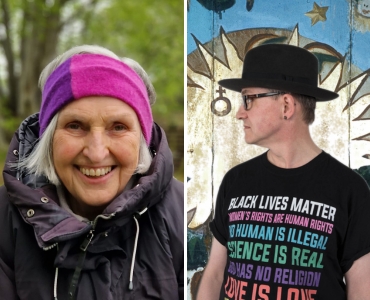
Anne Douglas is a Professor Emerita, Gray’s School of Art, Robert Gordon University, Scotland, who explores the changing place of the artist in public life. Chris Fremantle is a researcher and producer of award-winning projects, including the Harrisons’ project ‘Greenhouse Britain: Losing Ground, Gaining Wisdom’.
The Harrisons invite us to imagine life as a living system and both are foundational to coming to grips with the challenges in a way that planetary life is changing.
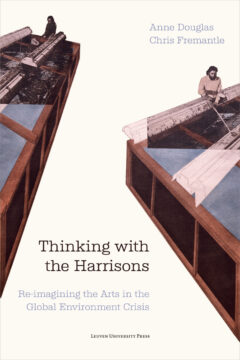
Helen Mayer Harrison and Newton Harrison, known as ‘the Harrisons’, dedicated five decades to exploring and demonstrating a new approach to artistic practice, centred on “doing no work that does not attend to the wellbeing of the web of life.” Their collaborative practice pioneered a way of drawing together art and ecology. Authors Anne Douglas and Chris Fremantle ‘think with’ the Harrisons, critically tracing their poetics as a reimaging and reconfiguring of the arts in response to the unfolding planetary crisis. In this Q&A, Douglas and Fremantle share their insights.
Briefly and concisely explain in plain language what the book is about.
Our aim is to explore what the arts can bring to the global environment crisis and we do this through the work of Helen Mayer Harrison (1927-2018) and Newton Harrison (1932-2022) because they started asking the question of how to reimagine human relations with the natural environment. They began in the early 1970s and continued exploring approaches for another 50 years. We also touch on a number of other artists of a younger generation (Lauren Bon, Brandon Ballengée, Tim Collins and Reiko Goto-Collins, Annie Sprinkle and Beth Stephens, Ruth Wallen) who share these concerns and are in dialogue with the Harrisons.
We recognise that philosophers of science such as Bruno Latour, Donna Haraway, Anna Tsing, and for us particularly Isabelle Stengers are opening up how the global environment crisis is brought about through the formation of technoscience – a science that is organised by capitalism and harnessed to industrial productivity. Stengers chooses to ‘think with’ an early 20th century philosopher, Alfred North Whitehead, and we follow her into exploring Whitehead’s process philosophy, a philosophy that focuses on the dynamic nature of life as ever changing. This informs our analysis of the Harrisons’ series of quasi-scientific experiments (which can also be understood as DIY urban farming). They are called the Survival Pieces and the contradictions that they generate in these experiments lead them to create The Lagoon Cycle, generally regarded as their masterwork. The Lagoon Cycle is an epic 360ft mural composition of poetic text and image which starts with a question about farming crabs for food. They skirt the danger that the success of their experimentation could become industrial fish farming and pollute the Gulf of Mexico and even the Pacific Ocean. Their insights lead them into questioning whether we can ever enter into dialogue with the universe. We trace key themes from this central focus through later works such as The Serpentine Lattice and into the most recent Force Majeure works using key concepts from Whitehead. He seeks a different characterisation of science from the reductionism of technoscience, one that undertakes an adventure in which all our senses and our imagination need to be involved in grasping life as emergent.
In many ways we might summarise the book by saying it is a specific response to Latour’s suggestion to scientists that the arts offer more than ‘popularisation and ornamentation’. The Harrisons provide a significant example of the ways in which the arts draw attention to the importance of a deep understanding of improvisation, of the emergence of systems aesthetics as relevant to the crisis, and of the value of a public space where judgement, as developed and manifest in aesthetic experience, has a significant role to play in the formation of new form of politics, one focused on creating a common world through difference.
What or who inspired you to choose this topic?
We were very privileged to know Helen Mayer Harrison and Newton Harrison for more than a decade thanks to an invitation from our colleague and friend David Haley to present at a symposium in 2005 where they were giving a keynote. We were able to work with the Harrisons on two projects (Greenhouse Britain: Losing Ground, Gaining Wisdom (2007-09) and On the Deep Wealth of this Nation, Scotland (2017-2019)). In fact, we were invited by them to write about their earlier work.
Our central concern is with arts practice today, and how artists learn from other artists. The Harrisons perceived the crisis in the 1970s through the then public concern with pollution, pesticides, and radiation, and even at this point they understood that these were symptoms of deeper environmental changes. While writing the book over the last 5 years the scale of the crisis has escalated. More and more artists are creating work in response. The Harrisons call this escalation the Force Majeure, evoking circumstances beyond our control but in which nonetheless, the question of responsibility arises.
We had already produced several articles exploring the Harrisons’ works and approaches from a practice-led research perspective, focused on the making of the work, its poetics and its relation to experience in the world. In this book we needed to challenge our own thinking on their work and position it in a wider context, principally where thinking in the arts on environmental issues meets thinking in the sciences with implications for the political.
Did the book turn out the way you imagined it? In what way(s) did it or did it not?
Initially we liked the idea of ‘thinking with’ as it seemed a warm, imaginative way into connecting the Harrisons’ work with their legacy to other artists and researchers including ourselves. Stengers’ approach to ‘thinking with Whitehead’ proved a great deal more challenging than expected. It involved reading Whitehead in the original, foregrounding the significant thinking that the sciences are undergoing, and the ways in which they are critical of technoscience and its political implications for the environment. This opened up a new set of connections between the arts and sciences, pointing to a different hierarchy of value that in turn informs a reimagining of the political. To confine the Harrisons’ work to the art world and its discourses would mean that its energy would eventually dissipate. Opening the work up to wider perspectives and practices, particularly others seeking to reimagine a related field of practice, would mean putting the available energy that their work offers to work in the world. The Harrisons’ work with scientists and their inclusion of ecological understanding in their works is well documented. Exploring current concerns in the philosophy of science through their work has helped us to give voice to what the arts might contribute. One key point is that the Harrisons do not offer solutions, but ways to think and feel the issues, to think for ourselves.
What social impact do you think the book can have, or would you like it to have?
The Harrisons work addresses the most important challenges of our time. They do not flinch from the implications. They open up pathways for addressing these challenges through the arts at a moment in time in which the sciences are reified as wealth producing and where questions on the damage to the environment are not allowed to be asked, a point that Stengers helped us to recognise. It is in this sense that their work is much more than ornamentation and popularisation. It is an invitation to face the challenges, think them through as a diverse community of participants with different knowledges, and develop new political forms that respond to what we find out. Hopefully the book will first and foremost support the work of younger artists, producers, scientists, activists and ecologists asking similar questions, not just through well informed descriptions of particular works in this groundbreaking practice, but also by harnessing ways to think critically and grasp the kind of contribution the arts now make at this particular moment in history.
Chris and Anne have been invited to co-ordinate a programme of events as part of ‘Helen and Newton Harrison: California Work’, a major four venue exhibition being held in San Diego from September 15th 2024 as part of the Getty Institute’s PST initiative.
In what way do you think your book can shape future research in your research field?
As artist researchers, we are keen to have artistic research understood, and for it to be developed, as a significant research field alongside the sciences. This book through its particular content has involved us in tracing how the arts can be in dialogue with other research fields while remaining itself, doing what the arts do best.
The arts and artistic research operate like the sciences in a world of artifice, man-made, produced through the human imagination and they do so in quite different ways. Where positivism in the sciences has tended to escape the world that is given, the arts seek to question and reimagine what livingness of the world means. Our approach seeks to reveal how artists work, research and innovate and place the arts and humanities centrally within current challenges alongside other research fields.
What is your favourite part of the book and why?
Anne’s favourite part was the opportunity to explore the Harrisons’ seminal work, The Lagoon Cycle, in some depth. When I first encountered this work in 2005, it was a struggle to follow its thread, though its provocative and joyful tone was not lost on me. Through repeated readings, sometimes in public, sometimes in private over years, it has become more and more clear as a complex epic poem, interlinking the visual and literary, experience and ideas. The poem tells the story of fish farming, the collision between Western (US based) values of productivity and non-Western (Sri Lankan) local practices that work with the givenness of natural resources. The analysis we undertook in Chapter 3 kept revealing more nuances, different tones and colours, challenging a range of ideas from colonialism to neoliberal economics, and the effects of industrialisation on the environment.
Another favourite part was exploring the incredible insights that Newton relayed to us from both his and Helen’s experience of the work of other artists that had influenced them: Rembrandt’s reversing of the way light is used in a painting, reducing light to reveal spirituality; Giotto’s story telling through images in the Arena chapel that led them to develop The Lagoon Cycle as a mural of architectural scale; Albers’ insight into the boundary between one colour and another that informed their understanding of political versus ecological boundaries in human practices. These insights enabled us to relive our many conversations with the Harrisons, exploring the nature of their decision making as artists informed by other artists in the Western canon.
Chris: One of my favourite parts is how Isabelle Stengers’ provided us with a guide to ‘thinking with’, asking ‘what is made to matter?’, ‘what is made silent?’, ‘how are the criteria of judgement affected?’, and ‘what becomes an obligation as a result?’ The elegant simplicity of these questions belies the work they make you do.
How did the writing process for this book go? Did you experience anything surprising, amusing or striking?
We have co-authored many journal articles and delivered many papers on the Harrisons’ work for over 25 years, as colleagues and friends. What was surprising was the differences that this book unearthed in our individual approaches and ways of thinking. Chris’ interest in systems aesthetics challenged Anne and her resistance to systems. Her interest is in improvisation and emergence. Systems appeared to contradict improvisation. The two interests frequently came into collision. With time this led to the insight that systems and improvisation could be imagined as a counterpoint to each other and to an extent belong in relation to each other, to the same world. The book has made us confront our differences and challenged us to come to terms with these and move forward. It made the process of writing more challenging than anything we had previously co-authored, but also more interesting, as if on a visceral level of experience, the Harrisons performing of their own differences, often in public, was living in us and affecting the development of our own understanding.
What was the most challenging step in the entire creation process of your book?
In addition to the above, one of our reviewers challenged us to read Whitehead in the original and not rely entirely on Stengers’ interpretation of his works in her own process of ‘thinking with Whitehead’. We thought the book had reached a stage of near completion when this challenge was offered, and it has proved to be incredibly sound advice. It has opened our thinking to the significance of process philosophy as a way to step outside the assumptions that currently appear to trap and frustrate the development of a different kind of consciousness in relation to the environmental crisis: the idea that there are no real alternatives to capitalist/neoliberal economics, or that our political systems need to become increasingly hierarchical and top down to control climate change at a global level. Reading Whitehead has been and remains a journey into seeing how our understanding of nature is limited and constructed around human self-interest and that there are alternatives that make demands on us as imaginative beings, trusting our experience in the world, capable of a ‘leap of the imagination’ to a completely different understanding. These parallel and resonate with the way the Harrisons invite us to imagine life as a living system and both are foundational to coming to grips with the challenges in a way that planetary life is changing.
What would have been good advice before you started this book project?
It would have been useful to know at the beginning that the book would need patience, focus, and the skill to encounter difference as generative.
What would you like readers to remember about your book?
Hopefully the book will introduce readers to the remarkable work that is currently ongoing/led by artists in relation to the environment, not just the work of the Harrisons, but also others (Bon, Ballengée, Collins and Goto-Collins, Sprinkle and Stephens, and Wallen mentioned earlier, as well as Mierle Laderman Ukeles, Hans Haacke, and now historical figures such as John Latham). In addition, it might reveal how and why art is important in a world in crisis. For readers already familiar with the work of these artists, hopefully the book has offered new insights and opened a different set of connections that may prove useful not just in the making of future work, but in understanding the fundamental value of the arts in society.
If you could travel through time, where would you want to go to talk about your research/book?
Following the Harrisons’ example, we would like to talk to primary, secondary and tertiary levels of education, along with those who may have ‘dropped out’ of formal education; to politicians, policy makers and economists who are sceptical of the environmental crisis, along with those that support it by researching alternatives; and to leaders of institutions and organisations that currently find it difficult to step outside of a world dependent upon techno science as the only way to imagine the future.
Your book will be made open access from 2027 onwards thanks to JSTOR Path to Open. What makes open access so attractive for you/your book?
The open access process will take place in three years’ time. The application has been made by the publishers, Leuven University Press. It is attractive to this book because as a scholarly work, it will widen the readership. It will mean that young researchers and artists in particular, working within or out with institutional settings, will be able to access the book without undue expense.
Do you have any plans yet for another publication? What will it be about?
Individually, yes.
Anne is developing a new text ‘Copying Klee’, into drawing as an exploratory practice into a different understanding of ‘nature’. The underpinning research was funded by the Knowing from the Inside Research, a five-year European Research Council Advanced Grant held by Professor Tim Ingold (2013-18).
Chris’ next piece of writing will also be co-authored and explores the ways that artists create art with trees, woods and forests through intergenerational projects. Examples include Joseph Beuys’ 7000 Oaks’, Katie Paterson’s ‘Future Library’, Cathy Fitzgerald’s ‘The Hollywood Forest Story’, and Alan Sonfist’s ‘Time Landscape’.