

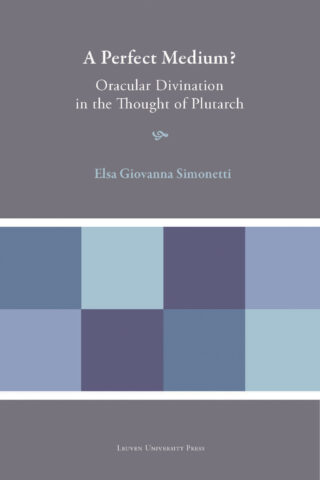
A Perfect Medium?
Oracular Divination in the Thought of Plutarch
Elsa Giovanna Simonetti (Author),
Series: Plutarchea Hypomnemata
Category: Classical Literature
Language: English
ISBN: 9789462701113
Publication date: September 24, 2017
€77.00 (including 6% VAT)
Buy NowNumber of pages: 256
Size: 234 x 156 x mm

Stock item: 117954
Standard delivery time for print books:
For Belgium: 5 to 8 working days
For EU: 2 to 3 weeks
For other countries: 4 to 5 weeks
Series: Plutarchea Hypomnemata
Category: Classical Literature
Language: English
ISBN: 9789461662361
Publication date: September 24, 2017
€65.00 (including 6% VAT)
Buy NowNumber of pages: 256
An in-depth analysis of oracular divination in Plutarch’s thought
Oracular divination was of special concern for Plutarch of Chaeronea (45–120 AD), Platonic philosopher as well as priest at the oracle of Apollo in Delphi. The peculiar nature of Delphic divination as an (im)perfect intermediary between the material and the immaterial world is fathomed in a thorough study of Plutarch’s Delphic dialogues. This in-depth philosophical-conceptual analysis will disclose an original interpretation of oracular divination in Plutarch as interconnected with his psychological and cosmological conceptions. A Perfect Medium? reveals the Delphic temple as a crucial element in Plutarch’s philosophy, as a microcosm reflecting the cosmic dynamics, and as a symbol embodying the relationship between human thirst for knowledge and divine absolute wisdom.
This publication is GPRC-labeled (Guaranteed Peer-Reviewed Content).
Acknowledgements
Introduction
1. An analysis of De Pythiae oraculis
1. Introduction
1.1. The character of Diogenianus and the style of philosophy
1.2 The role of the symbol
1.3 The function of the temple
2. The concept of krâsis
3. Prodigies
4. From poetry to prose
5. Enthusiasm
5.1 Body and soul
5.2 The soul of the Pythia
5.3 The dynamic of enthusiasm
5.4 The features of the Pythia
6. The history of the oracle
7. Solar symbolism
2. An analysis of De defectu oraculorum
1. Introduction
2. The character of Didymus and the style of philosophy
3. Narratives and inquiries
4. God’s responsibility
4.1. A plurality of worlds
5. The demons and the moon
5.1 Demonology, the kinds of divination and the structure of the soul
6. The psychology of divination
7. The sun and god
8. The theory of double causation
9. The theory of double causation applied on oracular divination
9.1 The pneûma
9.2 The role of the demons in the temple
9.3 Preliminary sacrifices and the concept of ‘kairos’
9.4 Delphi as a unique place
10. The Pythia
3. An analysis of De E apud Delphos
1. Introduction
2. Importance of symbols and riddles for philosophy and rational reflection
3. Tentative solutions
3.1. Apollo. The god of popular devotion
3.2. Religion and logic
3.3. Numerology and Pythagoreanism
4. Ammonius’ explanation
4.1. Ammonius: Apollo and the sun
4.2. Ammonius’ explanation of the ‘E’
5. The final image of Apollo and Plutarch’s god
5.1. Fate-providence-freedom
6. Plutarch’s dualism
6.1. Egypt and Oriental religions
7. ‘Conclusion’ and value of the dialogue
4. Divination and the soul
1. Plutarch’s psychology: the individual soul and the world soul
1.1. The individual soul
1.2. The cosmic soul
1.3. The analogy between the individual and the cosmic soul
2. The psychology of individual divination
3. Plutarch and the Timaeus
3.1. A ‘likely account’
3.2. Some remarks on the practical dynamics of Delphic divination
4. The “matter” of divination
4.1. The multiple characters of the Pythia
5. Apollo and the oracle: from chaos to harmony
6. The importance of studying the oracle
Conclusion
Bibliography
Abbreviations
Dictionaries
References
Index Locorum
Overall, this is an extremely thorough, erudite, and convincing exploration of Plutarch's philosophical conceptions of oracular divination, which offers a detailed and sensitive analysis of Plutarch's philosophical theories regarding the operation and efficacy of divination and makes an extremely important contribution to scholarship on ancient philosophy and its relationship with divination. As such, this work should be read by all scholars and postgraduate students of ancient philosophy and Graeco-Roman religions. It will also be immensely useful for scholars and students in philosophy, classics, religious studies, theology, and anthropology.Crystal Addey, Bryn Mawr Classical Review
2019.02.13
Frequently Asked Questions
What is "A Perfect Medium?" about?
An in-depth analysis of oracular divination in Plutarch’s thought
Oracular divination was of special concern for Plutarch of Chaeronea (45–120 AD), Platonic philosopher as well as priest at the oracle of Apollo in Delphi. The peculiar nature of Delphic divination as an (im)perfect intermediary between the material and the immaterial world is fathomed in a thorough study of Plutarch’s Delphic dialogues. This in-depth philosophical-conceptual analysis will disclose an original interpretation of oracular divination in Plutarch as interconnected with his psychological and cosmological conceptions. A Perfect Medium? reveals the Delphic temple as a crucial element in Plutarch’s philosophy, as a microcosm reflecting the cosmic dynamics, and as a symbol embodying the relationship between human thirst for knowledge and divine absolute wisdom.
This publication is GPRC-labeled (Guaranteed Peer-Reviewed Content).
Who wrote "A Perfect Medium?"?
"A Perfect Medium?" was written by Elsa Giovanna Simonetti.
Elsa Giovanna Simonetti obtained her PhD in philosophy from Università di Padova and KU Leuven in 2016.
Is "A Perfect Medium?" part of a series?
Yes, "A Perfect Medium?" is part of the "Plutarchea Hypomnemata" series.

The series Plutarchea Hypomnemata intends to further the scholarly study of, and international dialogue on, this rich Corpus Plutarcheum. To that end it welcomes monographs that explore specific themes developed in one or more Plutarchan writings, offer a thorough interpretation of and/or commentary on a particular text, or discuss various aspects of Plutarch's authorial activity, philosophical thinking, religious ideas, political convictions, and attitude towards history, science, and the arts. We also welcome studies that situate him in broader ideological and literary contexts (such as the so-called ‘Second Sophistic', ‘Middle Platonism', ancient biography) and/or in a contemporary political, social, and religious context.
Volumes in this series meet the highest scholarly standards and contribute significantly to the field of Plutarch studies. Specifically, they raise innovative questions while firmly grounded in sound methodology; they reach well-argued and original conclusions; and they are disseminated in the appropriate scientific format. This overall quality is guaranteed by international peer review.
Editorial Board
Jan Opsomer (KU Leuven), Geert Roskam (KU Leuven), Frances Titchener (Utah State University, Logan), Luc Van der Stockt † (KU Leuven)
Proposals
Proposals and enquiries can be sent to Geert Roskam. Please send a preliminary abstract (1-2 pp.) and a short bio. Upon approval of this abstract, the full manuscript will be submitted to international peer review. Two peer reviewers will be asked for expert advice, three in case of conflicting reports. At least one peer reviewer is not a member of the editorial or advisory board.
Please make use of the submission form to present your manuscript or proposal to our board.
Authors interested in Open Access can consult the available funding options.
Links & Resources
What is the Table of Contents for "A Perfect Medium?"?
Acknowledgements
Introduction
1. An analysis of De Pythiae oraculis
1. Introduction
1.1. The character of Diogenianus and the style of philosophy
1.2 The role of the symbol
1.3 The function of the temple
2. The concept of krâsis
3. Prodigies
4. From poetry to prose
5. Enthusiasm
5.1 Body and soul
5.2 The soul of the Pythia
5.3 The dynamic of enthusiasm
5.4 The features of the Pythia
6. The history of the oracle
7. Solar symbolism
2. An analysis of De defectu oraculorum
1. Introduction
2. The character of Didymus and the style of philosophy
3. Narratives and inquiries
4. God’s responsibility
4.1. A plurality of worlds
5. The demons and the moon
5.1 Demonology, the kinds of divination and the structure of the soul
6. The psychology of divination
7. The sun and god
8. The theory of double causation
9. The theory of double causation applied on oracular divination
9.1 The pneûma
9.2 The role of the demons in the temple
9.3 Preliminary sacrifices and the concept of ‘kairos’
9.4 Delphi as a unique place
10. The Pythia
3. An analysis of De E apud Delphos
1. Introduction
2. Importance of symbols and riddles for philosophy and rational reflection
3. Tentative solutions
3.1. Apollo. The god of popular devotion
3.2. Religion and logic
3.3. Numerology and Pythagoreanism
4. Ammonius’ explanation
4.1. Ammonius: Apollo and the sun
4.2. Ammonius’ explanation of the ‘E’
5. The final image of Apollo and Plutarch’s god
5.1. Fate-providence-freedom
6. Plutarch’s dualism
6.1. Egypt and Oriental religions
7. ‘Conclusion’ and value of the dialogue
4. Divination and the soul
1. Plutarch’s psychology: the individual soul and the world soul
1.1. The individual soul
1.2. The cosmic soul
1.3. The analogy between the individual and the cosmic soul
2. The psychology of individual divination
3. Plutarch and the Timaeus
3.1. A ‘likely account’
3.2. Some remarks on the practical dynamics of Delphic divination
4. The “matter” of divination
4.1. The multiple characters of the Pythia
5. Apollo and the oracle: from chaos to harmony
6. The importance of studying the oracle
Conclusion
Bibliography
Abbreviations
Dictionaries
References
Index Locorum
Related titles

 Diogenes of Oinoanda · Diogène d’Œnoanda
Jürgen Hammerstaedt (Editor), Pierre-Marie Morel (Editor), Refik Güremen (Editor),
March 2017
 Quaestiones super Priora Analytica Aristotelis
Radulphus Brito (Author), Gordon Wilson (Editor),
December 2016
 A Versatile Gentleman
Jan Opsomer (Editor), Geert Roskam (Editor), Frances B. Titchener (Editor),
June 2016
 Ancient Perspectives on Aristotle’s De anima
Gerd Van Riel (Editor), Pierre Destrée (Editor),
March 2013
 Les dialogues platoniciens chez Plutarque
Xavier Brouillette (Editor), Angelo Giavatto (Editor),
March 2013
 Platons Timaios als Grundtext der Kosmologie in Spätantike, Mittelalter und Renaissance
Thomas Leinkauf (Editor), Carlos Steel (Editor),
December 2005
 Platonic Ideas and Concept Formation in Ancient and Medieval Thought
Gerd Van Riel (Editor), Caroline Macé (Editor),
November 2004
 Speculum divinorum et quorundam naturalium Parts XIII-XVI
Henricus Bate (Author), Guy Guldentops (Editor),
March 2002
 Aristotle’s Zoology and its Renaissance Commentators (1521-1601)
Stefano Perfetti (Author),
October 2000