Blog
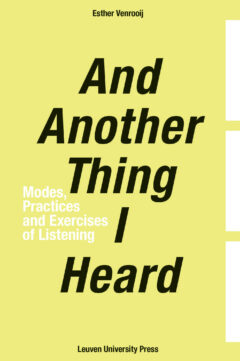
Esther Venrooij | And Another Thing I Heard
19th August, 2026 in Author’s corner
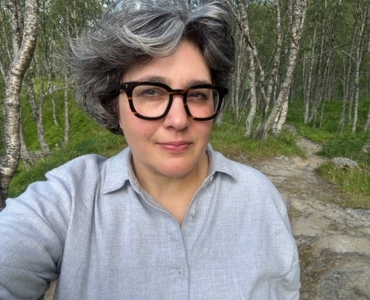
Esther Venrooij is composer, artist, and educator. She is professor of Mixed Media and Audio Topography at KU Leuven and LUCA School of Arts in Ghent.
Listening is not passive. It is something you can practice, something you can get better at, something that can change how you experience the world.
And Another Thing I Heard sets out to open your ears. Esther Venrooij offers a rich map of the various ways we engage with sound: how it reaches the body before the mind, how it reveals space, and how it carries meaning and memory. What does it mean to truly listen? Esther Venrooij reflects on sound, attention, and practice.
Briefly and concisely explain in plain language what the book is about.
This is a book about listening, but not in the earnest, fold your hands and eyes squeezed shut kind of way. It is about the many ways we can tune in, and also about why we so often tune out. I wrote it because I spend a lot of time around art students who are busy making visual things, and I kept noticing that they forgot about the ear. Sound was just there, like wallpaper. But listening, real listening, is not wallpaper. It is a kind of attention that changes how you experience everything.
The book is divided into modes and practices. Modes are the different orientations you can take toward sound, perceptual, interpretive, contextual. Practices are the things you actually do with those orientations. You can listen to spaces, walk and listen, listen with your body, listen to the unheard voices in a city. I also included a whole section of exercises, because I believe listening is something you do, not something you read about and then put back on the shelf.
Some of the exercises are quite ordinary. Sit in a room and notice the sounds. Others are more peculiar. Clap in a stairwell and let the echo talk back to you. Imagine the sound of an object that has never made a sound. Ask someone to sing a song from their childhood and listen to what happens between the notes. The book is not a lecture. It is more like a collection of small invitations to pay attention, and maybe to laugh at yourself when you realise how little you were hearing before.
What or who inspired you to choose this topic?
The book came from years of teaching at LUCA School of Arts, where I found myself explaining contemporary music, composition, performance, and sound art to students who had mostly been trained to use their eyes. They would show me their work, full of visual ambition, and I would gently suggest that maybe their ears could join the party. There was always a moment, a small spark in their eyes, when something clicked. When they realised that sound was not just background noise but a material they could work with, like paint or clay. That spark is what I wanted to capture and pass on.
As for the voices that guided me, there were many. Michel Chion and Pierre Schaeffer gave me the language to talk about sound as an object, something you can examine without immediately asking what it means or where it comes from. Murray Schafer opened my ears to the environment, to the idea that the world is a composition whether we notice it or not.
But the two that really lodged themselves in my memory are Eliane Radigue and Akio Suzuki. I once saw Radigue listening to her own sounds in a space, not performing, not explaining, just sitting there and letting the sound tell her where it wanted to go. It was not a demonstration. It was a lesson in patience. And Akio Suzuki performed in my kitchen once. My kitchen. He turned that ordinary, unremarkable room into a place where sound became visible, where you could almost touch it. That stayed with me. If a kitchen can become a concert hall, then listening can happen anywhere. That is really what the book is trying to say.
Did the book turn out the way you imagined it? In what way(s) did it or did it not?
Not really. The book I imagined was a modest little collection of exercises from other people. I thought I would send out some emails, gather contributions from musicians, artistic researchers and artists I admired, and arrange them nicely. A sort of listening cookbook. It seemed manageable.
Then I sent those emails and realised that a collection without a framework is just a pile of things. I needed to create some order, some structure that would help people understand why they were doing these exercises and what they were supposed to learn from them. So I went back to the sources, Pierre Schaeffer and Michel Chion, and started building. At that point I did not think I would be adding anything to their work. I was just borrowing their categories, grateful to have somewhere to start.
If a kitchen can become a concert hall, then listening can happen anywhere. That is really what the book is trying to say.
The turning point came during a doctoral committee in Acoustics. They were presenting listening tests with city noise, and I asked what kind of listening they were using. They had not really thought about it. I explained that in my classes we choose our modes of listening depending on what we want to discover. A spatial mode, a source mode, a temporal mode. They were intrigued. That conversation stuck with me. It made me realise that these modes were not just academic curiosities. They were practical, teachable, and surprisingly absent from the literature.
So the book grew. It became a framework with exercises attached, rather than just a collection. I also realised that most writing about listening stays frustratingly abstract. Sound is treated as a philosophical idea rather than something you can actually work with. I wanted to change that. I wanted to give people techniques, not just inspiration. The book I ended up with is much more substantial than the one I imagined, and much more personal. But I think that is a good thing. It is the book I needed to write, even if it was not the book I planned.
What social impact do you think the book can have, or would you like it to have?
I would like the book to have a very modest social impact. I would like it to help people clean things up. We are living in extraordinary times, wonderful in some ways, but also exhausting and saturated. There is so much noise. Not just the noise of traffic or construction, but the noise of information, of crisis, of constant alarm. It wears us down. It makes us numb. In the Prelude I wrote about Gaza, about the documentary Gaza Sound Man, about a sound engineer named Mohamed Yaghi who kept recording even as everything around him fell apart. Listening in this context is not a luxury. It is not a relaxation technique. It is a way of witnessing. What I hope the book can do is give people some tools to navigate this noise. Not to escape it, but to engage with it more deliberately. To choose what they attend to, to notice what is being drowned out, to hear the voices that are not being amplified.
I do not think a book about listening can change the world. But I do think it can change how we inhabit it. And in times like these, that might be the most important thing.
In what way do you think your book can shape future research in your research field?
There is a strange contradiction in art education. We talk about sharing, about community, about openness. But in practice, there is still a lot of hoarding. Knowledge is kept close, methods are guarded, and the creative process remains hidden behind a veil of mystery. You see the finished work, the exhibition, the performance, but you rarely see the years of practice, the failures, the small breakthroughs that made it all possible. As an artistic researcher, I feel an urgency to change this. I want to share methods, practices, insights, and skills. Not because I have all the answers, but because I have seen too much knowledge disappear into individual studios, never to be passed on. I have seen students struggle because no one ever showed them how to create, how to pay attention, how to turn sound into a material they could work with.
What I hope the book can do is give people some tools to navigate this noise. Not to escape it, but to engage with it more deliberately.
I have also noticed a troubling trend in the art world. Many famous artists do not actually make their own work anymore. They have assistants, fabricators, teams. The artist provides the concept, the signature, and the rest is executed by others. This is not necessarily wrong, it is a way of working that has a long history. But it does create a situation where the person whose name is on the work is often the one who knows least about how it was actually made. It also reinforces the idea that the creative process is something that happens in the head, not in the hands, not in the ears. What I try to do in my teaching is the opposite. I want my students to see the process, to understand the decisions, to know that making art is a series of small choices, most of which are not glamorous. I want them to know that listening is not a talent you are born with, but a skill you can develop. That is why I wrote this book. It is an attempt to pull back the curtain, to share what I have learned, and to offer something that other people can actually use.
If the book shapes future research, I hope it does so by encouraging other artistic researchers to be more open about their methods. To share their exercises, their failures, their small discoveries.
What is your favourite part of the book and why?
My favourite part of the book is the section on sacred listening. It is also the part I found most difficult to write. I have always shied away from this topic. It feels too personal, too exposed. Sacred listening is not a technique you can learn in a classroom. It comes from somewhere deeper, somewhere I do not always have words for. I wrote it last. After everything else was already on the page. I needed to write all the other sections first, the modes, the practices, the exercises, to build up the courage to approach this one. Sacred listening was the final piece, the one I had been avoiding. When I finally sat down to write, I realised the section was not just one memory. It was a thread running through my life. As a young musician, I encountered it in Vézelay, where Rostropovich’s cello met the stone of the Basilica and the building became part of the music. That moment changed how I heard everything. As a mother, I discovered it in the dark, listening to my son breathe, learning to hear what could not be expressed in words. Sacred listening, for me, is about attention so complete that it becomes something else. That is why it is my favourite part. It is where I stopped being a teacher and just let myself be a person.
How did the writing process for this book go? Did you experience anything surprising, amusing or striking?
The writing process was long and meandering. I thought I was writing one book, and then I realised I was writing a different one. The most surprising thing was how much the book kept growing. I would finish a section and then discover that I had only scratched the surface. The most amusing thing was that I ended up writing a whole taxonomy of listening, which is not something I ever planned to do. I am still not sure I am the right person for that job, but I did it anyway.
What was the most challenging step in the entire creation process of your book?
The most challenging step was writing the exercises. They seem simple, and they are meant to be simple, but finding the right words to describe a listening experience is surprisingly difficult. You cannot say, just listen, because that does not help anyone. You have to give people something to actually do. I rewrote many of the exercises multiple times to make them clear and usable. The other challenge was knowing when to stop. The book could easily have been twice as long.
What would have been good advice before you started this book project?
I spent a lot of time thinking about the book and not enough time actually writing it. The other piece of advice would be to trust that the structure will emerge. I kept worrying about the framework, but once I started writing, the framework revealed itself. You cannot design a book like this from the outside. You have to write your way into it.
What would you like readers to remember about your book?
I would like readers to remember that listening is not passive. It is something you can practice, something you can get better at, something that can change how you experience the world. I would also like them to remember that listening does not have to be serious. It can be curious, playful, even strange. And I would like them to remember that the book is full of exercises they can actually try. It is not a book to read and put back on the shelf. It is a book to use.
If you could travel through time, where would you want to go to to talk about your research/book?
If I could travel through time, I would go to the 1950s and sit in on John Cage’s and Merce Cunningham’s classes. Not to ask questions, just to listen. To hear what they were building together, a philosophy around time and space that changed everything. I would sit in the corner, keep quiet, and watch how they talked about listening and movement as if they were the same thing. But I would also go further back. I would travel to the Amazon and accompany Alexander von Humboldt on one of his journeys. He described how the sound of the plains changed with the heat of the day and the cold of the night. I want to hear that for myself. To stand in that landscape and listen to the temperature shift through sound. I think that would teach me more about listening than any book ever could.
Do you have any plans yet for another publication? What will it be about?
Yes, I am already working on the next one. It will be a book about listening in cinema, but not about sound design or music. It will be about the gesture of listening. The way characters physically show that they are listening. The tilt of a head, the cupping of an ear, the stillness of a body leaning toward a sound.
I have started a large collection of stills from all kinds of films. Sylvester Stallone in a dark room, understanding the space through listening. A character in Dario Argento’s Inferno, hearing a ghostly voice and not knowing where it comes from. James Bond’s MI5 team, huddled around a tape recorder, listening to the voice of the villain. Nanook of the North, holding a record to his ear. All these moments, across genres and decades, where listening becomes a performative act.
The book will be visual. Filled with images, not just text. I want to show what listening looks like, because we often forget that it has a physical form. It will also explore how listening functions in specific genres, prison films, escape movies, the French New Wave, surveillance thrillers. Gestures of listening that return again and again, each time with a different meaning. I am excited about it, but it is still early days.