

Blog
Sofía Monzón, Lucie Spezzatti, Elisabeth Goemans | Affect in Translation and Interpreting
30th June, 2026 in Author’s corner
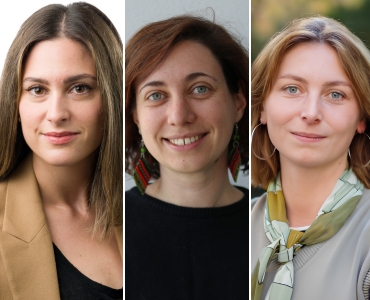
Sofía Monzón is Assistant Professor and Co-director of the Translation and Interpreting Program at Utah State University. Lucie Spezzatti is a post-doctoral researcher in literary translation at the University of Geneva’s Faculty of Translation and Interpreting. Elisabeth Goemans is a Lecturer in Hispanic Literatures and a researcher in languages and education at KU Leuven.
At a time when conferences and research on AI are proliferating rapidly, we hope our work will fuel reflection on translation as an embodied, sensory, affective, and profoundly human act.
This volume in the series Translation, Interpreting and Mediation explores how emotions, relationships, and human connection guide the work of translators and interpreters around the world. A Q&A with the editors.
Briefly and concisely explain in plain language what the book is about.
Affect in Translation and Interpreting explores how affects and human relationships shape the work of translators and interpreters. Through case studies and practitioner accounts, it shows that translation is a deeply human practice. Bringing together researchers and professionals from various backgrounds, it offers an in-depth look at how emotions and connection lie at the heart of multilingual communication.
What or who inspired you to choose this topic?
In 2022, while completing our PhD, the three of us — Sofía, Lucie, and Elisabeth — attended the 33rd CETRA Research Summer School in Translation Studies (Centre for Translation Studies, KU Leuven). The keynote speaker for that edition was Professor Kaisa Koskinen, whose groundbreaking volume Translation and Affect had been published in 2020. Inspired by her work, and with the opportunity to participate in a mentorship programme led by Professors Sara Ramos Pinto and Jack McMartin — aimed at producing an edited volume following the Summer School —, we decided to circulate a call for papers to further explore this theme. We found it particularly compelling as the three of us work with literary translations, archives, or interviews, inherently affective subjects.
Did the book turn out the way you imagined it? In what way(s) did it or did it not?
This was our first experience as editors, and we quickly discovered that the process of putting together an edited volume is far more time-consuming than we had anticipated — this project ultimately took us three years! It also underwent several significant changes along the way. Initially, we had planned to include only academic articles, but we later decided to add interviews with various translation professionals, in order to give a more direct voice to practitioners and to better capture the human affects and sensitivities that lie at the heart of translation work.
What social impact do you think the book can have, or would you like it to have?
We hope this book will contribute to conversations that place the human at the centre of translation work. It is both interesting and somewhat unsettling to note that our volume is appearing at a time when conferences and research on AI are proliferating rapidly. In this context, we hope our work will fuel reflection on translation as an embodied, sensory, affective, and profoundly human act.
In what way do you think your book can shape future research in your research field?
This volume deepens the connection between Affect theories and Translation Studies, engaging with a range of philosophical, sociological, psychological, and literary questions.
What is your favourite part of the book and why?
Our favourite part may the three interviews we conducted, which appear in the final section of the book. This is arguably where something distinctly ours came through. Each of us chose to reach out to translators whose work resonated with themes we wanted to explore more deeply: South African translator Jan Steyn delved into questions of literary translation, identity, and the philosophy of language and affect; human rights activist and Argentine translator Alicia Partnoy spoke about the struggle for human rights, resilience, and solidarity in translation; and the members of the feminist collective Vanvera reflected on feminist and non-professional as well as collaborative approaches to translating a podcast dealing with affective content.
How did the writing process for this book go? Did you experience anything surprising, amusing or striking?
Rather than speaking of a writing process, we prefer to speak of an editorial process, since our primary role in this volume was that of editors — even though we wrote the introduction together and Sofía is also the author of one of the articles.
We learned a great deal along the way: from drafting the call for papers and managing the abstracts we received, to the critical discussions involved in selecting contributions, exchanges with our mentors, identifying peer reviewers, and corresponding with authors, among many other things.
Although the process was a lengthy one, as we have mentioned, it taught us how to work collaboratively across distance — from three different countries, on two different continents, with three different mother tongues, communicating throughout in our shared second language, English. In many ways, this volume stands as a testament to a friendship that grew and deepened despite the miles between us, built around a common project. Our work together was shaped by attentiveness, mutual support, and genuine passion — even through the more stressful moments.
If you could travel through time, where would you want to go to talk about your research/book?
If we could travel back in time, we would return to CETRA in 2022 — where it all began — and bring with us the voices of the authors and interviewees whose work fills these pages, adding them to our own and letting them resonate alongside that of Kaisa Koskinen.
Do you have any plans yet for another publication? What will it be about?
Yes! In fact, this volume has opened up a number of exciting opportunities for both academic exchange and further research. In 2025, we convened a panel entitled “Affect(s) and Translation” at the 11th EST Congress, one of the largest Translation Studies conferences in Europe. We are now working on a second volume — this time focusing more specifically on the relationship between affect and literary translation.
Related Publications
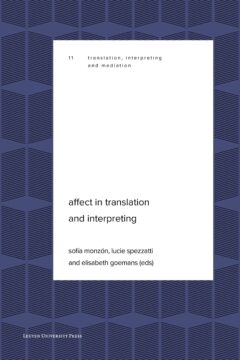 Affect in Translation and Interpreting
Sofía Monzón (Editor), Lucie Spezzatti (Editor), Elisabeth Goemans (Editor),
May 2026
