Blog
Briony Carlin | Encounters with Photobooks
27th March, 2026 in Author’s corner
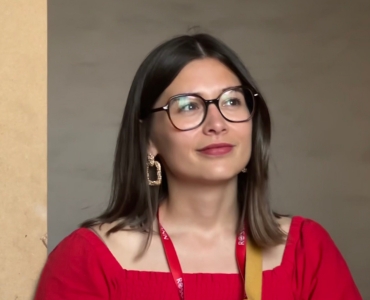
Briony Carlin is Lecturer in History of Art at Newcastle University.
Photobooks are complex, designed works that bring together many such choices through different aesthetic and verbal languages.
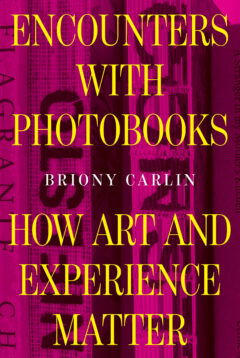
By weaving together creative writing about photobook encounters with critical traditions in museology, phenomenology, art history, new materialism, and feminist praxis, Briony Carlin, author of Encounters with Photobooks, illuminates the photobook’s multiplicity: its unique potential for its many copies to matter differently to makers and readers in each momentary encounter.
Briefly and concisely explain in plain language what the book is about.
The book is about the contemporary photobook, which is an increasingly important medium for photographic artists. The research foregrounds photobooks as art objects and artistic experiences to ask questions about the creative and social opportunities they support for the people who make and read them. Amid growing scholarship on what makes photobooks historically and formally interesting, too often the individual reader, and the circumstances of how and where we encounter these intriguing artworks, are left out of the conversation. This is because our experiences can be emotive, subjective, and highly variable, which my book celebrates.
The book makes connections between (macro) art world politics that shape how photobooks are valued on an institutional scale, and the (micro) interactions through which photobooks become individually meaningful. All of these encounters ‘matter’, in that they determine how and why we come to understand something as art (or not). This book uses theory and narrative inspired by feminist new materialism to explore the ‘mattering’ of that encounter in different ways that critique more traditional hierarchies around art production.
What or who inspired you to choose this topic?
Something that has always interested me about photography is the many choices it presents for artists in how they bring the images they make (and the stories they tell) into the material world. Considerations such as scale, texture, context, quantity, sequence, and movement impact how viewers or readers respond to images. Photobooks are complex, designed works that bring together many such choices through different aesthetic and verbal languages. As a curator, I approach photobooks as sites of interaction and interpretation, much like exhibitions.
No art objects are simple transmitters of messages – they matter in some ways for the people who make them, and they can come to have different meanings for people who encounter them. This can be hard to survey because the kinds of art experiences we have in galleries or theatres can be fleeting. Photobooks offer opportunities for us to understand how we live with art, how it enters us, how it perhaps enters our homes to build deep and changeable relationships with it, sometimes over very long periods of time.
I wanted to develop a way of thinking about photobooks – and art more broadly – that could hold together these ideas of the intentionality and creativity of artists and the agency of the person or people looking at their work, without privileging one over the other. Another thing I wanted to call attention to is that photobooks are multiples. This is too frequently forgotten – the nature of publishing means that one title can have hundreds, if not thousands, of different copies out there in the world, potentially doing different things. Both of these points require a shift in how we think about the world more pluralistically.
Did the book turn out the way you imagined it? In what way(s) did it or did it not?
It contains more storytelling, not only in the more self-consciously narrative ‘Encounter’ sections, but throughout the discussion chapters too. All the photobooks and the encounters I present are, in some ways, little stories about making and making meaning, informed by the practitioners I have spoken with, the books I have held, and the theories that have structured my understanding of these insights.
What social impact do you think the book can have, or would you like it to have?
Beyond its relevance to photobooks and art discourses, I would like my book to show that there are many ways to understand a complex object or topic, and that more than one of them can be ‘true’ at the same time. There are no absolutes or universals when it comes to how we approach artworks and the worlds they represent. Importantly, this differencing is not something that simply happens – it is an active process that reflects deep marginalisations in society. By holding onto a sense of multiplicity, we can also be more critical of why some narratives are more pervasive than others, and more attentive to those that may have been overlooked.
In what way do you think your book can shape future research in your research field?
By showing that affect, emotion, and personal circumstance should not be discounted from scholarship for being too tied to a feminised notion of ‘feelings’ – it’s not solipsistic; it’s important to be reflexive about how we form knowledge.
What is your favourite part of the book and why?
My favourite parts are the autoethnographic ‘Encounter’ texts that alternate with the discussion chapters.
We have many registers of making knowledge – some more scholarly, some more intuitive and emotive. There are important historical reasons why some forms of knowledge have been prioritised, while others have been disregarded. I used the passages of creative writing to explore other(ed), tacit understandings about art as we encounter it in the world. As a feminist scholar and cultural practitioner in a male-dominated subject area, it was important to me that these alternative ways of knowing were afforded the same status in the book as the more conventionally academic chapters.
I believe they make a useful contribution for readers by providing concrete examples in which to ground some of the more conceptual theoretical discussions.
How did the writing process for this book go? Did you experience anything surprising, amusing or striking?
This book has grown out of my PhD research, so it has taken a long time to produce. I enjoyed the freedom of rewriting it beyond the constraints of a doctoral thesis and centring the parts that really mattered to me (such as the creative writing). Over the decade I’ve been working with a framework of ‘encounters’, I’ve been struck by how much more frequently this word seems to crop up in wider discourse, as more value is placed on the situated and relational agencies of art, and we become more responsive to issues such as the uneven distribution of resources and access.
What was the most challenging step in the entire creation process of your book?
Illustrations. It is not possible to convey a photobook in a handful of still images. I was worried that selecting only two or three page spreads for each book could misrepresent the overall work; meanwhile, important material qualities aren’t always visible in a photograph. Fortunately, many of the works have more extensive documentation online via artists’ websites. More recently, I have contacted libraries to recommend they acquire some of the photobooks included in the research, in the hope that readers seek out their own encounters.
What would have been good advice before you started this book project?
Don’t wait until you get stuck to take a walk in the park!
What would you like readers to remember about your book?
A personal reading, response, or interpretation can be as valid as an institutional one, even if they differ. Their encounters with art can matter to them in the future in ways they might not yet recognise.
Your book will be published open access. How did the open access publication process go? What makes open access so attractive for you/your book?
My book is in the JSTOR Path to Open programme and will be published open access from 1/1/2029. This is exciting for me because I hope the research will be useful to creative practitioners and photobook makers beyond academia, who may not otherwise have access to the manuscript.
Do you have any plans yet for another publication? What will it be about?
My wider research and curatorial practice continue to surface questions about interactions between images, technologies, materials, and less traditional modes of encountering art. I am currently researching painting-by-numbers as a popular craft and creative practice. Painting-by-numbers can be thought of as another unconventional form of art publishing and distribution that re-materialises images in unexpected ways and challenges tacit hierarchies of high- and low-brow cultural production. I’m looking at how artists co-opt similar strategies of automation, how paint-by-numbers intersects with more traditional fine art histories, as well as how and why the craft practice becomes differently meaningful for people who engage with it.