

Blog
Andrea Aramburú, Dibyadyuti Roy, and Joe Sutliff Sanders | Comics and the Global South
6th March, 2026 in Author’s corner
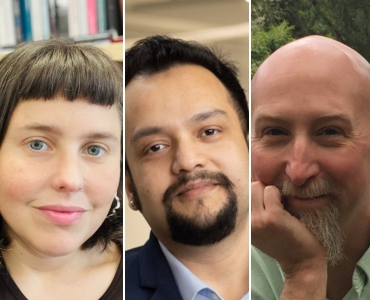
Andrea Aramburú is a Leverhulme Early Career Fellow at the University of Manchester. Dibyadyuti Roy is an Associate Professor in Cultural Studies, Media Studies, and Digital Humanities at the University of Leeds. Joe Sutliff Sanders is a Fellow at Lucy Cavendish College and a specialist in children’s media in the Faculty of Education at the University of Cambridge.
Comics are not entertainment. They are epistemology. They are resistance. And the Global South has been proving that for decades.
Comics and the Global South explores how comics from Latin America, Africa, and Asia challenge dominant Western theories of the comics medium and reshape how global comics are studied. In this Q&A, editors Andrea Aramburú, Dibyadyuti Roy, and Joe Sutliff Sanders discuss the book’s origins, aims, and impact.
Briefly and concisely explain in plain language what the book is about.
Comics and the Global South brings together work from across Latin America, Africa, Asia and beyond to argue that comics from these regions need to be read in relation to their own cultural specificities. It includes case studies from India, Bangladesh, Brazil, Kenya, Māori communities in New Zealand, and Somali refugee camps, among others. It exposes people around the world to exciting comics projects, but more importantly, it develops ways of approaching comics from within the histories, traditions, aesthetics, and cultures of Global Majority people.
What or who inspired you to choose this topic?
We met through our love of comics first, which led us to convene a special hybrid conference on comics and the Global South that brought together scholars, creators, and fans from around the world. At the conference, we noticed that several people working independently were trying to develop ways of approaching comics that borrowed from, revised, extended beyond, or even rejected analytic frameworks for comics that had been developed in Europe and North America, and we wanted to curate and amplify those efforts in a venue that would be available to everyone.
Did the book turn out the way you imagined it? In what way(s) did it or did it not?
The book does everything we wanted it to do and something we hadn’t originally considered! The chapters present clear, reproducible approaches to comics that were formed within the local specificities of the place of the comics’ birth. They also introduce the world to comics that weren’t known well enough outside of their original communities. They also demonstrate how comics themselves can be a method, how we can not only develop new approaches to comics but see comics as a medium for communicating health experiences, exploring complicated and under-documented pasts, and expressing community life.
What social impact do you think the book can have, or would you like it to have?
This is an academic book written by and intended for researchers, but we have nurtured it in such a way that academics, university students, aficionados, secondary school students, and eager fans can retrain their thinking and learn to explore art from the Global South on its own terms. We think of this book as cutting-edge research that answers a profound desire for the people who are the majority of the planet’s population to take the language used to talk about something they love and rewrite it in ways that are meaningful in their own circles.
In what way do you think your book can shape future research in your research field?
We hope this book does several things simultaneously for the field of comics studies. Most fundamentally, we want it to function as a methodological provocation — not just a collection of case studies from underrepresented regions in comics studies, but a serious challenge to the theoretical frameworks that comics scholarship has long taken for granted. Concepts like the “gutter,” panel sequence, and visual grammar were largely theorised through Western, primarily Anglophone comics traditions. This book asks what happens when those frameworks encounter patachitra scroll painting, Māori oral-visual storytelling, or the piracy-driven distribution networks of South American digital comics. The answer, our contributors demonstrate, is that the frameworks themselves must be rebuilt. We hope future researchers feel both licensed and obligated to undertake that rebuilding work. We also hope the book encourages more sustained South-South comparative scholarship, moving beyond the habitual Global South-to-Global North axis that still quietly organises much comparative cultural research.
What is your favourite part of the book and why?
We would not pick a specific favourite chapter because we consider they each offer a unique and situated perspective to comics scholarship. Instead, we think that what we like the most about the book is how the chapters come into conversation with each other, despite drawing on radically different cultures and approaches. This cross-cultural, cross-disciplinary dialogue is what makes the book a vital contribution to cultural studies and comics scholarship. As a whole, the book builds and encourages methodologies that embrace South–South solidarity.
How did the writing process for this book go? Did you experience anything surprising, amusing or striking?
We worked very well as a team, something that we already knew from the conference we organised in 2022. The writing and editing process went smoothly, particularly after aligning our vision for the contribution we were expecting the book to make. After this, we leaned on our specific knowledge of Global South comics and decolonial studies for the research and writing, and on several rounds of back-and-forth feedback, making sure our aims and the final result were in tune. It was interesting to see how the different stages of our academic careers—as well as our various cultural backgrounds—brought a range of experiences to the writing and editing process, and it was really fun learning from each other!
What was the most challenging step in the entire creation process of your book?
The most challenging step was building a genuinely transnational intellectual conversation across eleven chapters without collapsing regional specificity into a homogenous, monolithic “Global South” narrative. The Global South is not a place — it is a relational concept, and the risk of flattening Hong Kong’s liminality, Indian graphic narrative traditions, and refugee camp comics-making in Dadaab into one undifferentiated category was ever-present. We had to hold multiplicity and coherence in tension simultaneously. Balancing the voices of scholars working from within their own communities with the comparative framework the volume required was genuinely difficult editorial work. We also navigated questions of language, access, and whose theoretical frameworks were being centred in each chapter — constantly asking whether we were reproducing the very hierarchies we sought to dismantle. That tension never fully resolved, and we think that honesty makes the book stronger.
What would you like readers to remember about your book?
We would want readers to remember that comics from the Global South are not marginal, derivative, or secondary to the medium — they are vibrant, autonomous sites of decolonial resistance, political imagination, and entirely distinct aesthetic epistemologies. Too often, comics scholarship has centered Western traditions as the default, treating everything else as exotic variation. This book insists otherwise. From Bangladeshi (postcolonial) masculinity to Māori graphic storytelling, from Brazilian feminist epistemology to piracy networks reshaping comics distribution across South America, the chapters collectively demonstrate that the Global South produces not just different comics, but different ways of thinking through comics. We hope readers leave with a richer, more honest map of what the medium truly is — and a commitment to South-South dialogue as a generative scholarly and creative practice.
If you could travel through time, where would you want to go to talk about your research/book?
We would possibly want to travel to 2024 — specifically into the heart of those record-breaking global elections, when voters across 64 nations went to the polls in the largest democratic exercise in human history. We would want to be present in the streets of Buenos Aires where El Eternauta was being reclaimed as a symbol of political defiance, in the newsrooms and social media feeds of India where comic-format political narratives were circulating at enormous scale, and in the grassroots cultural spaces of Latin America, Africa, and Asia where visual storytelling was quietly doing the work that conventional political discourse could not. We would bring this book and say: look, here is the scholarship catching up to what artists and communities already knew. Comics are not entertainment. They are epistemology. They are resistance. And the Global South has been proving that for decades.
Your book is published open access. How did the open access publication process go? What makes open access so attractive for you/your book?
Open access was never simply a practical decision for us — it was an ethical one, deeply entangled with the book’s core argument. A volume demanding that comics scholarship decenter its Western, Anglophone assumptions would have been fundamentally contradictory if locked behind a paywall accessible only to researchers at well-resourced institutions in the Global North. Open access meant that a scholar in Dhaka, a comics artist in Lagos, or a graduate student in Lima could read this book without institutional privilege determining their access. That alignment between form and content felt essential. The process itself was made possible through generous support from the University of Cambridge Faculty of Education Research Development Fund, KU Leuven’s Fund for Fair Open Access, and the Open Book Collective — and we are enormously grateful to Leuven University Press for their commitment to the model. That said, the funding landscape for open access humanities publishing remains fragile and uneven, and we were fortunate in ways that many comparable projects are not. Open access does not fully solve structural inequalities in global knowledge production — but it removes one significant barrier. If our argument is that the Global South deserves to be heard on its own terms, then the least we can do is ensure the scholarship making that argument can actually be read there. Representation in scholarship is partly about ideas, but it is also about infrastructure — and we hope this volume contributes to building both.
Do you have any plans yet for another publication? What will it be about?
Yes, we have all been working on various comics-related and beyond publications and projects alongside this book, as it often happens in academia. Andrea, for example, has been writing her first solo-authored monograph, based upon her PhD work on feminist, queer, and decolonial identities in Latin American comics. Joe has been working on a project that explores the connections between comics and autism, and Dibya has been working on a project that examines how nuclear power, as one of the most contested and consequential dominant technologies in human history, is actively constructed, legitimised, and challenged through visual storytelling and graphic narratives — with a particular focus on contexts emerging from the Global Majority spaces.
Related Publications
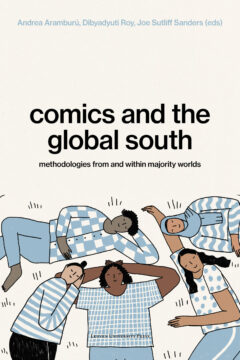 Comics and the Global South
Andrea Aramburú (Editor), Dibyadyuti Roy (Editor), Joe Sutliff Sanders (Editor),
February 2026
