Blog
Christiaan Engberts | Decentering Leuven University
26th January, 2026 in Author’s corner

Christiaan Engberts studied philosophy and history at Leiden University. Until recently he was affiliated with the Research Group Cultural History since 1750 at KU Leuven.
Transnational ties are not primarily created and maintained by “the university” but rather by individual scholars, colleges, and research institutes.
In 2025, Leuven University celebrated its 600th anniversary. Since its foundation in 1425, the university has always been a transnational institution. In his book Decentering Leuven University, Christiaan Engberts explores how this transnational character has shaped the university across six centuries, with cross-border ties emerging as a recurring theme throughout its history, from the Middle Ages to the present day. “People at the university have created and maintained such a variety of cross-border ties.”
Briefly and concisely explain in plain language what the book is about.
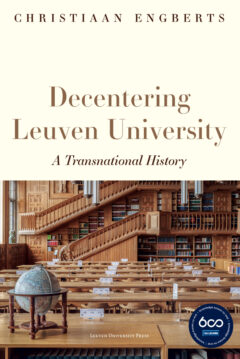
Decentering Leuven University: A Transnational History is a history of the cross-border ties that have shaped Leuven University from its foundation in the 15th century until today.
In six chapters I explore six ways in which transnational connections shaped the university: the recruitment of staff members across Europe in the 15th century, the relations between the university and humanist networks in the 16th century, the contribution of Leuven’s mission colleges to the Counter-Reformation, the cross-border initiatives at the root of the university collections, the university’s involvement in Belgium’s African colonial project, and the emergence of research institutes as transnational hubs of knowledge.
The exploration of the transnational ties results in a decentering in two ways. In the first place it draws attention to the university’s cross-border networks rather than to the organization itself. Secondly, the book emphasizes how transnational ties were created by individuals and individual institutes rather than by the university’s central administrative organs.
Did the book turn out the way you imagined it? In what way(s) did it or did it not?
In a lot of ways, the book turned out more or less the way I imagined it: early on I realized that a transnational university history should emphasize the wide range of transnational ties in which a university is engaged.
However, somewhat naively, I assumed at the very start of this book project that the book would show how the university became increasingly transnational throughout the centuries. I soon realized, however, that such a quantification of the transnational character of the university does not add to our understanding of it. To be sure, different cross-border ties have been more significant at different moments, but the university has from the very beginning been a fundamentally transnational institution.
In what way do you think your book can shape future research in your research field?
A transnational approach to university history is quite new. Most literature in this genre focuses on a single university in a way that doesn’t invite an exploration of the transnational networks that shape it.
Transnational approaches are much more common in the related fields of the history of science and the history of knowledge. I hope this book will contribute to facilitating a fruitful dialogue between these related fields.
The book is also an invitation to other university historians to adopt a transnational approach to their work. This allows for a clearer view of what developments are shared by different universities and what features are unique. What is more, an investigation of the transnational networks of which universities are part provides a starting point not only for determining differences and similarities, but it also offers a vantage point from which they can be explained.
How did the writing process for this book go? Did you experience anything surprising, amusing or striking?
I started writing thinking that I would write a book about “the university”. However, during the writing process I noticed that it became increasingly difficult to recognize “the university” as an easily identifiable agent. All the transnational ties that I zoomed in on were not primarily created and maintained by “the university” but rather by individual scholars, colleges, and research institutes: these were certainly part of the university, but they were not “the university” itself.
This was the moment that I realized that I was not only decentering the university by trying to understand it as a part of a myriad of cross-border networks, but also by engaging with it as an institution that often primarily acts through the many different people and institutions that constitute it.
What was the most challenging step in the entire creation process of your book?
Before I started working on this book, I was a specialist in late-nineteenth and early-twentieth-century history of scholarship. This was the first time for me to work on late-medieval and early modern history. This meant that I had to do a lot of reading, not only to get more familiar with these eras but also to acquaint myself with the type of sources that specialists in these periods use and to get a sense of just what kinds of claims a researcher is allowed to make on the basis of what kind of materials.
The fact that I have been able to share some of my research about these eras with colleagues, for example at one of KU Leuven’s Lectio Conferences, has been invaluable in providing me with the confidence that I had something meaningful to add to the conversations about the period between the early 1400s and the mid-1700s.
What would you like readers to remember about your book?
I hope the readers will enjoy engaging with the fact that people at the university have created and maintained such a variety of cross-border ties. And I especially hope that this will encourage them to reflect on other transnational ties that either Leuven University or other universities had, have, or could have. In this way, the discussion started in the book is not an endpoint, but rather a starting point for more research and conversations.
Your book is published open access. How did the open access publication process go? What makes open access so attractive for you/your book?
The open access process went smoothly.
Publishing this book in open access is important to me for a number of reasons. In the first place, the publication of this book is part of the celebration of 600 years Leuven University and open access publishing invites the broadest range of people to join the celebration. Secondly, Leuven University plays an important role in the lives of many people, such as staff, students, alumni/alumnae, and Leuven residents. I like the fact that part of the history of an institution that matters to so many people is freely available to them. Thirdly, I think it is important for universities to share the results of their work with as many people as possible, and open access publishing contributes to this. Finally, I am glad that my chapter about the university’s colonial legacy is now easily available to people in the Democratic Republic of the Congo as well. Most academic books are already expensive for European readers, but the customary price of academic books might even be more daunting for potential Congolese readers than for Europeans.