Blog
Nidesh Lawtoo and Willow Verkerk | Homo Mimeticus III
1st December, 2025 in Author’s corner

Nidesh Lawtoo is a philosopher and cultural critic, professor of Modern European Literature and Culture at Leiden University. Willow Verkerk is lecturer in Continental Philosophy and Social Philosophy at the University of British Columbia.
We are not only passively shaped by others; we can also actively give shape to ourselves.
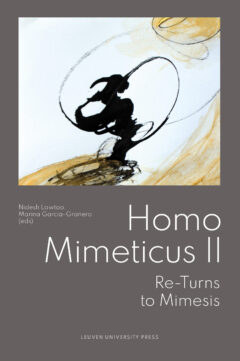
The volume Homo Mimeticus III argues that plasticity—understood in its double capacity to receive form and to give form—plays a transformative role in the many lives of homo mimeticus qua homo plasticus. It shows that both new materialisms and mimetic studies are central to affirming plastic metamorphoses in the twenty-first century. A Q&A with the editors.
Briefly and concisely explain in plain language what the book is about.
NL: This book is the third volume of a trilogy on Homo Mimeticus that opens up the field of mimetic studies. It is an interdisciplinary field that rethinks the human tendency to imitate—what the Greeks called mimesis—in relation to contemporary phenomena, such as emotional contagion, mimicry, simulation and, we now add, plasticity too. To establish this innovative connection between mimesis and plasticity, international scholars in disciplines like philosophy, literary theory, gender studies, sociology, semiology, and neurobiology join forces with French philosopher, Catherine Malabou—the most influential thinker of plasticity to date. If our brain is plastic and can both be formed and give form to who we are, this book explains why: namely, because we have relational, embodied, and mimetic brains. Our wager is that this new connection between plasticity and mimesis accounts for the human ability to change in time and go through a metamorphosis of identity. There is also a gendered component at play. Willow, do you want to address this feminist side of the book?
WV: Catherine Malabou has been writing about feminist issues from the start with her early publication, Changing Difference to her most recent book Pleasure Erased. In both texts she challenges the received notion of essence as a metaphysics of substance or discourse of culture, proposing instead that essence is a movement of “coming into presence” which is constituted by an “originary plasticity.” Malabou’s vision of sex as the corporeal location which holds technologies of gender and experiences of embodiment as an interchange that reveals the fundamentally changeable conditions of identification is key not only to the feminist element. It loops back to the conceptual link foundational to this book, what one might venture to call the speculative ontologies of plasticity and mimesis, which in their interdisciplinary scope promote a continual opening towards future metamorphoses.
What or who inspired you to choose this topic?
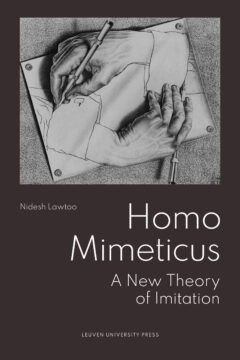
NL: In Homo Mimeticus I had already devoted a chapter to the “plasticity of mimesis.” It engaged for the first time Malabou’s work on plasticity from the angle of both the passive and active properties of imitation. My hypothesis was that these two concepts mirrored each other in productive ways: both concepts account for how subjectivity is formed, for good and ill, as a philosophical tradition from Plato to Derrida, Lacoue-Labarthe to Malabou, suggest. My three-year old daughter provided the inspiration as she caught me saying, “I don’t like Plato.” To which she replied: “You do like Play-Doh!” She was philosophically right in establishing a connection between Plato and plasticity! So, as mimetic studies inaugurated a series of dialogues, with Willow and the Gendered Mimesis Team, we thought of inviting Catherine Malabou to an international conference devoted to sealing the connection between mimesis and plasticity. Catherine gamely joined the conference along with many international contributors—and this is how the book came to be.
WV: As Nidesh notes, the Gendered Mimesis Project allowed for a continuation of the HOM Project with a specifically gendered theme. Our aim was to investigate how contemporary articulations and variation of mimesis were being applied to thinking about new ontologies of gender. This book was inspired by one aim of the Gendered Mimesis Project, to bring plasticity into dialogue with mimetic studies. We asked: How can we understand gender identity today in relation to the changing landscape of gendered and sexual differences? The GM project proposed a return to the subject through a rethinking of the theory of homo mimeticus in dialogue with philosophies of inclination, performativity, and plasticity in continental feminist and queer philosophy.
Did the book turn out the way you imagined it? In what way(s) did it or did it not?
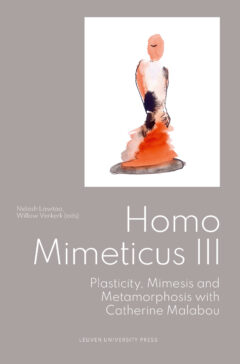
NL: Both plasticity and mimesis challenge the idea that subjectivity is modelled, once and for all, on a stable, pre-existing form. In many ways, this applies to the writing of a book as well, even more so if it’s the product of a collective effort. Given the excellent collaboration with Willow and all the contributors, its final form turned out much better than I could have foreseen. In fact, new conceptual forms emerged in the process of writing—from negative plasticity to material mimetism, plastic figurations to conflicting subliminalities—among many others. Speaking of form, the plastic figure on the book cover by Michaela Lawtoo captures a phrase from Montaigne’s Essays that serves as the epigraph of the whole book and emerged only at the end: “The clay is soft and malleable. / Quick! hurry to fashion it on that potter’s wheel / which is forever spinning.”
WV: Having the opportunity to work together with Nidesh, and to learn from authors from diverse backgrounds all fascinated by the relationalities between plasticity and mimetic studies, has been a wonderful experience. It has led me down new collaborative pathways to broaden my understanding of these concepts both theoretically and practically. The greatest surprise was to realize the scope to which theories of plasticity and mimesis, in dialogue with Malabou, can be applied; to see the interdisciplinary networks these analyses were able to forge between seemingly disparate fields.
What social impact do you think the book can have, or would you like it to have?
NL: This volume adds an important step to mimetic studies for it opens up discussions about the human tendency to imitate not only to the neurosciences, which, via Vittorio Gallese and mirror neurons, were already central to the other volumes, but also to the emerging field of Critical AI studies—a field that promises to galvanize attention for decades to come. Having Malabou as a philosophical ally as well as a number of both established and emerging contributors that show, from different perspectives, that the human tendency to receive new forms is tightly connected to our ability to give new forms to ourselves, provide a profound lesson to remember in times of fast transformations: we are not only passively shaped by others; we can also actively give shape to ourselves. This question is not only relevant to the humanities but to all humans. I hope readers with different backgrounds will find their ways in the book and that it will prove formative for their own lives.
WV: The question of identity: how we are formed, and more specifically how we are formed by the world, events and others (biological and artificial), and whether we have the ability to self-form, are questions that remain important to those both inside and outside of the academy. The dialogue centered in this book between plasticity and mimesis speaks to these issues with innovation and insight and has the potential to spark new conversations in public philosophy and speak to those in creative fields whether it be the arts or sciences.
In what way do you think your book can shape future research in your research field?
NL: As I mentioned, the book is part of a larger mimetic turn, or re-turn of attention to the mimetic, adaptive, and plastic tendencies of humans, including non-human animals and materials as well. As both the genealogies of mimesis and plasticity show, this lesson is as old as philosophy itself. If these concepts have been marginalized to a corner of the humanities restricted to aesthetics in the past century, it should now be clear that the ability of AI to simulate the human brain, precisely by taking its plasticity as a model to imitate, makes both plasticity and mimesis topics central to contemporary discussions in a number of fields, from aesthetic to psychology, sociology to literary theory, philosophy to gender studies to neurobiology, among others. Mimetic studies in general and this book in particular show that many new theoretical turns—to embodiment, performativity, cognition, simulation—are actually re-turns to old mimetic questions that take new forms today. Hence, the need for a re-turn in the first place.
WV: As both Nidesh and Catherine show, the notions of mimesis and plasticity go back to ancient philosophy and continue to fascinate scholars working in ancient, modern, and contemporary studies. In this book, these concepts have been employed in dialogue with Plato, Kant, Hegel, Nietzsche, Lenin, Proust, Merleau-Ponty, Caillois, Deleuze, and Benjamin, amongst others. This book is a testament to the broad impact that these topics can have on research. And, if my own experience is any indicator, I’ve noticed that early career researchers, graduate and undergraduate students are keen to engage with plasticity and mimesis as frameworks for approaching diverse problems in the history of ideas. I suspect this will continue and be furthered with the publication of this book.
What is your favourite part of the book and why?
NL: It’s difficult to pick one part for they all contribute to the whole. Let me say this: As I started reworking the concept of mimesis, over twenty years ago, there were only a few scholars interested in showing that this ancient concept is still relevant to face contemporary challenges—from new fascism to disinformation, subject formation to AI simulation. It is now really gratifying to see so many scholars across disciplines, nationalities and generations engaging creatively with the plasticity of mimesis connection. Every chapter—be it on epigenetics, plastic materials, resonance, eroticism, neuroliterature and many others—are a feast for anyone interested in mimetic studies. I truly enjoyed co-writing the introduction with Willow à quatre mains for reasons I’ll return to. The dialogue with Catherine that closes the volume took place during the conference, and I have a fond memory of that exchange, which is also available online. I hope the reader will enjoy both versions.
WL: There are certainly some chapters that stood out to me during the editing process because they aligned more directly with my own scholarly interests. It is exciting to work closely with authors exploring ideas of interest to you and to have the opportunity to support the generation of their analysis, as an editor. However, if I was to name a favourite part, it would be process itself, bringing the book together, the shared editorial experience with Nidesh, and the generous contributions of Catherine, as well as the innovative writings of the authors who worked co-operatively with us.
How did the writing process for this book go? Did you experience anything surprising, amusing or striking?
NL: The final shape of the book as we see it now on the table of content is really a co-creation: it’s the product of many productive discussions with Willow over the past two years and a huge effort of collective coordination with all international contributors. This requires the ability to work as a team, which is easier said than done. Teamwork was not only facilitated but rendered pleasurable by the fact that Willow is a great team player who understands the importance of good timing, coordination, and fast passes when time is short. Willow lives in Vancouver—so we worked nine hours apart. This can get tricky when pressed up against imminent deadlines. I was at times amused that communication with Willow was often faster than others on the same time-zone. Time difference doesn’t matter much as players feel connected on the same court—a lesson I first learned on basketball courts. What applies to bodies remains valid for brains. As it was already the case for volume two, which I co-edited with Marina Garcia-Granero, this generated a warm, collaborative and friendly atmosphere that was shared by all contributors. I believe it’s visible in the final form of the book, beginning, middle, and end.
WV: I was surprised by the workload and the many steps we went through with the authors to help them get ready for publication. The time and energy investment was more than I anticipated, although I had heard that editing a book collection is a considerable task, so this was somewhat expected too. That the authors are from many different countries, and that Nidesh and I live so far apart, could have been a considerable challenge. Yet, as Nidesh indicates, it was not. I think this is because we both value clear and timely communication and are able when challenges or personal difficulties arise to speak to them directly. My past experiences in Belgium and England with mentors and colleagues have not always been so good: from avoidant personality types who are unable to communicate clearly (or at all) to those who dismiss queer and feminist scholarship, the academy can be, at times, unhospitable. Working with Nidesh has been a distinctly positive experience both with this volume and the GM project more broadly. In addition to being a great team player, the intellectual atmosphere that Nidesh fosters is one in which academic rigor is pursued with feminist curiosity and kindness. This mood is captured in the book, both in style and content.
What would you like readers to remember about your book?
NL: That our brain is plastic, and we don’t know it, as Catherine says. To which we add: that our brain is mimetic, and we are beginning to know it. Think of it: who you are, your most individual characteristics, which for a long time were considered, wrongly, to be innate, are both the product of our brain plasticity and of mimetic relations with others. If we become aware of this fact, not only our view of human nature changes, but we can change who we want to become via culture—without setting up a binary between the two. Michaela’s cover illustration, titled, Transfigurations IV: Self-Fashioning Figura, is meant to give readers a first impression of this transformative potential.
WV: Philosophical conceptions of plasticity and mimesis, and how they work together, can teach us more about ourselves, about the world, and about human relationships. A significant part of what motivates us is very much unknown (as Nietzsche states- we are most unknown to ourselves), so cultivating an inquisitive approach to the process of knowledge acquisition which realizes we are unfinished in our plastic and mimetic forms is vital for both the intellectual and spiritual health of culture and people.
If you could travel through time, where would you want to go to talk about your research/book?
NL: The book ends with an attempt to rethink Nietzsche’s “Three Metamorphoses of the Spirit” at the beginning of Thus Spoke Zarathustra. Since Nietzsche is one of the major philosophical influences on mimetic studies, I would love to join Nietzsche for a chat on metamorphoses in upper-Engadin, in Sils-Maria, Switzerland, where he used to spend his summers (now that I think of it, I recorded the idea of linking metamorphosis to mimesis precisely up there—you can view it here). I was born in that canton, and my maternal grandmother was from Engadin, so I’m rooted in that corner of the Alps—a hike with Nietzsche would indeed be inspiring for someone fascinated by shadows and phantoms.
WV: I too would like to meet Nietzsche in the upper-Engadin (or on the beach looking at the mountains in Vancouver) and talk to him about the three transformations of the spirit from Thus Spoke Zarathustra, a book I have been teaching for the past 3 years in my Nietzsche seminar at UBC. Nidesh and I share a great appreciation of his thinking, his discovery of the unconscious (before Freud), and his mimetic reflections on life and the human being.
Your book is published open access. How did the open access publication process go? What makes open access so attractive for you/your book?
NL: I will never tire stressing how fantastic the opportunity to publish the entire Homo Mimeticus trilogy Open Access with Leuven UP has been for the international distribution of individual books and of mimetic studies more generally. I don’t keep track of numbers but the last time our editor, Mirjam Truwant, mentioned the downloads of volumes one and two, I could not believe it! It really makes a huge difference that anyone with an internet connection can download the book for free. I could not recommend publishing OA with Leuven UP more highly.
WV: Accessibility can be a considerable challenge when it comes to sharing research. Often academic texts are expensive and only accessible to those with university affiliation and library access. Open access solves this issue!
Do you have any plans yet for another publication? What will it be about?
WV: I’m continuing to explore mimetic studies through a book chapter called “Thinking for ‘Oneself’? Nietzsche’s Critique of the Sovereign Individual as a Disciplinary Subject of Mimesis,” in Nietzsche and Democracy: Retrospect and Prospect, eds. Conway, Lawrence, Lemm, EUP. I’m also working on a mini book for the Cambridge Elements Series on Nietzsche, provisionally titled Nietzsche and Gender.
NL: I look forward to both Willow! As for the Homo Mimeticus mini-series, well…in principle a trilogy comes to an end with the publication of the third book, right? I’m fully satisfied with the final shape of the trilogy, so, in a sense, the circle is closed. Yet the book begins with the intention not to bring mimetic studies to an end. Which one is it? Here is a confession: as part of the HOM project, I accumulated many dialogues with influential thinkers across disciplines, from J. Hillis Miller in literary theory to William E. Connolly in political theory, Jean Luc Nancy in philosophy to Adriana Cavarero in feminist philosophy, Katherine Hayles in posthuman studies to Judith Butler in gender studies, among others. Who knows? I might be tempted to assemble them in a last volume to provide Homo Mimeticus with a finale.