Blog
Steven Jacobs and Raf Wollaert | Marcel Broodthaers and Film
13th January, 2025 in Author’s corner
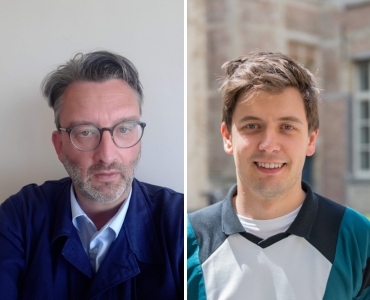
Steven Jacobs is an art historian specializing in the relations between art and film. He teaches at Ghent University and the University of Antwerp. Raf Wollaert completed a PhD on the subject of Marcel Broodthaers’s cinema at the University of Antwerp in 2024.
We, as editors, and we are sure the authors of this book as well, have obviously struggled with the recalcitrant character of Broodthaers’s cinema.
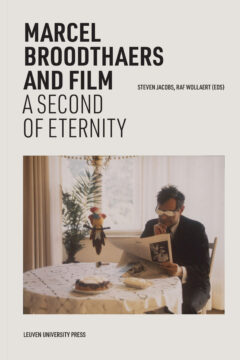
Marcel Broodthaers, one of the key figures of the postwar avant-garde, has been recognized and extensively studied as a poet who became a visual artist in 1964. However, years before creating his first sculptural objects and installations, Broodthaers made his debut as a filmmaker in 1957 with La Clef de l’horloge. In Marcel Broodthaers and Film editors Steven Jacobs and Raf Wollaert discuss his films as inseparable from his entire oeuvre while situating them in the larger history of experimental film.
Briefly and concisely explain in plain language what the book is about.
As its title implies, Marcel Broodthaers and Film: A Second of Eternity covers the cinema practice of the Belgian artist Marcel Broodthaers (1924-1976). While Broodthaers is widely known and acclaimed for his visual artworks, for instance the iconic Casseroles de moules, the numerous short films he produced have generally remained in the shadows. Our book seeks to remedy this critical gap. In addition to a comprehensive introduction to Broodthaers’s cinema and an updated filmography, nine essays each delve into a crucial aspect of his filmmaking or discuss a specific title.
What or who inspired you to choose this topic?
Marcel Broodthaers and Film originated from a screening and conference on Broodthaers’s cinema, held at Cinematek in the summer of 2022. These events were organized as part of Raf’s PhD research (2019–2024) on Broodthaers’s cinematic practice. The enthusiastic response to this research underscored the need for a deeper exploration of the subject, which ultimately took shape in this essay collection.
In what way do you think your book can shape future research in your research field?
Marcel Broodthaers and Film is the first scholarly work dedicated exclusively to Marcel Broodthaers’s cinema practice. Rather than treating his films as a separate category within his multidisciplinary oeuvre, this book advocates for a cinema-centered approach as a compelling alternative to the visual arts- or poetry-driven perspectives that are more common to the scholarship on Broodthaers. While the poetic, painterly, and plastic qualities of his films have been emphasized ad nauseam, we aim to reverse this dynamic and ask how cinema, in turn, shaped Broodthaers’s poetry, visual works, and exhibitions. This subtle shift in perspective may encourage future scholars not only to include the artist’s filmic endeavors to their analyses, but also to recognize the cinematic spirit that underpins many of his works. In so doing, our book underscores cinema’s broader legitimacy as a lens through which other media can be critically re-examined—a potential that recent scholarship in the field has increasingly demonstrated.
At the same time, our book is not solely aimed at art historians and media scholars. Film programmers and curators, who often grapple with the inherent idiosyncrasy and entropy of Broodthaers’s cinematic oeuvre, may also find it a valuable resource. The updated filmography, in particular, provides a practical tool for navigating the complexities of his film work and presenting it to contemporary audiences.
What was the most challenging step in the entire creation process of your book?
Assessing the precise role of Broodthaers’s cinema within his intermedial practice remains an extremely precarious endeavor. For the artist, cinema was not an end in itself but rather a “procedure.” This does not mean, however, that his films function merely as neutral vehicles. On the contrary, Broodthaers placed particular emphasis on the history and social sphere of cinema. Furthermore, his films are deeply intertwined with, and influenced by, other media—and vice versa. This interplay gives rise to various hybrid forms, such as so-called cinepoetry, paracinema, and bioscopic books, which urge the viewer to rethink and expand our general definition of cinema—or even to reconceive it entirely. We too, as editors, and we are sure the authors of this book as well, have obviously struggled with this recalcitrant character of Broodthaers’s cinema.
What would have been good advice before you started this book project?
Quoting Broodthaers quoting Nicolas Boileau: “Vingt fois sur le métier remettez votre ouvrage!”