

Blog
Angeliki Sioli, Nishat Awan, and Kristopher Palagi | Architectures of Resistance
20th December, 2024 in Author’s corner
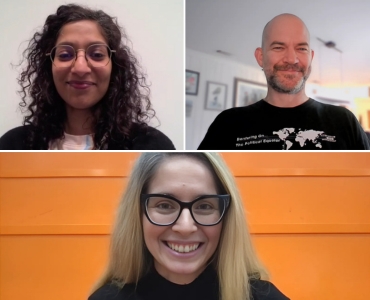
Angeliki Sioli is assistant professor at the Department of Architecture, TU Delft. Nishat Awan is professor of architecture and visual culture at UCL Urban Laboratory. Kristopher Palagi is associate professor at the School of Architecture, Louisiana State University.
Our lives are shaped by borders, and we need to be able to recognize them in our everyday lives in order to push beyond them.
Borders between countries, neighbourhoods, people, beliefs, and policies are proliferating and expanding despite what self-proclaimed progressive societies wish or choose to believe. For a wide variety of reasons, the early 21st century is caught struggling between breaking down barriers and raising them. Architecture is complicit in both. The volume Architectures of Resistance addresses spatial boundaries as places where social and political conditions are intensified and where new spatial practices of architectural resistance arise. A Q&A with the editors.
Briefly and concisely explain in plain language what the book is about.
Architectures of Resistance is about the borders that shape our everyday lives, borders of segregation, immigration, exclusion and fear. Rather than viewing borders solely as divisions, in this book we try to find their potential as places of meaningful encounter between people on the borders’ opposite sides. How we can redefine borders through spatial practices (as architects, urban planners, artists, geographers, and historians) to move towards more inclusive and socially just worlds?
What or who inspired you to choose this topic?
The topic was inspired by our lives in Baton Rouge and our teaching (Angeliki and Kristopher) at Louisiana State University. In collaboration with the director of the School, Marwan Ghandour, we embarked on a journey to explore the boundaries of segregation and racism as they manifest in the everyday lives of our students. We recognized that this was a challenging topic to address, but we wanted to give the students the space to explore and discuss it through their lenses as future architects. To achieve this, we organized a three-day workshop (open to all students at the School) with political theorist professor Fonna Forman and concluded the workshop with the international symposium “Bordering On.” Renowned scholars from around the world and local community actors in Baton Rouge came together to discuss issues of borders and societal inequalities.
Do you have any reading suggestions to share (books, blogs, journals, …) for anyone who wants to know more about the subject?
There are many important books on the topics our book addresses. If we have to pick a few, these would be:
• Anzaldúa, Gloria. Borderlands / La Frontera: The New Mestiza. San Francisco: Spinsters / Aunt Lute Book Company, 1987.
• Mezzadra, Sandro, and Brett Neilson. Border as Method, or, the Multiplication of Labor. Durham: Duke University Press, 2013.
• Petti, Alessandro, and Sandi Hilal. Permanent Temporariness. Art and Theory Publishing, 2018.
How did the writing process for this book go? Did you experience anything surprising, amusing or strange?
The book emerged from the international symposium “Bordering On” that the two of us (Angeliki and Kristopher) organized at the School of Architecture at Louisiana State University in 2019. We had invited Nishat as one of the presenters, among other scholars and community leaders whose work is included in the book. After the symposium and many life events, global moves and changes in institutional affiliations, we came together in what felt like an organic collaboration. Rethinking how the material from the conference could take shape as an academic book was a surprisingly creative and fun process.
What would you like readers to remember about your book?
Borders and border conditions are everywhere, ranging from life-threatening to more subtle forms. Our lives are shaped by these borders, and we need to be able to recognize them in our everyday lives in order to push beyond them.
Your book is published open access thanks to the partial support of the KU Leuven Fund for Fair Open Access. How did the open access publication process go? What makes open access so attractive for you/your book? Have you thus far noticed that your book reaches a wider audience?
For us, it made perfect sense that a book dedicated to spatial borders should be open access, available to everyone! Our three respective institutions are actively encouraging and supporting open access publications, so the process was very smooth. In less than a month since its open access publication, Architecture of Resistance had been downloaded hundreds of times, which speaks volumes about the book’s wider outreach and appeal.
Do you have any plans yet for another publication? What will it be about? Would you consider publishing the book open access?
All three of us have different publication plans up in the air at the moment and open access is definitely our priority.
Related Publications
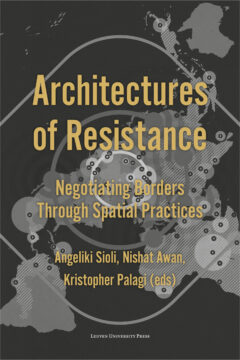 Architectures of Resistance
Angeliki Sioli (Editor), Nishat Awan (Editor), Kristopher Palagi (Editor),
August 2024
