Blog
Nidesh Lawtoo and Marina Garcia-Granero | Homo Mimeticus II
25th September, 2024 in Author’s corner

Nidesh Lawtoo is a philosopher and cultural/literary critic, professor of Modern European Literature and Culture at Leiden University. Marina Garcia-Granero is an assistant professor of Moral Philosophy at the University of Valencia.
More attention to the powers of mimesis is needed if we want to minimally control the digital influences that are currently forming and transforming us.
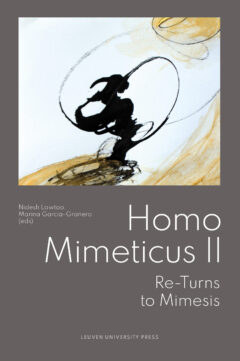
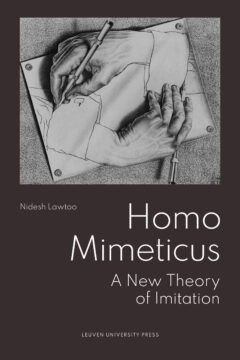
In this second installment of the Homo Mimeticus series, international scholars working in philosophy, literary theory, classics, cultural studies, sociology, political theory, and the neurosciences engage creatively with Nidesh Lawtoo’s Homo Mimeticus: A New Theory of Imitation to further the transdisciplinary field of mimetic studies. A Q&A with editors Nidesh Lawtoo and Marina Garcia-Granero.
Briefly and concisely explain in plain language what the book is about.
NL: As the title suggests, this is the second volume of a mini-series titled Homo Mimeticus. Its general goal is to rethink who we are as a species, while also opening up a new interdisciplinary field of study we call mimetic studies. The first volume established the theoretical foundations for a new theory of imitation that is neither restricted to art copying reality (realism) nor to the imitative nature of human desires (mimetic desire). In the present volume, I joined hands with Marina Garcia-Granero and a number of contributors who put the new concepts of mimetic studies to use in areas as diverse as continental philosophy, classics, literary studies, political theory, environmental studies, and other perspectives. We were extremely fortunate to have a balanced mix of internationally renowned scholars as well as emerging voices who addressed mimetic phenomena such as the hypnotic power of new media, empathy, techne, affective contagion, biomimicry, including a discussion with one of the discoverers of mirror neurons, Vittorio Gallese. Do you think that, collectively, we succeeded in opening up mimetic studies, Marina?
MGG: Yes, Nidesh, I believe we succeeded in unfolding and revealing the plurality of sources, questions and perspectives inherent in mimetic studies. It was precisely this plurality that inspired the subtitle of the book, Re-Turns to Mimesis. Not a single return, but a plurality of them. I think readers will be fascinated not only by the centrality and scope of imitation in our human condition, which justifies its denomination as homo mimeticus, but also by the variety and abundance of sources and disciplines coming together, as Nidesh just mentioned. The book works as a chorus of voices working together to launch mimetic studies.
What or who inspired you to choose this topic?
NL: I already answered this question for the first volume (read it here >), but let me say this: in the wake of hypermimetic phenomena such as conspiracy theories, the re-turns of (new) fascist leaders, both in Europe and the US, not to speak of AI generating hypnotizing memes that chain people within algorithmic bubbles, I could not be more convinced that we urgently need education in new mimetic studies to address the all too human, as well as posthuman tendencies to mimic others. Since you joined the ERC team in its final phase, Marina, maybe I can ask you if it was Nietzsche or mimesis that first attracted you to the Homo Mimeticus project? I know it’s both now, but as you first came to Leuven what was your expectation?
MGG: I was attracted by the precise intersection of both: Nietzsche and mimesis. I wouldn’t be surprised if this were the case for other contributors as well; some of them have studied mimesis for decades, others are established scholars well-versed in their domain and now intrigued by the intersection with mimesis and the role played by it: specifically, the realization that mimesis is central to our human condition. In my case, I had already studied Nietzsche for many years and visited other universities to study Nietzsche alongside major Nietzsche scholars; but I came to Leuven specifically drawn by the idea of studying Nietzsche from the lens of mimesis with Nidesh Lawtoo, as he had already published widely on Nietzsche as a philosopher of mimesis, most importantly The Phantom of the Ego (2013). I expected to acquire a fresh and novel perspective to approach Nietzsche’s philosophy, beyond the usual themes already addressed in Nietzsche studies (such as the overhuman or the will to power), and I couldn’t be happier with my decision to come to Leuven and join the project.
Did the book turn out the way you imagined it? In what way(s) did it or did it not?
MGG: It came out better than I expected because we succeeded in creating a very coherent volume, which is not always the case with this format. The chapters address the same themes and concepts from different perspectives and thus complement each other and provide the reader with a very enriching overall view. This is the result of a great deal of coordination not only between Nidesh and me as coeditors but also with the contributing authors and between them, as they established a dialogue with the theory of Homo Mimeticus developed in volume 1 and with the main sources of mimetic studies.
NL: The beauty of editing a collective volume is that one can never fully imagine how the final product will look in the end. Sure, we had a clear plan and we invited contributors who participated in a conference titled, “The Mimetic Turn” organized at KU Leuven in 2022, so we knew the chapters would be of high quality. But the whole is always more than the sum of its parts, and the final output far exceeded my most optimistic expectations. For instance, the final interview with Vittorio Gallese was not originally planned and I could not expect that he would engage in such a productive dialogue to take mimetic studies beyond the brain and body oppositions. I was also surprised to find out that a key passage from Nietzsche that had initially attracted my attention to mirror neurons, was also a source of inspiration for his neurological theory of embodied simulation. It was a synchronicity I never would have dreamed of, as I discovered that passage over 20 years ago!
What social impact do you think the book can have, or would you like it to have?
NL: It’s always difficult to foresee the societal impact of a book, for after all, we live in a digital, hyper-mediatized society. But precisely for this reason, it’s great that the book will be available Open Access to download for free. As Homo Mimeticus is part of a mini-series in mimetic studies, I am already delighted that so many international scholars have been joining perspectives to broaden this new area of study, promoting a plurality of mimetic re-turns. More attention to the powers of mimesis is needed if we want to minimally control the digital influences that are currently forming and transforming us. A good sign of the impact mimetic studies is currently having is the number of translations that are currently taking place, including most recently the translation of Homo Mimeticus into Spanish, right Marina?
MGG: Yes, Homo Mimeticus I has just been published in a Spanish translation with Tirant Lo Blanc, a very prestigious press indeed, thus adding to the editions already published in German and soon to come in Dutch, Italian, French, Portuguese, and even Chinese. This attests to the growing international, academic interest in mimesis and mimetic studies. It is also our hope to promote a communal, social discussion of mimesis beyond academia, as we are convinced that the takeaways of mimetic studies are of interest to all since mimesis takes part in all of our lives.
In what way do you think your book can shape future research in your research field?
MGG: I personally teach moral philosophy and feel that there is a lot of power in the realization that mimesis can shape people into either ethical citizens or uncritical masses. The different contributions of the volume sketch a diagnostic of good and ill forms of mimesis. They also make us realize that humans are, from birth, social, cooperative but also precarious creatures who are inevitably entangled in the affect of the other—hence the need to strengthen those mimetic bonds across ideological divisions and oppositions. We have the power to reflect and decide how to use imitation, how to channel our mimetic pathos, when to resist mimesis and when to foster it. That question is central to moral philosophy, which is a type of normative knowledge that aims to guide people’s actions. What about you, Nidesh?
NL: The Homo Mimeticus trilogy is already shaping the field of mimetic studies and, by extension, different strands of critical theory. I’m in fact very pleased to see that the concepts developed in volume 1 such as mimetic pathos, patho(-)logies, and the mimetic unconscious, are effectively put to use in new areas in vol. 2 in ways I could not have foreseen. For a scholar who aims to speak across disciplinary specialization at a period in which hyperspecialization tends to be dominant and open up a transdisciplinary field of study, this is eminently satisfying.
What is your favourite part of the book and why?
NL: Difficult to say. It’s a collection of heterogeneous essays that go from Plato and Homer to Machiavelli and Nietzsche, Girard and Irigaray to Lacoue-Labarthe, Pessoa and de Kerangal, reaching via topics like empathy, biomimicry, contagion, and mirror neurons into the present. I really like the fact that the reader can enter the book through different chapters, navigating across different periods, disciplines, and topics, depending on their interests. I’m also proud that thinkers who, early on in my career, contributed to shaping my own thinking about mimesis, such as Mikkel Borch-Jacobsen and Henry Staten, intellectuals who share my passion to take mimesis beyond disciplinary specialization, such as Bill Connolly and Vittorio Gallese, my editor and mimetic theorist, Bill Johnsen, who promoted my first books at Michigan State UP, as well as my former PhD student, Niki Hadikoesoemo, among many others, all of whom joined forces generating a long genealogical chain now promoting the mimetic turn or re-turn. Lastly, I am very pleased that if traditionally philosophers who deal with mimesis tend to be male, the volume begins to balance this bias via a plurality of women philosophers, theorists, and critics including my co-editor of course.
MGG: Yes, I am particularly pleased with the substantial contributions by early-career scholars. For instance, Teresa Casas analyzes Plato’s and Aristotle’s foundational accounts of mimesis not to focus on their often-repeated opposition but on their continuity instead; their concern to move away from an oral tradition of mimesis rooted in performance. She traces the hidden reasons that led Plato and Aristotle to replace oral mimesis with the visual trope of painting. Likewise, HOM member Niki Hadikoesoemo offers an erudite reading of Philippe Lacoue-Labarthe and Luce Irigaray, affirming a corporeal philosophy of theatrical mimesis that anticipates the rise of performativity and paves the way for a feminist theory of gendered mimesis within mimetic studies. Finally, Carmen Bonasera convincingly frames the phenomenon of negative empathy (the emotional identification toward/away from characters portrayed as immoral and seductive) as a mimetic, immanent, and contagious human behavior. These are just three examples among the multiple interventions, which more than prove that there is a future in the emerging field of mimetic studies and carry the torch to the next generation.
How did the writing process for this book go? Did you experience anything surprising, amusing or striking?
NL: Co-editing the book with Marina has been a real pleasure and contributors did a fantastic job in taking on board suggestions and submitting chapters on time, despite the many other deadlines and due dates that, surprisingly but also joyously, overlapped with the completion of the book. Marina, how was it for you since you were busy with a due date that was double?
MGG: Yes, indeed, the due date of the book was doubled by a second, more personal one. At the same time we were working on the book, I was expecting a baby with a due date in late July. We were all —not just Nidesh and I but also the editors at LUP— intensely working with the due date in mind and aiming to submit the book before the birth, to which we succeeded. Nidesh was also very supportive as a co-editor in the process. I will forever remember this book as a life-affirmative event connected to my son.
What was the most challenging step in the entire creation process of your book?
NL: Interdisciplinarity is often praised in theory but, as Gallese also noted in the Coda, in practice it requires a lot of work to make it possible to speak across disciplines in a way that is both productive and understandable for a general readership. Marina and I had many discussions on how to best organize the table of contents, so as not only to move forward historically, from the past to the present, but also to generate genealogical continuities between the chapters and parts. Of course, we could not cover all perspectives and some areas were left underrepresented, such as decolonial perspectives of mimesis, for instance. There is still space for subsequent mimetic studies to fill the gap. In the end, I think we found the right balance. The fact that the book is structured in three parts, each with an equal number chapters, also provides a sense of equilibrium.
MGG: As a collective volume engaging 17 contributing authors, it required extensive coordination and communication among us all. This feat is something I now see as one of the book’s main virtues.
What would have been good advice before you started this book project?
NL: Everything went smooth so nothing comes to mind. A book is often compared to a baby but I think the comparison does not hold up to the reality. Once out in the world, a book immediately takes on an independent life of its own; a baby too, of course, but as my children remind me (now 11 and 14 years-old), they have mimetic powers of their own that need attending for a little longer! The advice I gave myself and Marina was that we should try to finish the book as soon as possible so she could focus on those agentic, all too mimetic powers in real life.
MGG: Indeed, Nidesh. I would now advise myself to trust the process and that all the time dedicated to working on the volume will be visible in the final result.
What would you like readers to remember about your book?
NL: That mimesis is not only a foundational concept in western culture; it is also a sharp lens that allows us to better understand the mimetic and hypermimetic influences that are currently shaping us—for good and ill. Hence, the need to continue studying homo mimeticus through the conceptual lenses of mimetic studies.
MGG: That it is not a question of rejecting or condemning imitations, but reorienting them – toward sympathy or exemplarity, for example. Liberation from mimesis is impossible as it is part of our human condition. It is instead a question of liberating ourselves from their ill, pathological forms, and such liberation will inevitably work within (good) mimesis.
If you could travel through time, where would you want to go to talk about your research/book?
NL: In the Prologue I mention two “great examples” of homo mimeticus: one from the Homer’s Odyssey and the other from Machiavelli The Prince. As the origins of the Odyssey are obscure and Homer was probably more than one person, I’d probably opt for a chat with Machiavelli in Italy since I speak Italian. Specifically, his famous claim that the prince should be both a lion and a fox intrigued me. I’d like to know whether my hypothesis that he had in mind Achilles as lion and Ulysses as fox as grandissimi esempli to imitate, is correct.
MGG: I would evidently want to discuss mimesis with Nietzsche – not only our mimetic reading of his philosophy, but also how we use his philosophy as a critical genealogical source and stepping stone for mimetic studies.
Your book is published open access. How did the open access publication process go? What makes open access so attractive for you/your book?
NL: This is a wonderful opportunity. Vol. 1 of Homo Mimeticus has been circulating for free, reaching a readership across the world, including communities that traditionally lack access to academic books. This open access dissemination policy at KU Leuven is perfectly in line with the ERC mission to reach both top academics and non-academic readers. I’m thus delighted that anyone with an internet connection can follow the growth of mimetic studies internal to Homo Mimeticus II.
Do you have any plans yet for another publication? What will it be about?
NL: I suspect the question is whether there will be a Homo Mimeticus III…It’s too early to say for sure, but I admit a trilogy has a nice ring. I’d have to get back to work, but if you are interested in the future developments of mimetic studies—stay tuned!